
When you buy a gemstone, you may hear the words carat and ratti from a jeweller or astrologer. Many people think both mean the same because both are used to talk about the weight of a gemstone. But they are actually different.
Table of Contents
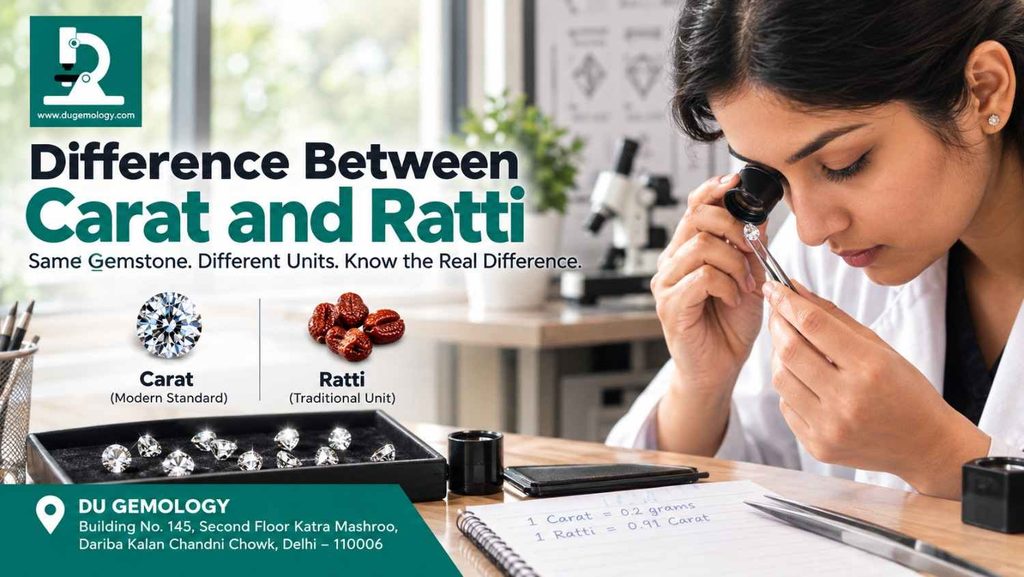
Carat is the standard unit used today to measure the weight of diamonds and gemstones. Ratti is a traditional Indian unit that has been used for measuring gemstones, especially in traditional gemstone buying. So, 1 ratti should not simply be assumed to be the same as 1 carat.
In this guide, we’ll explain the difference between carat and ratti, show how their weights are converted, and provide a simple conversion chart. We’ll also explain which measurement you should check when buying a gemstone and answer some common questions about carat and ratti.
What Is a Carat?
A carat is a unit used to measure the weight of a diamond or gemstone. It is written as ct. One carat equals 200 milligrams (mg) or 0.2 grams (g).
The word “carat” comes from the Greek word “keration,” which means carob seed. In ancient times, carob seeds were used with balance scales because they were believed to have a similar weight. Over time, this led to the use of the word carat for weighing gemstones.
Today, the carat is a standard unit used around the world for diamonds and gemstones. Gemological laboratories such as GIA, IGI and GRS use carats when recording the weight of a gemstone or diamond.
Carat and Karat Are Not the Same
It is easy to confuse carat with karat, but they mean two different things:
- Carat (ct): Measures the weight of diamonds and gemstones.
- Karat (K): Shows the purity of gold, such as 24K, 22K or 18K.
For example, a 1-carat diamond tells you the weight of the diamond, while 18K gold tells you about the purity of the gold.
What Is a Ratti?
Ratti is a traditional Indian unit used to describe the weight of gemstones. It has been used in India for many years and is still commonly mentioned when buying gemstones, especially in Vedic astrology and traditional jewellery markets.
One ratti is commonly taken as around 180–182 milligrams (mg), or about 0.18 grams. However, the exact value of a ratti can vary because it is a traditional unit.
The term is traditionally connected with the ratti or Gunja seed (Abrus precatorius), which was used as a reference for weight in ancient times.
You may often hear gemstones described as 3 ratti, 5 ratti, 7 ratti, and so on. But when comparing a ratti measurement with carats, it is important to know which ratti standard is being used.
This is one of the main differences between carat and ratti: carat has a fixed international value, while the value of ratti can vary slightly depending on the traditional system being followed.
For this reason, when buying a gemstone, it is better to also check its actual weight in carats or grams.
Carat vs Ratti — Core Differences
The main difference between carat and ratti is that carat is a fixed and internationally standardized unit, while ratti is a traditional Indian unit whose exact weight can vary slightly depending on the system being used.
| Parameter | Carat | Ratti |
|---|---|---|
| Origin | Linked to the Greek word “keration” and carob seeds | Traditionally linked to the Indian Gunja (ratti) seed |
| Weight | 1 carat = 200 mg (0.2 g) | Commonly around 180–182 mg (about 0.18 g) |
| Standardization | Internationally standardized | Traditional unit with some regional variation |
| Commonly used by | Gemological laboratories and the international diamond and gemstone trade | Vedic astrologers and traditional gemstone sellers in India |
| Precision | Fixed and precise | Can vary depending on the ratti standard being used |
In simple terms: a carat has a fixed weight of 200 mg, while the weight used for one ratti may differ slightly. This is why you should check the actual carat or gram weight when comparing gemstones sold in ratti.
Carat to Ratti Conversion Formula
Once you know the approximate relationship between carat and ratti, the conversion is quite simple.
Using the commonly used conversion of 1 ratti ≈ 0.91 carat, you can use these formulas:
Ratti to Carat:
Carats = Ratti × 0.91
Carat to Ratti:
Ratti = Carats × 1.1
Examples
Example 1: 5 Ratti to Carat
5 × 0.91 = 4.55 carats
So, 5 ratti is approximately 4.55 carats.
Example 2: 7 Ratti to Carat
7 × 0.91 = 6.37 carats
So, 7 ratti is approximately 6.37 carats.
Example 3: 5 Carats to Ratti
5 × 1.1 = 5.5 ratti
So, 5 carats is approximately 5.5 ratti.
Important Note
These conversions are approximate, because the traditional ratti measurement can vary. If you are buying or valuing a gemstone, it is better to check its actual weight in carats or grams rather than depending only on the ratti value given by a seller.
Quick Reference Conversion Table
Here is a quick ratti-to-carat and gram conversion table for easy reference. The values are approximate and use the commonly used conversion of 1 ratti ≈ 0.91 carat.
| Ratti | Approx. Carat | Approx. Weight in Grams |
|---|---|---|
| 1 ratti | 0.91 ct | 0.182 g |
| 2 ratti | 1.82 ct | 0.364 g |
| 3 ratti | 2.73 ct | 0.546 g |
| 4 ratti | 3.64 ct | 0.728 g |
| 5 ratti | 4.55 ct | 0.910 g |
| 6 ratti | 5.46 ct | 1.092 g |
| 7 ratti | 6.37 ct | 1.274 g |
| 8 ratti | 7.28 ct | 1.456 g |
| 9 ratti | 8.19 ct | 1.638 g |
| 10 ratti | 9.10 ct | 1.820 g |
Note: These are approximate conversions based on the commonly used ratti standard. Since ratti is a traditional unit and its exact value can vary, the actual gemstone weight should be checked in carats or grams when buying, testing, or valuing a gemstone.
Why Do Astrologers Use Ratti Instead of Carat?
You may wonder why astrologers talk about gemstones in ratti instead of carats. The main reason is tradition.
Ratti has been used in India for a long time and is closely associated with traditional gemstone practices and Jyotish. Over the years, this measurement became familiar to astrologers, gemstone sellers and buyers across different parts of India.
Another reason is familiarity. Many people who buy gemstones for astrological purposes are already used to terms such as 5 ratti, 7 ratti or 9 ratti. Using ratti makes it easier for them to understand the recommended gemstone weight.
Using ratti is not necessarily wrong. It is simply a different, traditional way of describing gemstone weight. However, because ratti is not as precisely standardized as carat, it is useful to check the gemstone’s actual weight in carats or grams, especially when buying, testing or valuing a gemstone.
Which Unit Should You Use When Buying?
Both carat and ratti are used when talking about gemstone weight, but they are useful in different situations. The important thing is to understand what the measurement means before buying.
| Use Carat When | Use Ratti When |
|---|---|
| Buying a gemstone from an international seller | Following a traditional Indian astrologer’s recommendation |
| Checking or comparing a professional laboratory report | Buying a gemstone based on a traditional ratti recommendation |
| Comparing gemstone prices between different sellers | Buying from a trusted traditional jeweller who clearly explains the weight |
| You want a fixed and standardized weight | You are comfortable with the traditional Indian measurement |
A useful tip: Even if a gemstone is recommended or sold in ratti, ask the seller for its actual weight in carats or grams. This gives you a clearer and more standardized way to compare the gemstone with other stones.
Common Mistakes to Avoid
When buying a gemstone, a few simple mistakes can lead to confusion about its actual weight and value. Here are some common mistakes:
1. Assuming 1 Ratti = 1 Carat
Ratti and carat are not the same unit. A commonly used conversion is around 1 ratti ≈ 0.91 carat, although the exact ratti value can vary depending on the convention being used.
2. Not Asking for a Lab Certificate
If you are buying an expensive gemstone, don’t rely only on the weight mentioned by the seller. A professional laboratory report can provide useful information about the gemstone’s identity, natural or synthetic status, treatments and other characteristics.
3. Ignoring Regional Ratti Variation
Ratti is a traditional unit and is not standardized in exactly the same way as carat. Different sellers or regions may use slightly different values. Always ask which ratti-to-carat conversion they are using.
Frequently Asked Question(FAQs):-
Q1. Is 1 ratti equal to 1 carat?
Ans:- No. 1 ratti is not equal to 1 carat. A commonly used conversion is 1 ratti ≈ 0.91 carat, but the exact value can vary because ratti is a traditional, non-standardized unit.
Q2. How many carats is 5 ratti?
Ans:- Using the commonly used conversion 1 ratti ≈ 0.91 carat:
5 ratti ≈ 4.55 carats.
Since ratti is a traditional unit and can vary slightly, this should be treated as an approximate conversion.
Q3. Why do astrologers use ratti and not carat?
Ans:- Astrologers use ratti because it is a traditional Indian unit commonly used in Jyotish and gemstone practices.
Q4. Which is more accurate — ratti or carat?
Ans:- Carat is more accurate because it is an internationally standardized unit with a fixed value. Ratti is a traditional unit and its exact weight can vary slightly depending on the convention used.
Q5. Do gem labs certify in ratti or carat?
Ans:- Gemological laboratories generally record and certify gemstone weight in carats (ct), not ratti.
Q6. Can I convert ratti to grams directly?
Ans:- Yes. You can convert ratti to grams using an approximate value of 1 ratti ≈ 0.182 grams, but the exact weight may vary because ratti is a traditional unit.
Conclusion
The difference between carat and ratti is simply the way gemstone weight is measured. Carat is the standard unit used by gem labs and the gemstone trade worldwide, while ratti is a traditional Indian unit commonly used for gemstones and astrology. 1 carat equals 200 milligrams (0.2 grams), while 1 ratti is roughly 180–182 milligrams (about 0.91 carat). Knowing the difference can help you understand gemstone weight more easily when buying or comparing stones.


