
Two gemstones can look identical and still be completely different materials, with very different values. A gem testing lab is where trained gemologists examine a stone with specialised instruments to identify what it is, whether it is natural, synthetic or simulant, and whether it has been treated.
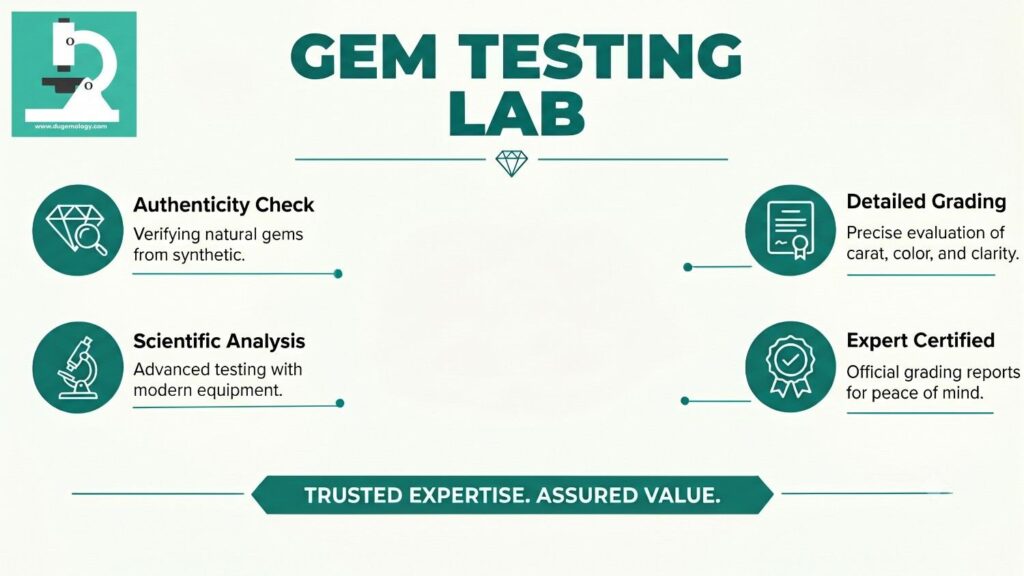
If you are buying, selling, inheriting or setting a gemstone, this information can protect you from costly mistakes. In this guide, we explain what a gem testing lab does, which services it provides, how testing works, what affects the cost, how to submit a stone, and how to choose a lab you can trust.
What Is a Gem Testing Lab?
A gem testing lab is a specialised facility where trained gemologists use professional instruments and tested methods to identify gemstones. The lab can tell you what the stone is, whether it is natural, synthetic or an imitation, and whether there is evidence of treatment. Many labs also record weight, measurements and other features in their report.
It is useful for individual buyers, jewellery owners, jewellers, gemstone traders, wholesalers and manufacturers, because a stone’s appearance alone is not a single factor to its identity.
Services Offered by a Gem Testing Laboratory
The services available depend on the lab’s expertise, equipment and the type of stone. Here are the most common ones.
1. Gemstone Identification
Identification determines what kind of gemstone you have. The gemologist studies colour, internal features and the stone’s physical and optical properties. For example, ruby and red spinel can look very similar, but they are different materials, and only testing can separate them correctly.
2. Natural, Synthetic and Imitation Identification
Natural gemstones form in the earth. Synthetic gemstones are grown in laboratories and have the same chemical composition as natural diamond. Imitations are different materials made to look like another gemstone, such as glass sold as emerald. A lab uses suitable methods to tell these three groups apart.
3. Treatment Detection
Many gemstones are treated to improve colour or clarity. Heating, dyeing, oiling and fracture filling are common examples. Treatments change how a stone should be described, sold and valued. A lab can examine a stone for evidence of treatment, but not every treatment can be detected in every stone, so results depend on the gemstone and the methods used.
4. Grading and Quality Assessment
Depending on the stone, a lab may check colour, clarity, cut, transparency, weight and measurements. Coloured gemstones do not follow a single universal grading system, so always ask which characteristics the lab will assess and what the report will include.
5. Diamond Testing
A diamond testing service can help establish whether a stone is a natural diamond, a lab-grown diamond or a simulant such as cubic zirconia or moissanite, and can look for signs of treatment.
6. Testing for Business and Valuation Support
Jewellers and traders use testing to describe stones accurately. Note that testing and valuation are different. Testing identifies and examines a gemstone, while valuation estimates its monetary worth, which depends on quality, weight, treatment, market demand and the purpose of the valuation.
Benefits of Gem Testing (and Who Needs It)
Gem testing helps people make better decisions when they buy, sell or handle stones.
| Who | How Gem Testing Helps |
|---|---|
| Individual buyers | Confirms what you are buying and whether the stone is natural, synthetic or imitation before you pay. |
| Jewellery owners | Identifies stones already set in inherited or older ornaments. |
| Jewellers and retailers | Supports accurate product descriptions and builds customer trust. |
| Gemstone traders and wholesalers | Provides reliable information for buying, selling and sorting parcels. |
| Manufacturers | Helps check the materials used in jewellery production. |
The information a lab can provide always depends on the gemstone and the tests performed.
How Gemstones Are Tested: Instruments and Methods
A gem testing lab combines several methods, because no single test answers every question. The right combination depends on the stone.
Visual examination. The gemologist first studies colour, transparency, surface and visible features under good lighting, with a loupe. This gives useful clues, but appearance alone is not enough for identification.
Refractive index (RI) testing. A refractometer measures how light bends as it passes through a stone. Because each gem material has a RI range, the reading helps narrow down its identity.
Polariscope and dichroscope. A polariscope shows how a stone interacts with polarised light, which helps separate materials with different optical structures. A dichroscope checks whether a stone shows different colours when viewed from different directions, a property called pleochroism that some gemstones display.
Specific gravity. Comparing a stone’s weight to its volume gives a density value that supports identification, especially for loose stones.
Microscopic examination. A gemological microscope reveals inclusions, growth patterns, fractures and other internal features. These generally show whether a stone is natural, synthetic or treated.
Spectroscopy. A spectroscope shows how a stone absorbs light, which can help identify certain gems and some treatments.
Advanced testing. Some stones need more detailed analysis, for example infrared (FTIR), UV-Vis-NIR or Raman spectroscopy, or chemical analysis such as EDXRF.
Not every stone needs advanced testing. The lab chooses the methods based on the gemstone and the question that needs answering.
Common Gemstone Treatments Labs Look For
Treatments are widespread in the gem trade and are not always disclosed. These are some common examples.
| Gemstone | Treatments Commonly Examined |
|---|---|
| Ruby | Heating; fracture or cavity filling with glass. |
| Sapphire | Heating; diffusion treatment. |
| Emerald | Oiling or resin filling of surface-reaching fractures. |
| Tanzanite | Heating (very common). |
| Jadeite | Bleaching and polymer impregnation; dyeing. |
| Diamond | High-pressure high-temperature (HPHT) treatment; laser drilling; fracture filling. |
Whether a treatment can be confirmed depends on the stone and the evidence available. A trustworthy lab will tell you when a result cannot be established with certainty.
How to Submit a Gemstone for Testing
The exact process varies by lab. In general, it looks like this.
- Contact the lab first. Confirm that the lab identifies your type of stone and ask what the report will cover.
- Prepare your stone. Gently clean it, and if possible bring it loose, since testing is easier and more informative on an unset stone. Set stones can usually still be examined, though some tests may be limited.
- Bring identification and details. Carry valid ID and any purchase paperwork, previous reports or invoices you have.
- Stone registration. The lab records the stone’s basic details, such as weight and dimensions, so it can be tracked through testing.
- Examination. Gemologists test the stone using suitable methods.
- Receive and verify your report. Collect the report and check that it can be verified through a report number or another method.
Gem Testing Lab Cost: What Affects the Price?
Charges differ from lab to lab, so a single price is rarely accurate. These are the main factors that influence what you pay.
- Type of gemstone: some stones need more complex testing than others.
- Size and number of stones: larger stones and multiple-stone submissions can change the charge.
- Loose or set stone: set stones can be harder to examine fully.
- Type of report: a basic identification report differs from one that includes treatment findings or additional detail.
- Need for advanced testing: specialised instruments add to the work involved.
- Urgency: express service, where offered, may cost more.
A lower price is not automatically better. Check what the test includes and what the report will tell you before comparing.
How to Choose a Reliable Gem Testing Lab
Before submitting a stone, check these points.
| What to Check | Why It Matters |
|---|---|
| Experience and expertise | Trained gemologists with experience in your type of stone give more dependable results. |
| Suitable equipment and methods | The lab needs the right tools for your gemstone, not just basic ones. |
| Clear reports | The report should explain findings in simple terms and state exactly what was examined. |
| Honest communication | A reliable lab explains the limits of testing and says when something cannot be confirmed. |
| Services offered | Identification, grading, treatment detection and valuation are different services. |
| Report verification | You should be able to verify a report using a report number or another method. |
| Transparency on cost and turnaround | Clear information up front avoids surprises. |
If you are unsure whether a lab suits your stone, ask these questions before you submit it. Good labs welcome them.
Gem Testing Lab vs Gemstone Testing Report
The two are closely related but not the same thing. The lab is where trained professionals examine the stone. The report is the document that records the findings, which may include the gemstone’s identity, weight, measurements and detectable treatments.
Not all reports provide the same information, and a report does not automatically confirm market value or every aspect of quality. Always read what the report covers before relying on it.
Gem Testing Lab in Delhi: DU Gemology
If you are looking for a gem testing laboratory in Delhi, DU Gemology provide gemstone identification and laboratory-related services for individuals and for the gemstone and jewellery trade. It is located in Dariba Kalan, Chandni Chowk, a long-established hub of Delhi’s jewellery and gemstone market. The institute focuses on gemology, laboratory services, education, research and industry support.
Before visiting or submitting a stone, contact DU Gemology to confirm that the test you need is available and what information the report will include.
Book a Gemstone Test / Get a Quote on WhatsApp
Frequently Asked Questions About Gem Testing Labs
Q1. What is a gem testing lab?
Ans:- A gem testing lab is a specialised facility where trained gemologists examine gemstones with professional tools and methods to identify them and understand their characteristics.
Q2. How does a gem testing lab identify a gemstone?
Ans:- It combines methods such as visual examination, refractive index testing, polariscope and dichroscope checks, specific gravity, microscopy and, when needed, spectroscopy and other advanced instruments.
Q3. Can a gem testing lab tell natural and synthetic gemstones apart?
Ans:- Yes, appropriate testing can often distinguish natural from synthetic stones. The result depends on the gemstone and the evidence available, and some cases need advanced instruments.
Q4. Can a lab detect gemstone treatments?
Ans:- A lab can detect evidence of many treatments, but some treatments are difficult or impossible to confirm in certain stones.
Q5. What does a gemstone testing report contain?
Ans:- It may include the stone’s identity, weight, measurements and details of any detectable treatments covered by the examination. Contents vary between labs and report types.
Conclusion
A gem testing lab helps you understand what a gemstone really is and what its characteristics are, which is valuable whether you are buying, selling or simply curious about a stone you own. Before choosing a lab, check its experience, testing methods, report quality and verification options, and remember that identification, grading, treatment detection and valuation are different services.
If you need gemstone identification or laboratory services in Delhi, contact DU Gemology in Dariba Kalan, Chandni Chowk, to discuss your requirements and confirm the right service.


