
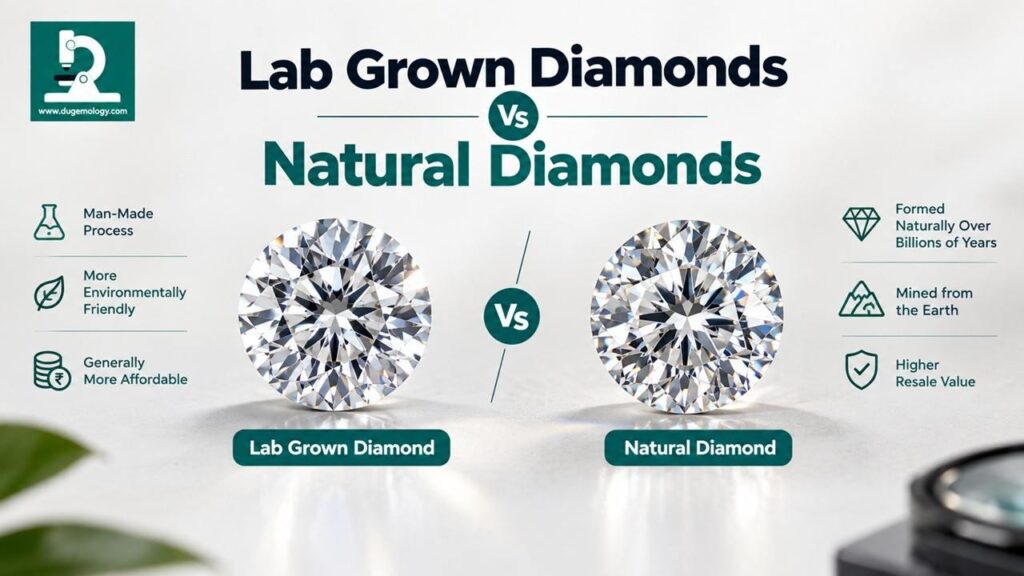
Lab-grown diamonds are becoming popular as many buyers look for an alternative to natural diamonds. In lab grown diamonds vs natural diamonds, both are real diamonds, but they differ in how they are formed, where they come from, their market price, rarity, and value. Knowing these differences can help you understand which option suits your needs. In this guide, we’ll look at their formation, properties, 4Cs, identification, certification, price, resale value, and other important factors to consider before buying.
Table of Contents
What Are Lab-Grown Diamonds?
Lab-grown diamonds are diamonds created in a laboratory instead of forming naturally inside the Earth. They are made using advanced technology that recreates some of the conditions needed for diamond growth. Lab-grown diamonds have the same basic chemical composition and crystal structure as natural diamonds, which is why they are considered real diamonds, not diamond simulants.
There are two main methods used to grow lab-grown diamonds: HPHT (High Pressure High Temperature) and CVD (Chemical Vapor Deposition).
- HPHT Diamond Growth Method
HPHT stands for High Pressure High Temperature. This method recreates the high pressure and temperature conditions under which diamonds can form. A small diamond seed is placed with a carbon source inside a specialized machine. Under high pressure and high temperature, the carbon gradually forms around the seed and grows into a diamond crystal.
- CVD Diamond Growth Method
CVD stands for Chemical Vapor Deposition. In this method, a thin diamond seed is placed inside a controlled chamber filled with a carbon-containing gas. The gas is heated to create a plasma, allowing carbon atoms to settle on the diamond seed and grow layer by layer.
What Are Natural Diamonds?
Natural diamonds are diamonds that form naturally deep inside the Earth. They develop under very high pressure and temperature over a very long period of time. These natural diamonds are later brought closer to the Earth’s surface through geological activity and can be recovered through mining.
Lab Grown Diamonds Vs Natural Diamonds: Key Differences
| Factor | Lab-Grown Diamond | Natural Diamond |
|---|---|---|
| Origin | Laboratory | Earth |
| Formation | HPHT or CVD | Natural geological process |
| Chemical Composition | Carbon | Carbon |
| Crystal Structure | Diamond | Diamond |
| Hardness | 10 Mohs | 10 Mohs |
| Appearance | Diamond appearance | Diamond appearance |
| Rarity | Manufactured | Naturally occurring |
| Price | Generally lower | Generally higher |
| Identification | Requires appropriate testing | Requires appropriate testing |
| Certification | Available | Available |
| Resale / Value Expectations | Market-dependent | Market-dependent |
Are Lab-Grown Diamonds Real Diamonds?
Yes, lab-grown diamonds are real diamonds. The main difference is where they are formed. Natural diamonds develop deep inside the Earth, while lab-grown diamonds are created in a controlled laboratory environment. They have the same basic carbon composition and diamond crystal structure as natural diamonds.
Lab-Grown Diamonds vs Diamond Simulants
Lab-grown diamonds should not be confused with diamond simulants. A lab-grown diamond is a diamond, while a simulant is a different material that is made to look like a diamond.
Cubic zirconia (CZ) and moissanite are common diamond simulants. They can look similar to diamonds, but their chemical composition and physical properties are different. Other materials can also be used as diamond simulants.
Physical and Optical Properties of Lab-Grown and Natural Diamonds
Lab-grown and natural diamonds have many similar physical and optical properties because both are diamonds.
Chemical Composition and Crystal Structure
Both are mainly made of carbon and have the same basic diamond crystal structure. The main difference is how they are formed.
Hardness and Durability
Both have a 10 Mohs hardness, which makes them very hard and suitable for everyday jewellery.
Refractive Index and Light Performance
Both can bend and reflect light very well. However, the cut and proportions of a diamond have a major effect on how well it performs with light.
Brilliance, Fire and Scintillation
Both can show brilliance, fire, and scintillation. These effects mainly depend on the diamond’s cut, proportions, and lighting.
Inclusions and Internal Characteristics
Both types can have inclusions. However, the type and pattern of inclusions can be different. Gemologists can study these features to help identify whether a diamond is natural or lab-grown.
Lab-Grown Diamonds Vs Natural Diamonds: Understanding the 4Cs
Both lab-grown and natural diamonds are graded using the 4Cs: Cut, Color, Clarity, and Carat Weight. These factors help describe the quality and appearance of a diamond.
Cut
Cut has a major effect on how much light a diamond reflects. A well-cut diamond can look bright and lively, whether it is lab-grown or natural. The diamond’s origin does not replace the importance of good cut quality.
Color
Diamond color is graded by comparing the stone with a set of grading standards. Lab-grown and natural diamonds can both be found across different color grades, although the available colors and characteristics may vary between individual stones.
Clarity
Clarity refers to the inclusions and other internal or surface characteristics found in a diamond. A higher clarity grade does not always mean the diamond will look more brilliant, because cut quality also plays an important role in its appearance.
Carat Weight
Carat weight measures how much a diamond weighs, not exactly how large it looks. Two diamonds with the same carat weight can have different visual sizes depending on their shape, proportions, and cut.
How Are Lab-Grown and Natural Diamonds Identified?
Lab-grown and natural diamonds can look very similar. So, it is not always easy to identify their origin just by looking at them.
Can You Tell the Difference by Looking at a Diamond?
Usually, you cannot tell whether a diamond is lab-grown or natural just by looking at it. Both can have similar shine, color, and appearance.
Why Basic Home Tests Are Not Enough
Simple home tests or basic diamond testers may help check if a stone has diamond-like properties. However, they cannot reliably tell whether the diamond is natural or lab-grown.
How Gemological Laboratories Identify Diamond Origin
Gemological laboratories use specialized equipment and detailed testing to identify a diamond’s origin. Experts may check:
- Growth patterns
- Inclusions and internal features
- Other identifying characteristics
- Results from advanced testing methods
Lab-Grown Diamonds Vs Natural Diamonds: Price and Value
Price is one of the main things people consider when comparing lab-grown and natural diamonds. However, the price can vary from one diamond to another.
Why Are Lab-Grown Diamonds Generally Less Expensive?
Lab-grown diamonds are made in controlled laboratory conditions. They can be produced in larger quantities, so they are generally less expensive than similar natural diamonds.
Why Do Natural Diamonds Usually Command Higher Prices?
Natural diamonds form naturally inside the Earth over a very long period of time. Their limited supply, natural origin, rarity, and market demand can contribute to higher prices.
Price Is Not the Same as Value
Price is what you pay for a diamond. Value depends on several factors, including the diamond’s quality, characteristics, origin, and current market conditions. So, a higher price does not always mean higher value.
What Factors Affect Diamond Value?
Several factors can affect a diamond’s value, including:
- 4Cs: Cut, Color, Clarity, and Carat Weight
- Origin: Natural or lab-grown
- Market conditions
- Certification
- Demand
- Rarity
- Size and overall quality
This is why there is no single price difference that applies to every lab-grown and natural diamond.
Resale Value of Lab-Grown vs Natural Diamonds
Resale value is an important point to consider when buying a diamond. However, the amount you may get when selling a diamond later can be different from what you originally paid.
Can Lab-Grown Diamonds Be Resold?
Yes, lab-grown diamonds can be resold. However, the resale price depends on factors such as the diamond’s quality, certification, market demand, and current prices.
What Affects Diamond Resale Value?
Several factors can affect resale value, including:
- Cut, Color, Clarity, and Carat Weight
- Natural or lab-grown origin
- Certification
- Current market conditions
- Demand
- Diamond quality and condition
Why Purchase Price and Resale Value Are Different
The price you pay when buying a diamond and the price you may receive when selling it later are not necessarily the same. Market conditions, demand, and other factors can affect the resale price.
Why You Should Be Careful With Future-Value Claims
Diamond prices and market conditions can change over time. Therefore, claims about guaranteed resale prices or future returns should be treated carefully. It is better to consider current market information rather than assume a diamond will have a specific future value.
Rarity and Availability: Lab-Grown vs Natural Diamonds
Natural and lab-grown diamonds are available in different ways. Natural diamonds come from the Earth, while lab-grown diamonds are made in laboratories.
Why Natural Diamonds Are Naturally Limited
Natural diamonds take a very long time to form deep inside the Earth. Only a limited number can be found and recovered through mining, so their availability is naturally limited.
How Laboratory Production Affects Availability
Lab-grown diamonds are made in controlled laboratory conditions. Their availability depends on production capacity, technology, and market demand rather than natural formation.
Does Rarity Affect Diamond Value?
Rarity can affect a diamond’s value, but it is not the only factor. The 4Cs, quality, origin, certification, demand, and market conditions can also affect value.
Common Myths About Lab-Grown and Natural Diamonds
There are many myths about lab-grown and natural diamonds. Let’s look at some common ones and understand the facts.
Myth 1: Lab-Grown Diamonds Are Fake
Fact: Lab-grown diamonds are real diamonds. They have the same basic carbon composition and diamond structure as natural diamonds. The main difference is how they are formed.
Myth 2: Lab-Grown Diamonds Are the Same as Cubic Zirconia
Fact: They are different. A lab-grown diamond is a diamond, while cubic zirconia (CZ) is a different material that is used to look like a diamond.
Myth 3: You Can Identify a Lab-Grown Diamond With a Simple Home Test
Fact: Simple home tests can help check if a stone behaves like a diamond, but they cannot reliably tell whether it is natural or lab-grown. Professional testing may be needed.
Myth 4: Higher Clarity Always Means More Brilliance
Fact: Not always. A diamond’s cut, proportions, symmetry, and lighting can have a bigger effect on how bright and sparkly it looks.
Myth 5: A Grading Report and Valuation Are the Same
Fact: They are different. A grading report describes a diamond’s characteristics, while a valuation gives an estimated monetary value.
Myth 6: Carat Weight Alone Determines Diamond Value
Fact: Carat weight is only one factor. Cut, color, clarity, origin, certification, rarity, demand, and market conditions can also affect value.
How to Choose Between a Lab-Grown and Natural Diamond
The right choice depends on what is important to you. Think about your budget, diamond quality, origin, and long-term expectations before buying.
Consider Your Budget
First, decide how much you want to spend. Lab-grown diamonds are generally less expensive than similar natural diamonds, so your budget may allow you to consider different sizes or qualities.
Consider Your Preference for Origin and Rarity
Think about whether the natural origin and rarity of a diamond matter to you. Natural diamonds form inside the Earth, while lab-grown diamonds are made in controlled laboratory conditions.
Consider Diamond Quality and the 4Cs
Pay attention to the 4Cs — Cut, Color, Clarity, and Carat Weight. These factors can make a big difference in how a diamond looks and what it is worth.
Check the Grading Report
Always check the grading report before buying. It gives important information about the diamond and can state whether it is natural or lab-grown.
Consider Your Long-Term Value Expectations
Diamond prices and resale values can change over time. Do not assume that a diamond will have a fixed future value. Instead, look at current market conditions and your own needs.
Buy From a Reliable Source
Buy from a reliable seller or gemological laboratory that provides clear information and proper documentation. This can help you make a more informed decision.
Frequently Asked Questions(FAQs)
Q1: Are lab-grown diamonds real diamonds?
Ans:- Yes. Lab-grown diamonds are real diamonds with the same basic carbon composition and diamond crystal structure as natural diamonds.
Q2: What is the main difference between lab-grown and natural diamonds?
Ans:- The main difference is their origin: natural diamonds form inside the Earth, while lab-grown diamonds are created in controlled laboratory conditions.
Q3: Are lab-grown diamonds as hard as natural diamonds?
Ans:- Yes. Both lab-grown and natural diamonds have a 10 Mohs hardness, making them highly durable for everyday jewellery.
Q4: Can you tell a lab-grown diamond from a natural diamond by looking at it?
Ans:- No. They can look very similar, so you usually cannot reliably tell the difference just by looking at them. Professional gemological testing is needed to identify their origin.
Q5: How are lab-grown diamonds identified?
Ans:- Lab-grown diamonds are identified using specialized gemological testing, including growth patterns, inclusions, and other identifying characteristics. Professional laboratory equipment may be required for reliable identification.
Q6: Are lab-grown diamonds cheaper than natural diamonds?
Ans:- Yes. Lab-grown diamonds are generally less expensive than similar natural diamonds, although the actual price depends on factors such as the 4Cs, certification, and market conditions.
Q7: Do lab-grown diamonds have resale value?
Ans:- Yes. Lab-grown diamonds can be resold, but the resale amount depends on factors such as quality, certification, market demand, and current prices.
Q8: Are lab-grown diamonds rare?
Ans:- Lab-grown diamonds are not considered rare in the same way as natural diamonds because they can be produced in controlled laboratory conditions. Their availability depends mainly on production capacity and market demand.
Q9: What is the difference between a lab-grown diamond and a diamond simulant?
Ans:- A lab-grown diamond is a real diamond, while a diamond simulant is a different material that only looks like a diamond, such as cubic zirconia or moissanite.
Q10: Is a diamond grading report the same as a valuation report?
Ans:- No. A grading report describes a diamond’s characteristics and quality, while a valuation report estimates its monetary value.
Conclusion
When comparing lab grown diamonds vs natural diamonds, the main differences are their origin, formation process, rarity, and market value. Both are real diamonds, but lab-grown diamonds are created in controlled laboratory conditions, while natural diamonds form naturally inside the Earth.
Before buying a diamond, it is important to consider the 4Cs, identification, certification, and valuation. Understanding these factors can help you compare both options and make an informed decision based on your budget, preferences, and individual requirements.


