
A CVD diamond is a lab-grown diamond made using a process called Chemical Vapor Deposition. It has the same basic properties as a natural diamond but was created in a laboratory. Many buyers want to know how CVD diamonds are made, graded, and priced. In this guide, we’ll explain these points and compare CVD diamonds with natural diamonds.
Table of Contents
What Is a CVD Diamond?
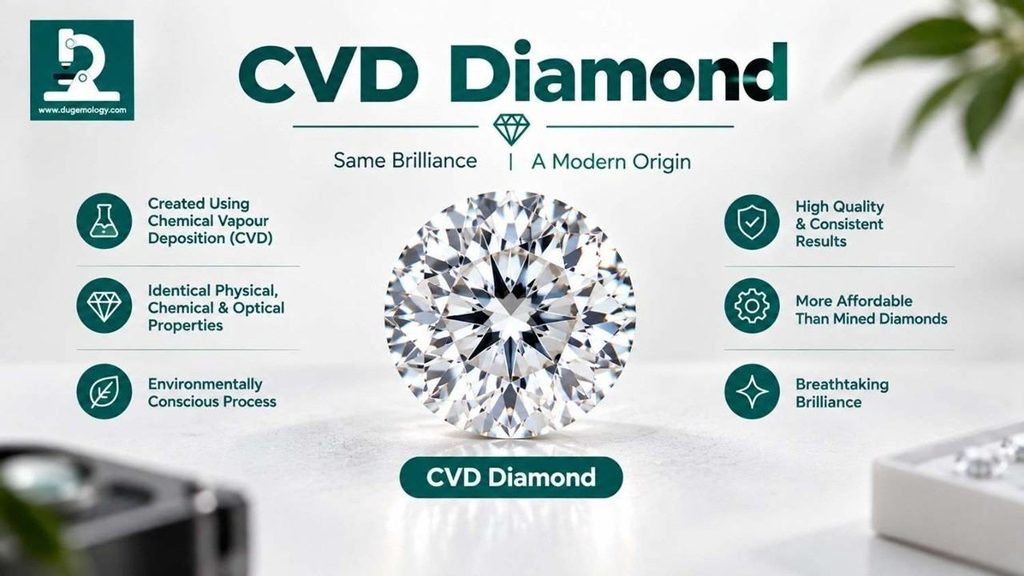
CVD is for Chemical Vapor Deposition. A CVD diamond is a lab-grown diamond made in a laboratory. In this process, a small diamond seed is placed inside a special chamber, where carbon-rich gases are used to grow the diamond layer by layer.
CVD diamonds are real diamonds because they are made of carbon and have the same basic crystal structure as natural diamonds. They are different from diamond simulants, such as cubic zirconia and moissanite, which only look like diamonds but have different chemical compositions and structures.
Are CVD Diamonds Real Diamonds?
Yes, CVD diamonds are real diamonds. They are made from carbon, just like natural diamonds, and have the same crystal structure. They also have similar properties, such as hardness, shine, and the way they interact with light. The main difference is how they are formed: natural diamonds develop deep inside the Earth, while CVD diamonds are grown in a laboratory.
How Are CVD Diamonds Made?
CVD diamonds are made in a laboratory using a process called Chemical Vapor Deposition. The process starts with a small diamond seed and grows a larger diamond around it.
Step 1: Preparing the Diamond Seed
A thin piece of diamond, called a diamond seed, is placed inside a special chamber. This seed provides the surface on which the new diamond formed.
Step 2: Creating the Vacuum Chamber
The air is removed from the chamber to create a controlled low-pressure environment. The temperature and pressure are then carefully maintained for the diamond-growing process.
Step 3: Introducing Carbon-Rich Gases
Gases such as methane and hydrogen are added to the chamber. Energy is used to break down the gases and release carbon atoms.
Step 4: Growing the Diamond Layer by Layer
The carbon atoms settle on the diamond seed and slowly form new layers. As more layers build up, a larger diamond crystal is formed.
Step 5: Cutting and Polishing the Diamond
Once the diamond reaches the required size, it is removed from the chamber. It is then cut and polished to give it the desired shape, shine, and brilliance.
How Long Does It Take to Grow a CVD Diamond?
The time required to grow a CVD diamond depends on its size and the conditions used during the process. Smaller diamonds may grow faster, while larger diamonds usually take more time. Factors such as temperature, pressure, gas mixture, and growth speed can also affect the process.
What Are the Properties of CVD Diamonds?
CVD diamonds have many of the same basic properties as natural diamonds because both are made of carbon. However, their colour, clarity, size, and internal features can be different from one diamond to another.
Colour
CVD diamonds can have different colour grades, from colourless to diamonds with a visible tint. Some CVD diamonds may have a slight brown or grey tint due to the growth process.
Clarity
CVD diamonds can have different clarity levels. Small internal features or marks may be present, and their size and visibility can affect the clarity grade.
Carat Weight
CVD diamonds are available in different carat weights and sizes. Carat weight refers to the weight of the diamond, not its exact visual size. The cut and shape can also affect how large a diamond looks.
Crystal Structure
CVD diamonds have the same basic diamond crystal structure as natural diamonds. This gives them the hardness and other important properties associated with diamond.
CVD vs HPHT Diamonds: What’s the Difference?
CVD and HPHT are two different methods used to grow diamonds in a laboratory. Both can produce real lab-grown diamonds, but the growth process and some of the features seen inside the diamonds can be different.
| Feature | CVD Diamond | HPHT Diamond |
|---|---|---|
| Growth Process | Grown layer by layer using carbon-rich gases | Grown using high pressure and high temperature |
| Growth Environment | Controlled chamber with low pressure and gases | Very high pressure and high temperature |
| Common Characteristics | May show growth patterns and strain features | May show metallic flux-related features and growth patterns |
| Inclusions | Can have small dark or needle-like inclusions | May contain metallic or other mineral inclusions |
| Colour | Can range from colourless to slightly tinted | Can range from colourless to different tints |
| Treatments | Some stones may be treated to improve colour | Some stones may also be treated to improve colour |
| Identification | Specialised gemological equipment can identify CVD growth features | Specialised equipment can identify HPHT growth features |
| Grading | Can be graded by recognised gemological laboratories | Can also be graded by recognised gemological laboratories |
CVD Diamond vs Natural Diamond
When comparing CVD diamond vs natural diamond, the main difference is how they are formed. Both are made of carbon and have the basic crystal structure of diamond, but their origins are different. A CVD diamond is grown in a laboratory using the Chemical Vapor Deposition process, while a natural diamond forms deep inside the Earth under high pressure and temperature over a very long period.
CVD diamonds and natural diamonds can look very similar and have many of the same physical and optical properties. However, their origin can be identified through proper diamond testing and grading. Their prices may also differ based on factors such as carat weight, colour, clarity, cut, overall quality, demand, and current market conditions.
How Can You Identify a CVD Diamond?
Identifying a CVD diamond is not always possible by simply looking at the stone. CVD diamonds can look very similar to natural diamonds, so specialised gemological testing is needed. Gemologists examine the diamond for specific features using advanced instruments, which can help determine whether it was grown using CVD technology.
Can You Identify a CVD Diamond With the Naked Eye?
Usually, no. CVD diamonds can look very similar to natural diamonds, so their origin cannot be confirmed just by looking at them.
Can a Regular Diamond Tester Detect CVD Diamonds?
A basic diamond tester can help confirm that a stone has diamond-like properties, but it usually cannot tell whether it is CVD or natural.
What Instruments Are Used to Identify CVD Diamonds?
Gemologists use specialised equipment such as microscopes, spectroscopy, and other advanced testing instruments to identify CVD growth features.
Why Professional Laboratory Testing Is Important
Professional laboratory testing provides a more reliable way to determine whether a diamond is natural or CVD-grown and can provide a proper identification or grading report.
CVD Diamond Grading and Certification
CVD diamonds can be graded for the same 4Cs—Cut, Colour, Clarity, and Carat Weight—used to describe natural diamonds. A grading report also identifies the stone as a laboratory-grown diamond. Depending on the laboratory and testing, the report may provide additional information about its CVD growth. Certification is important because it gives buyers documented information about the diamond’s quality and laboratory-grown origin, rather than relying only on appearance or a seller’s description.
How Much Does a CVD Diamond Cost?
The price of a CVD diamond depends on its quality and several other factors. Carat weight, colour, clarity, and cut can all affect the price. A diamond with a grading report may also be priced differently from one without a report. If the diamond has been treated, this can also be an important factor. Since CVD diamond prices can change over time, it is useful to compare the quality, grading report, and treatment details before making a purchase.
CVD Diamond Price vs Natural Diamond
CVD diamonds and natural diamonds can have different prices because they are formed in different ways and have different market values. The price depends on factors such as carat weight, colour, clarity, cut, grading report, and treatment. Natural diamond prices can also be affected by rarity and market demand. For CVD diamonds, production costs and market conditions can affect the price. So, you should not compare diamonds based on carat weight alone, as two diamonds of the same weight can have different prices.
Advantages and Limitations of CVD Diamonds
Potential Advantages of CVD Diamonds
CVD diamonds are real diamonds and have the same basic properties as natural diamonds. They are available in different sizes, shapes, colours, and clarity grades. Their laboratory-grown origin is also clearly identified, making them an option for buyers who want a diamond with specific quality and budget requirements.
Important Considerations Before Buying
Before buying a CVD diamond, check its grading report and the 4Cs—Cut, Colour, Clarity, and Carat Weight. Also check whether the diamond has received any treatment. Since CVD diamonds can look very similar to natural diamonds, proper documentation and professional testing can help you understand what you are buying.
Common Myths About CVD Diamonds
Are CVD Diamonds Fake?
No. CVD diamonds are real diamonds made from carbon. The main difference is that they are grown in a laboratory instead of forming naturally inside the Earth.
Can CVD Diamonds Be Called Lab-Grown Diamonds?
Yes. CVD diamonds are lab-grown diamonds because they are created in a laboratory using the Chemical Vapor Deposition process.
Can Every Diamond Tester Identify CVD Diamonds?
No. A basic diamond tester can help check if a stone has diamond properties, but it usually cannot tell whether it is CVD or natural.
Are All CVD Diamonds the Same Quality?
No. CVD diamonds can differ in colour, clarity, cut, and carat weight. Some may also have different growth features or treatments, so each diamond needs to be assessed separately.
Frequently Asked Questions about CVD Diamond
Q1. What does CVD mean in diamonds?
Ans: CVD stands for Chemical Vapor Deposition, a process used to grow diamonds in a laboratory.
Q2. Are CVD diamonds real diamonds?
Ans: Yes. CVD diamonds are real diamonds made of carbon and have the same basic crystal structure as natural diamonds; the main difference is that they are grown in a laboratory.
Q3. Is CVD better than HPHT?
Ans: CVD and HPHT are two different methods of growing lab-grown diamonds. Neither is “better”—the choice depends on the diamond’s quality, characteristics, treatment, and grading report.
Q4. How can you identify a CVD diamond?
Ans: A CVD diamond usually cannot be identified by eye alone. Specialised gemological equipment and laboratory testing are used to identify its growth features and confirm whether it is CVD-grown.
Q5. Are CVD diamonds cheaper than natural diamonds?
Ans: Yes, CVD diamonds are generally less expensive than natural diamonds, although the exact price depends on factors such as carat weight, colour, clarity, cut, certification, and treatment.
Q6. Can CVD diamonds have inclusions?
Ans: Yes. CVD diamonds can have inclusions or other internal features formed during the growth process. Their type, size, and visibility can vary from one diamond to another.
Q7. Do CVD diamonds come with a grading report?
Ans: Yes. CVD diamonds can come with a grading report from recognised gemological laboratories. The report generally states that the diamond is laboratory-grown and provides details about its 4Cs—Cut, Colour, Clarity, and Carat Weight.
Q8. Can CVD diamonds be treated?
Ans: Yes. CVD diamonds can be treated after they are grown. Treatments such as HPHT treatment may be used to improve their colour, and any treatment should be properly disclosed when applicable.
Conclusion
CVD diamonds are real, lab-grown diamonds made using the Chemical Vapor Deposition process. They have the basic properties of natural diamonds, but their origin and growth process are different. Their quality can vary based on the 4Cs, treatments, and other characteristics. If you are buying a CVD diamond, always check its grading report, treatment details, and quality.


