
A diamond sieve chart is useful for sorting diamonds according to their size. It has the approximate diamond sizes that can be grouped using different sieve sizes. In diamond sorting and assorting, diamonds are passed through sieves of different-sized. This helps separate stones into groups of similar sizes. A diamond sieve chart helps diamond professionals understand these size ranges and maintain consistency during the sorting process.
Table of Contents
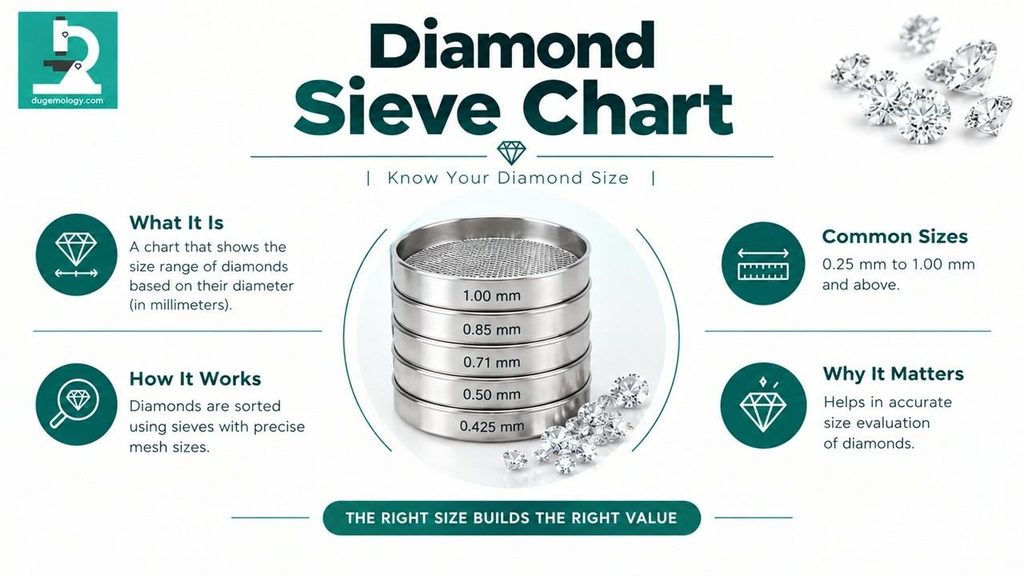
Keep in mind that sieve size gives an approximate size range, because the actual dimensions and carat weight of a diamond can vary depending on its shape and proportions.
| Group Name | Sieve Size | Approx. Weight in Carat |
|---|---|---|
| -2 | -2 | < 0.005 ct |
| Stars | +2 to -6.5 | 0.006–0.02 ct |
| Melee | +6.5 to -11 | 0.021–0.07 ct |
| +11 (Big Melee) | +11 to -14 | 0.08–0.13 ct |
| +14 | +14 to -15.5 | 0.14–0.17 ct |
| 1/5th | — | 0.18–0.22 ct |
| 1/4th (Quarters) | — | 0.23–0.29 ct |
| 30 Pointers | — | Above 0.30 ct |
| 40 Pointers | — | Above 0.40 ct |
| 50 Pointers | — | Above 0.50 ct |
| Solitaire | — | 1.00 ct and above |
Note: The carat ranges shown are approximate and may vary depending on diamond shape, cut, and proportions.
Diamond Sieve Chart
A diamond sieve chart helps diamond professionals understand the relationship between sieve numbers, sieve openings, and the approximate size of diamonds. The exact size range can vary depending on the diamond’s shape and proportions, so the chart should be used as a practical sorting guide rather than an exact measurement.
Diamond Sieve Chart for Different Diamond Sizes
| Sieve Number | Diam (mm) | Carat | Approx. PCS per Carat |
|---|---|---|---|
| +0.0 to -1.5 | 1.10 | 0.0055 | ~182 |
| +1.5 to -2.5 | 1.20 | 0.0086 | ~116 |
| +2.5 to -3.5 | 1.25 | 0.0098 | ~102 |
| +3.5 to -4.0 | 1.30 | 0.0125 | ~80 |
| +4.0 to -4.5 | 1.40 | 0.0136 | ~73 |
| +4.5 to -5.0 | 1.50 | 0.0145 | ~69 |
| +5.0 to -5.5 | 1.55 | 0.0157 | ~64 |
| +5.5 to -6.0 | 1.60 | 0.0188 | ~53 |
| +6.0 to -6.5 | 1.70 | 0.0211 | ~47 |
| +6.5 to -7.0 | 1.80 | 0.0267 | ~37 |
| +7.0 to -7.5 | 1.90 | 0.0305 | ~33 |
| +7.5 to -8.0 | 2.00 | 0.0347 | ~29 |
| +8.0 to -8.5 | 2.10 | 0.0418 | ~24 |
| +8.5 to -9.0 | 2.20 | 0.0450 | ~22 |
| +9.0 to -9.5 | 2.30 | 0.0511 | ~20 |
| +9.5 to -10.0 | 2.40 | 0.0581 | ~17 |
| +10.0 to -10.5 | 2.50 | 0.0651 | ~15 |
| +10.5 to -11.0 | 2.60 | 0.0726 | ~14 |
| +11.0 to -11.5 | 2.70 | 0.0774 | ~13 |
| +11.5 to -12.0 | 2.80 | 0.0837 | ~12 |
| +12.0 to -12.5 | 2.90 | 0.0983 | ~10 |
| +12.5 to -13.0 | 3.00 | 0.1100 | ~9 |
| +13.0 to -13.5 | 3.10 | 0.1177 | ~8.5 |
| +13.5 to -14.0 | 3.20 | 0.1290 | ~7.7 |
| +14.0 to -14.5 | 3.30 | 0.1457 | ~6.9 |
| +14.5 to -15.0 | 3.40 | 0.1533 | ~6.5 |
| +15.0 to -15.5 | 3.50 | 0.1646 | ~6.1 |
| +15.5 to -16.0 | 3.60 | 0.1820 | ~5.5 |
| +16.0 to -16.5 | 3.70 | 0.1989 | ~5.0 |
| +16.5 to -17.0 | 3.80 | 0.2060 | ~4.8 |
| +17.0 to -17.5 | 3.90 | 0.2300 | ~4.3 |
| +17.5 to -18.0 | 4.00 | 0.2480 | ~4.0 |
| +18.0 to -18.5 | 4.10 | 0.2560 | ~3.9 |
| +18.5 to -19.0 | 4.20 | 0.2650 | ~3.8 |
| +19.0 to -19.5 | 4.30 | 0.3000 | ~3.3 |
How Does a Diamond Sieve Work?
A diamond sieve is a simple tool used to sort diamonds by size. Diamonds are placed on the sieve and gently moved so that smaller stones can pass through the openings while larger stones stay on top. This makes it easier to separate a mixture into groups of similar-sized diamonds.
- Sorting Diamonds by Size
The main purpose of a diamond sieve is to separate diamonds into different size groups. Smaller diamonds pass through the sieve openings, while larger diamonds remain on the sieve. By using different sieve sizes, diamond professionals can sort a parcel into more specific size ranges. This is particularly useful when sorting large quantities of small diamonds.
- Understanding Sieve Openings
The size of the openings decides which diamonds can pass through the sieve. A larger opening is used for larger diamonds, while smaller openings are used for smaller stones. However, the sieve opening does not tell you the exact carat weight of a diamond. The diamond’s shape, cut and proportions can affect how it passes through the sieve.
- Why Consistent Sizing Matters
Consistent sizing makes diamond sorting and assorting more organized. When diamonds of similar sizes are grouped together, they are easier to compare, handle and use for different purposes. It also helps professionals create more consistent parcels for manufacturing, trading and further diamond assessment.
Diamond Sieve Sizes and Their Uses
Different diamond sieve sizes are used for sorting diamonds of different sizes. Larger openings are used for larger diamonds, while smaller openings are used for smaller diamonds and melee. When a parcel contains diamonds of different sizes, professionals can use a series of sieves to separate them into different size groups. The right sieve size depends on the diamonds being sorted and the purpose of the sorting.
How to Use a Diamond Sieve for Sorting
A diamond sieve is a simple tool that helps separate diamonds by size.
- Prepare the Diamonds
Make sure the diamonds are clean and free from dust or other material before sorting.
- Select the Appropriate Sieves
Choose the right sieve size for the diamonds you are sorting. Use larger openings for larger stones and smaller openings for smaller stones.
- Sieve the Diamonds
Place the diamonds on the sieve and gently shake it. Smaller diamonds pass through the openings, while larger ones stay on top.
- Check and Record the Results
Check each group after sorting to make sure the diamonds are properly separated. You can also record the size and quantity of each group for easy reference.
- Diamond Sieve vs Diamond Screen
A diamond sieve and a diamond screen are both used to separate diamonds by size. The terms can vary depending on the trader, manufacturer, or region. A sieve usually has fixed-size openings, while a screen is a more general term for a mesh or surface used for size sorting. In the diamond trade, both terms may sometimes be used for similar equipment, so the exact meaning can depend on the sizing system being used.
Why Diamond Sieving Is Important in Assorting
Diamond sieving helps sort diamonds into similar size groups. This makes the mixture easier to organize, compare, and prepare for sale or manufacturing. Proper size separation can also help during pricing and valuation, as size is an important factor when assessing diamonds. For manufacturers, sorted diamonds make it easier to choose the right stones for different jewellery designs and production needs.
Common Mistakes When Using a Diamond Sieve
A diamond sieve makes size sorting easier, but some simple mistakes can affect the results.
- Using the wrong sieve size: The wrong sieve can place diamonds in the wrong size group.
- Mixing different shapes: Different diamond shapes can pass through a sieve differently, even if they have a similar weight.
- Ignoring the sieve condition: A damaged or worn sieve may not give reliable results.
- Relying only on the sieve: A sieve only helps with size sorting. It does not tell you the diamond’s quality, grade, or exact value.
Diamond Sieve Chart vs Carat Weight
A diamond sieve chart and carat weight are not the same thing. A sieve helps sort diamonds based on their physical size, while carat tells you the weight of the diamond. Since diamonds can have different shapes and proportions, two diamonds with the same carat weight have into different sieve size groups. Likewise, diamonds in the same sieve group may have slightly different carat weights.
So, a sieve chart is useful for sorting diamonds by size, but it cannot tell you the exact carat weight of a diamond.
Frequently Asked Questions About Diamond Sieve Chart
Q1. What is a diamond sieve chart?
Ans:- A diamond sieve chart shows different sieve sizes and the approximate diamond sizes they can sort. It helps professionals separate diamonds into similar size groups.
Q2. What are diamond sieve sizes?
Ans:- Diamond sieve sizes refer to the size of the openings in a sieve used to sort diamonds by size. Different sieve sizes help separate diamonds into different size ranges.
Q3. How does a diamond sieve work?
Ans:- A diamond sieve separates diamonds by size using openings of different sizes.
Smaller diamonds pass through the openings, while larger diamonds remain on the sieve.
Q4. How are diamonds sorted using sieves?
Ans:- Diamonds are placed on sieves with different-sized openings and gently shaken to separate them by size. Smaller stones pass through, while larger stones remain on the sieve.
Q5. Is diamond sieve size the same as carat weight?
Ans:- No, diamond sieve size and carat weight are different. Sieve size relates to physical size, while carat weight measures the diamond’s weight.
Q6. Can a sieve determine diamond quality?
Ans:- No. A diamond sieve cannot determine quality; it is mainly used to sort diamonds by size.
Q7. What sieve is used for melee diamonds?
Ans:- Melee diamonds are generally sorted using small-opening sieves designed for tiny stones. The exact sieve size depends on the melee size range being sorted.
Conclusion
A diamond sieve chart helps sort diamonds into different size groups. It is useful for separating mixtures of loose diamonds, especially small and melee diamonds. However, a sieve cannot tell the exact carat weight or quality of a diamond. For accurate identification, grading, and valuation, professional testing is needed.


