
When people search for how to check diamond purity, they usually want to understand its quality. But checking a diamond is not just about looking at how much it shines. Some stones can look like diamonds, so it is difficult to confirm whether a stone is natural, lab-grown, or a simulant.
Table of Contents
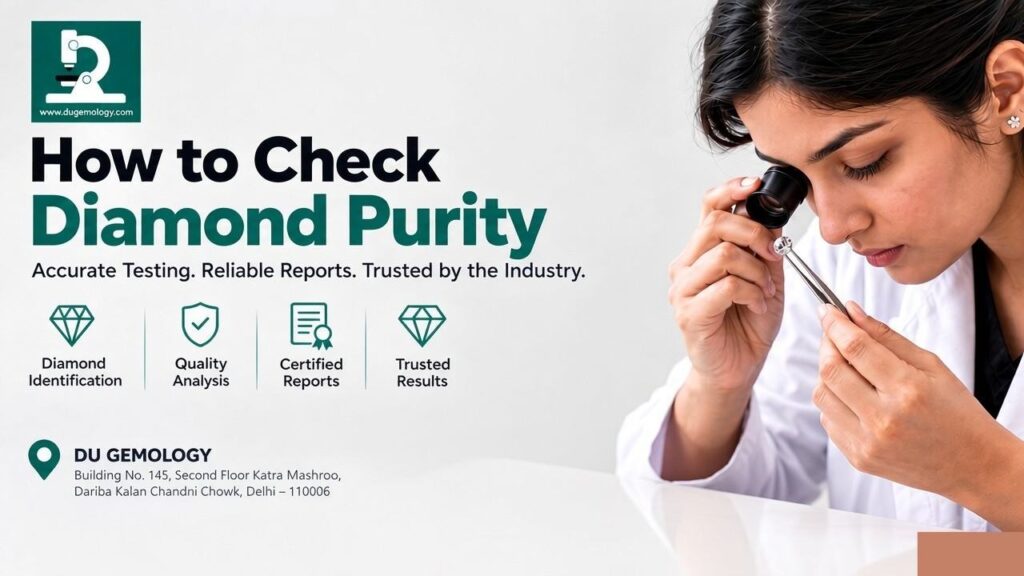
Simple home checks, such as using a loupe or checking the diamond under good lighting, can give you some basic clues. However, these checks are not enough for a reliable result. A professional gemological laboratory uses special instruments and expert testing to identify the diamond and check details such as colour, clarity, carat weight, and possible treatments.
What Does Diamond Purity Mean?
Diamond purity means understanding how genuine and clean a diamond is. Unlike gold, diamonds do not have a fixed purity percentage. When checking a diamond, factors such as whether it is natural, lab-grown, or a simulant, along with its colour, clarity, and any treatments, are considered to understand its quality and identity.
Diamond Purity vs. Diamond Clarity
Diamond purity and clarity are different things. Purity is a general term used to understand whether a diamond is genuine and learn about its characteristics. Clarity specifically refers to the small inclusions and marks found inside or on the surface of a diamond.
Diamond Purity vs. Diamond Authenticity
Diamond purity and authenticity are closely connected, but they mean different things. Authenticity means checking whether the stone is actually a diamond. Purity is a broader term that can include understanding the diamond’s identity and other characteristics.
Diamond Purity vs. Diamond Quality
Diamond purity and diamond quality are also different. Purity focuses more on understanding the diamond’s identity and characteristics, while quality depends on factors such as cut, color, clarity, and carat weight. These factors are considered together when assessing a diamond’s overall quality.
How to Check Diamond Purity at Home
You can do a few simple checks at home to get an idea about a diamond. You can look at it under good lighting, use a 10× loupe to see small inclusions, and check its overall appearance. However, these checks only give basic clues and cannot confirm whether the stone is a natural diamond, lab-grown diamond, or simulant.
For a more reliable result, it is better to have the diamond checked by a professional gemologist or laboratory using proper testing equipment.
1. Check the Diamond’s Appearance
Start by looking at the diamond in good lighting. A diamond usually reflects light and gives off bright flashes, but this alone cannot prove that it is a real diamond. Some other stones can look similar, so treat this as only a first check.
2. Try the Fog Test
Hold the diamond close to your mouth and gently breathe on it. A thin layer of fog may appear and disappear quickly on a diamond because it conducts heat well. However, this test is not reliable enough to confirm that a stone is a genuine diamond.
3. Try the Water Test
Place the loose diamond in a glass of water. A diamond will normally sink because it is denser than water. However, other gemstones can also sink, so this test cannot confirm that the stone is a diamond.
4. Examine the Diamond With a 10× Loupe
A 10× loupe lets you see the diamond more closely. You may notice small inclusions, surface marks, or other details that are difficult to see with the naked eye.
- What to Look for Under a 10× Loupe
Look for small marks or inclusions inside the diamond and any blemishes on its surface. You can also check the edges and facets for visible signs of any damage. These details can give you some useful clues about the stone.
- What a Loupe Cannot Confirm
A loupe cannot confirm whether a diamond is natural, lab-grown, or a simulant. It also cannot reliably identify treatments or replace professional diamond testing.
Can Home Tests Confirm Diamond Purity?
Proper testing can help identify whether the stone is a natural diamond, lab-grown diamond, or simulant and provide reliable information about its characteristics.
- Limitations of the Fog Test
The fog test is a simple way to check a diamond at home, but it cannot tell you for sure whether the stone is genuine. The result can also change depending on the diamond’s cleanliness and surrounding conditions.
- Limitations of the Water Test
The water test can give you a quick idea, but it cannot confirm that a stone is a diamond. Many other gemstones can also sink in water. This means the test alone cannot give you a reliable answer.
- Why the Scratch Test Is Not Recommended
The scratch test is not a good way to check a diamond because it can damage the stone or the jewellery. It also cannot reliably confirm whether the stone is a diamond. It is safer to use proper testing methods instead.
- Why Visual Inspection Alone Is Not Enough
Looking at a diamond can help you notice its colour, clarity, and overall appearance, but it cannot confirm its identity. Natural diamonds, lab-grown diamonds, and some diamond simulants can look very similar. For a reliable result, professional testing is recommended.
How to Check Diamond Purity With a Diamond Tester
A diamond tester can help you check whether a stone is likely to be a diamond. It works by checking certain properties of the stone, such as how it conducts heat or electricity. To use it, make sure the stone is clean and dry, then place the tester’s tip on the stone as directed by the device. The tester will give a reading based on its test.
However, a diamond tester cannot tell you everything about a diamond. Some stones may need further testing to get a clear result. For a more reliable check, it is better to have the diamond tested by a professional gemologist or laboratory.
How a Basic Diamond Tester Works
A basic diamond tester checks certain properties of a stone, usually how it conducts heat. You place the tester’s tip on the clean stone. It then gives a reading that can help you understand whether the stone may be a diamond.
- What a Diamond Tester Can Detect
A diamond tester can provide you an idea of whether a stone has properties commonly found in diamonds. It can be useful for checking loose stones or diamonds set in jewellery. However, the result is only a basic check and may not give you complete information about the stone.
- What a Diamond Tester Cannot Confirm
A basic diamond tester cannot tell you everything about a diamond. It cannot reliably confirm whether a diamond is natural or lab-grown, and it does not provide complete information about colour, clarity, treatments, or overall quality. For a detailed and reliable result, professional gemological testing is recommended.
How Professionals Check Diamond Purity
Professionals use special tools and equipment to check a diamond more carefully. They examine the stone to find out whether it is a natural diamond, lab-grown diamond, or simulant. They can also check details such as colour, clarity, carat weight, and signs of treatment.
Unlike simple home tests, professional testing follows a proper process and uses specialized instruments.
- Diamond Identification Testing
- Diamond Testing With a Loupe and Microscope
- Inclusions and Internal Features
- Surface Characteristics
- Thermal and Electrical Conductivity Testing
- UV Fluorescence Examination
- Advanced Laboratory Testing
Does a Diamond Grading Report Prove Its Purity?
A diamond grading report gives you important information about a diamond, but it is not simply a “purity certificate.” Depending on the type of report, it may tell you whether the diamond is natural or lab-grown and provide details such as its colour, clarity, and carat weight.
A grading report is useful because it records the results of professional testing. You should also check the report number and verify the report with the issuing laboratory when possible. It helps you understand the diamond’s characteristics rather than giving it a single purity percentage.
What Information Is Included in a Diamond Grading Report?
A diamond grading report gives you important details about a diamond, such as its carat weight, colour, clarity, and cut. It may also include its shape, measurements, polish, symmetry, fluorescence, and whether it is natural or lab-grown. The details can vary depending on the laboratory and type of report.
How to Check a Diamond Report
First, check the report number and the diamond details mentioned on the report. If the laboratory has an online verification service, enter the report number to check the information. Make sure the details on the report match the diamond you have.
Why the Diamond Should Match the Report
The diamond should match the information given in its report. You can compare details such as carat weight, measurements, shape, and clarity characteristics. If the diamond has a laser-inscribed report number, you can also check whether it matches the report.
Grading Report vs. Diamond Valuation
A grading report tells you about the characteristics and quality of a diamond based on professional examination. Diamond valuation is different because it estimates how much the diamond may be worth based on its characteristics and market conditions. In simple terms, a grading report tells you what the diamond is like, while a valuation focuses on what it may be worth.
How to Check Diamond Purity Before Buying
Before buying a diamond, check its grading report and make sure the details on the report match the diamond. Look at important information such as carat weight, colour, clarity, and whether the diamond is natural or lab-grown. You can also verify the report number with the issuing laboratory, if an online verification service is available.
Do not rely only on the diamond’s sparkle or simple home tests. If you are unsure about the diamond or its report, get it checked by a professional gemologist or gemological laboratory before buying. This can help you understand the diamond’s identity and characteristics with greater confidence.
Common Mistakes When Checking Diamond Purity
One common mistake is judging a diamond only by its sparkle or appearance. Home tests can give you some basic clues, but they cannot confirm whether a stone is natural, lab-grown, or a simulant. It is also a mistake to think that a grading report and a diamond valuation are the same thing.
Another important step is checking the grading report and making sure its details match the diamond. Check information such as the report number, carat weight, colour, clarity, and diamond type. If you are unsure, getting the diamond checked by a professional gemologist or laboratory can give you more reliable information.
Relying Only on the Fog Test
The fog test is a simple home check, but it cannot confirm whether a diamond is genuine. The result can be affected by different conditions, so it should only be treated as a basic clue.
Assuming a Diamond Tester Proves Everything
A diamond tester can help check certain properties of a stone, but it does not tell you everything about it. It may not confirm whether the diamond is natural or lab-grown or provide complete information about its quality.
Confusing Clarity With Purity
Clarity and purity are not the same thing. Clarity refers to the inclusions and marks in a diamond, while purity is a broader term used when discussing the diamond’s identity and characteristics.
Assuming Appearance Confirms Natural Origin
A diamond’s sparkle and appearance cannot confirm that it is a natural diamond. Lab-grown diamonds and some diamond simulants can look very similar. Proper testing may be needed to determine the diamond’s type.
Buying Without Checking Documentation
Do not buy a diamond without checking its available documentation. Review the grading report, report number, and important details such as carat weight, colour, clarity, and diamond type. If possible, verify the report with the issuing laboratory before making the purchase.
Final Checklist: How to Check Diamond Purity
- Check the diamond’s physical characteristics
- Use home tests only as preliminary checks
- Examine the stone with proper magnification
- Check its identification and origin
- Review the grading report
- Use professional laboratory testing when necessary
- Obtain a separate valuation when you need to know its monetary value
Frequently Asked Questions About Diamond Purity
Q1. How can I check diamond purity at home?
Ans:- You can do basic home checks like the fog test, water test, and 10× loupe inspection, but these cannot confirm diamond purity. For a reliable result, get the diamond professionally tested.
Q2. Can a diamond tester check diamond purity?
Ans:- A diamond tester can help identify whether a stone is likely to be a diamond, but it cannot fully confirm diamond purity or whether it is natural or lab-grown.
Q3. Is diamond purity the same as clarity?
Ans:- No. Diamond purity and clarity are different. Clarity refers to the inclusions and blemishes in a diamond, while purity is a broader term related to its identity and characteristics.
Q4. What is the most reliable way to check diamond purity?
Ans:- The most reliable way is professional testing by a qualified gemologist or gemological laboratory using proper testing equipment.
Conclusion
Knowing how to check diamond purity is important before buying or checking a diamond. Simple home tests and diamond testers can give you some basic clues, but they cannot fully confirm whether a diamond is natural, lab-grown, or a simulant.
For a more reliable result, get the diamond professionally tested and check its grading report. By looking at the diamond carefully, checking the documents, and taking expert advice when needed, you can better understand the diamond and buy with confidence.


