
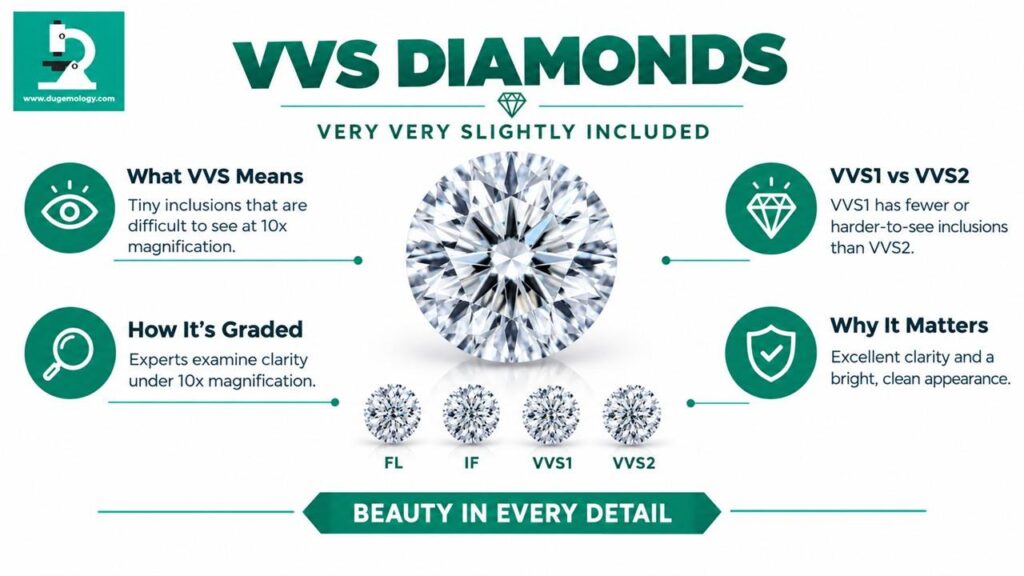
VVS diamonds are diamonds with inclusions that even a trained grader finds very hard to see under 10× loupe. That is why they are among the most demanded clarity grades for engagement rings, solitaires and fine jewellery.
But what does VVS actually mean? Is VVS1 really better than VVS2? And is VVS clarity worth the extra money, or can a VS diamond look just as good for less amount? This guide answers all three, with a clarity chart and practical buying tips.
Key Takeaways
- VVS stands for Very Very Slightly Included. It is split into VVS1 (higher) and VVS2.
- VVS inclusions are not visible to the naked eye. Both grades are eye-clean.
- VVS1 typically costs a modest premium over VVS2, but the visible difference is almost always zero.
- Many VS1 and VS2 diamonds also look clean and cost noticeably less.
- Cut matters more than clarity for sparkle. A well-cut VS can outshine a poorly cut VVS.
- Both natural and lab-grown diamonds can be VVS. The grade describes clarity, not origin.
What Are VVS Diamonds?
VVS diamonds are diamonds graded Very Very Slightly Included. Their inclusions (internal features) and blemishes (surface marks) are so small that they are extremely difficult to see under 10× magnification, even for an experienced gemologist.
These features form naturally as the diamond crystallises, or can appear during cutting, polishing or handling. In a VVS diamond they have essentially no effect on how the stone looks to the naked eye.
The VVS category has two grades:
- VVS1: the higher grade, with inclusions that are extremely difficult to see.
- VVS2: the lower grade, with inclusions that are very difficult to see.
A VVS grade tells you about clarity only. It says nothing about cut, colour or carat weight, which also decide how a diamond looks and what it costs.
The Diamond Clarity Scale at a Glance
| Grade | Full Name | What It Means | Visible to the Naked Eye? |
|---|---|---|---|
| FL | Flawless | No inclusions or blemishes visible under 10× magnification. | No |
| IF | Internally Flawless | No inclusions, only minor surface blemishes under 10× magnification. | No |
| VVS1 | Very Very Slightly Included 1 | Inclusions extremely difficult to see under 10× magnification. | No |
| VVS2 | Very Very Slightly Included 2 | Inclusions very difficult to see under 10× magnification. | No |
| VS1 | Very Slightly Included 1 | Minor inclusions, difficult to see under 10× magnification. | Usually no |
| VS2 | Very Slightly Included 2 | Minor inclusions, somewhat easy to see under 10× magnification. | Usually no |
| SI1 | Slightly Included 1 | Noticeable inclusions under 10× magnification. | Sometimes |
| SI2 | Slightly Included 2 | Easily seen under 10× magnification. | Often |
| I1 to I3 | Included | Inclusions obvious and may affect durability. | Yes |
How Gemologists Grade VVS Diamonds
Gemologists examine each diamond under 10× magnification and check five factors:
- Size of the inclusions
- Number of inclusions
- Position (a flaw under the table is more noticeable than one near the edge)
- Nature (the type of feature)
- Relief (how much it contrasts with the surrounding diamond)
VVS1 inclusions are often so small or so well placed that they can only be seen from the pavilion (the bottom of the stone). VVS2 inclusions are slightly easier to locate.
Common Inclusions in VVS Diamonds
Typical features in VVS stones include:
- Pinpoints: tiny crystals that look like dots
- Feathers: small internal fractures, usually very faint in VVS grades
- Needles: thin, rod-like crystals
- Clouds: groups of pinpoints; in VVS grades these are very faint
- Minor blemishes: tiny polish lines or surface marks
In lower grades like SI, the same features are larger, more numerous or centrally located, which is why they become visible without magnification.
VVS1 vs VVS2: What Is the Difference?
Both grades have excellent clarity. The only real difference is how easily a skilled grader can find the inclusions under 10× magnification. To the naked eye, the two look identical.
| Feature | VVS1 | VVS2 |
|---|---|---|
| Clarity Rank | Higher | Lower |
| Inclusions Under 10× | Extremely difficult to see | Very difficult to see |
| Typical Location | Often visible only from the pavilion side | Can be visible from the crown side too |
| Visible to Naked Eye | No | No |
| Typical Price Premium | Roughly 5–15% above a comparable VVS2 (indicative) | Baseline |
| Best For | Buyers who want the top VVS grade and collectors | Buyers who want high clarity with better value |
Which Is Better: VVS1 or VVS2?
VVS1 ranks higher, but many buyers choose VVS2 and put the savings into a better cut grade, a higher colour grade or a larger carat weight, all of which are clearly visible.
Choose VVS1 if you want the highest possible VVS grade, or you are buying as a long-term collectable. Choose VVS2 if you want the same visible result and better value.
Are VVS Diamonds Eye-Clean?
Yes. VVS diamonds are eye-clean, meaning inclusions cannot be seen without magnification under normal viewing conditions.
“Eye-clean” is not an official grade, and it is not exclusive to VVS. Many VS1 and VS2 diamonds are eye-clean too, and some SI1 stones as well. If your goal is a diamond that looks clean, you do not always need to pay for VVS.
VVS vs Other Clarity Grades
- VVS vs VS
VS diamonds have slightly larger or more noticeable inclusions under 10×, yet most still look clean to the naked eye. A VS1 or VS2 usually costs noticeably less than a VVS stone of the same size, colour and cut. For many buyers, VS is the best value in the clarity scale.
- VVS vs SI
SI diamonds have inclusions that are easy to see under magnification, and in some stones visible to the naked eye. An SI1 can be a smart budget choice, but only if you inspect the actual diamond (or its video and plot) to confirm the inclusions are not visible or centrally placed.
- VVS vs IF and FL
Internally Flawless (IF) diamonds show no inclusions under 10×, only minor blemishes. Flawless (FL) diamonds show neither. Both are rarer and carry a significant premium over VVS. Yet to the naked eye, a VVS1 and an IF diamond look the same. Paying for IF or FL is mostly about rarity and prestige, not appearance.
VVS Diamond Price: How Much Do They Cost?
There is no single fixed price for VVS diamonds. Cost depends on carat weight, cut, colour, shape, origin (natural or lab-grown) and current market conditions.
How VVS Compares in Price
- VVS1 vs VVS2: VVS1 typically costs a small premium, commonly in the range of 5-15%.
- VVS vs VS1: A VVS diamond often costs roughly 10-25% more than a comparable VS1.
- Natural vs lab-grown: A lab-grown VVS diamond usually costs a fraction of a natural one of equal size and grade.
Note that a smaller VVS1 can cost less than a larger VVS2, so always compare diamonds with similar specifications.
What Affects the Price of a VVS Diamond?
| Factor | Effect on Price |
|---|---|
| Carat Weight | Larger stones cost more, with price jumps at 0.50, 1.00 and 2.00 ct. |
| Cut | Excellent cut commands a premium because it maximises sparkle. |
| Colour | Colourless grades (D–F) cost more than near-colourless grades (G–J). |
| Clarity | VVS1 costs more than VVS2; both generally cost more than VS grades. |
| Shape | Round brilliants usually cost more per carat than fancy shapes. |
| Origin | Natural diamonds generally cost far more than comparable lab-grown diamonds. |
Natural vs Lab-Grown VVS Diamonds
Both natural and lab-grown diamonds can have VVS clarity, and lab-grown stones are very commonly graded VVS or VS. Both are real diamonds with the same chemical composition and physical properties. The clarity grade describes the stone’s internal features, not where it came from.
| Feature | Natural VVS | Lab-Grown VVS |
|---|---|---|
| Origin | Formed in the Earth over billions of years. | Grown in a laboratory over weeks. |
| Material | Diamond | Diamond |
| Clarity | Can be VVS1 or VVS2. | Can be VVS1 or VVS2. |
| Price | Higher | Considerably lower |
| Resale Value | Generally retains more value. | Generally lower. |
| Identification | Requires laboratory testing. | Requires laboratory testing. |
A gemological laboratory with advanced testing equipment is required to confirm origin, which is why a grading report matters.
Are VVS Diamonds Worth It?
VVS diamonds are worth it if you specifically want very high clarity, you value the grade on paper, or you are buying a large stone where inclusions are more likely to be visible.
They may not be worth it if you want the best-looking diamond for your budget. Since VVS and VS look the same to the naked eye, the money saved by choosing VS1 or VS2 can go toward a better cut or a bigger stone.
Benefits of VVS Clarity
- Inclusions are invisible even under magnification
- Reliably eye-clean
- Clarity documented on an independent report
- A strong choice for larger stones and for buyers who prefer to leave nothing to chance
When to Choose VS Instead
Consider VS1 or VS2 if you want a clean-looking diamond within a set budget. Ask to see the actual stone or a high-resolution video.
Choosing the Right Cut, Colour and Setting for a VVS Diamond
Prioritise cut. Clarity does not create sparkle. Cut does. Choose Excellent (or Ideal) cut for round diamonds, and Very Good to Excellent for fancy shapes.
Match colour to clarity. There is little point in pairing a top clarity grade with a visibly yellow stone. G-H colour is a popular balance for VVS and VS diamonds, while D-F suits buyers who want a fully colourless look.
Pick a shape you love. Step-cut shapes such as emerald and Asscher show inclusions more readily, so clarity matters more for them. Brilliant cuts such as round, oval and cushion hide small inclusions more easily.
Consider the setting. Prongs can cover inclusions near the edges, while bezel settings protect the girdle. This matters most for lower clarity grades, but it is good to know when comparing VVS and VS stones.
How to Buy a VVS Diamond Safely
- Insist on a grading report from a recognised laboratory such as GIA, IGI or SGL. Grading standards differ between labs, so the lab name affects both value and trust.
- Check the report details: report number, shape, carat weight, colour, clarity, cut grade (where given) and measurements.
- Verify online using the laboratory’s official report-check tool.
- Match the stone to the report. Many diamonds have a laser inscription on the girdle with the report number, visible under a loupe.
- Ask for an independent verification if the diamond has no report or the report is from an unfamiliar lab.
Get Your VVS Diamond Verified at DU Gemology
As a gemology laboratory, DU Gemology can help you confirm a diamond’s clarity grade, check whether it is natural or lab-grown and identify treatments, so you know what you are paying for.
Book a diamond testing appointment
Frequently Asked Questions About VVS Diamonds
Q1. Is VVS2 clarity good?
Ans:- Yes. VVS2 is the fourth-highest clarity grade, and its inclusions are very difficult to see even under 10× magnification. It is eye-clean and an excellent choice.
Q2. Is VVS1 better than VVS2?
Ans:- On the grading scale, yes, but the difference is invisible without magnification. Most buyers cannot tell the two apart, so VVS2 often offers better value.
Q3. Which is better for an engagement ring, VVS1 or VVS2?
Ans:- For most rings, VVS2 is the more practical choice, as it looks identical to VVS1 and costs less. Choose VVS1 only if you want the highest VVS grade or are buying a large stone.
Q4. Are VVS diamonds real?
Ans:- Yes. VVS is a clarity grade, not a type of diamond. Both natural and lab-grown diamonds can be VVS.
Q5. Can you see inclusions in a VVS diamond?
Ans:- Not with the naked eye. Even trained graders find them extremely difficult to see under 10× magnification.
Q6. Are VVS diamonds expensive?
Ans:- They cost more than VS and SI diamonds of the same size, colour and cut, but price depends heavily on carat weight, cut, colour and whether the diamond is natural or lab-grown.
Q7. Is VVS better than VS?
Ans:- VVS ranks higher on the clarity scale, but both can look clean to the naked eye. VS often delivers better value.
Q8. What is the difference between VVS and IF?
Ans:- IF (Internally Flawless) diamonds have no inclusions visible under 10×, only minor surface blemishes. VVS diamonds have tiny inclusions. The two look the same to the naked eye, but IF costs more.
Q9. Is VVS clarity worth it for a lab-grown diamond?
Ans:- Often yes, since lab-grown VVS stones cost much less than natural ones and the premium over VS is smaller in absolute terms. Still, compare the cut and the report first.
Q10. How can I tell if a diamond is VVS?
Ans:- You cannot tell by eye. Only a trained gemologist using 10× magnification, backed by a grading report, can confirm the grade.
Q11. Are VVS lab-grown diamonds different from natural VVS diamonds?
Ans:- They share the same clarity grade and the same physical properties. The difference is origin and price, and testing equipment is needed to tell them apart.
Q12. What is the price difference between VVS and VS diamonds?
Ans:- VVS diamonds typically cost roughly 10-25% more than comparable VS1 stones, depending on size, colour and cut. Check current prices before you buy.
Conclusion
VVS diamonds have very high clarity with inclusions that are invisible. VVS1 is the higher grade, but VVS2 looks the same and costs less.
The best diamond is not the one with the highest clarity grade. It is the one with an excellent cut, a colour you like, a size that fits your budget and a trusted grading report. Compare the full specifications, see the actual stone and verify the certificate before you buy.


