
A lab grown diamond is a diamond made in a laboratory instead of being formed naturally inside the Earth. It is made from carbon and has the same basic chemical composition and crystal structure as a natural diamond. This means a lab grown diamonds has many of the same physical and optical properties as a natural diamond. The main difference is where it comes from.
Table of Contents
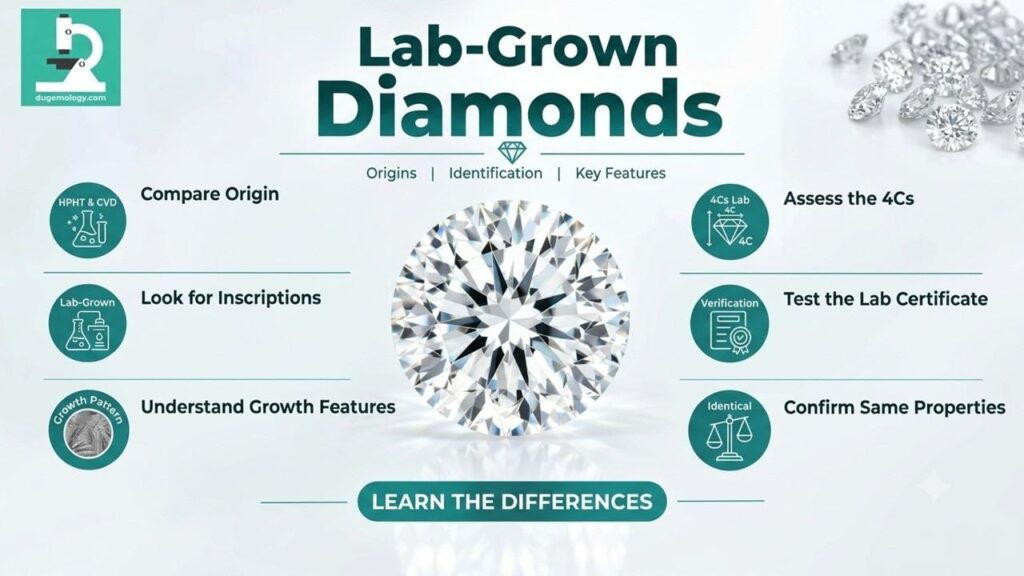
Natural diamonds form inside the Earth through natural geological processes, while lab grown diamonds are created in a laboratory environment using advanced technology. Because of this, lab grown diamonds can also be cut, polished, graded, and used in jewellery just like natural diamonds.
How Is a Lab Grown Diamond Made?
Lab grown diamonds are created in a laboratory by using technology. There are two main methods used to grow diamonds: CVD (Chemical Vapor Deposition) and HPHT (High Pressure High Temperature). Both methods start with a small diamond and create the conditions required for diamond crystals.
- CVD Diamond: Chemical Vapor Deposition
CVD stands for Chemical Vapor Deposition. In this method, a small piece of diamond, called a diamond seed, is placed inside a specially designed chamber. Carbon-containing gases, such as methane, are introduced into the chamber and activated under controlled conditions.
The carbon atoms separate from the gas and gradually settle on the diamond seed. They build up layer by layer, slowly forming a larger diamond crystal. Once the process is complete, the rough diamond can be cut and polished for use in jewellery. CVD diamonds can have the same basic chemical composition and crystal structure as natural diamonds.
- HPHT Diamond: High Pressure High Temperature
HPHT stands for High Pressure High Temperature. This method is designed to recreate the high-pressure and high-temperature conditions under which natural diamonds can form inside the Earth.
A small diamond is placed inside a growth chamber along with a carbon source. Very high pressure and temperature are applied to the materials. Under these conditions, the carbon dissolves and gradually increases around the diamond seed, allowing the diamond crystal to grow.
After the growth process is complete, the rough diamond is removed, cut, and polished. Like CVD diamonds, HPHT diamonds are real diamonds, but their origin can be identified through careful examination and laboratory testing.
CVD vs HPHT Lab Grown Diamond
CVD and HPHT are two different methods for lab grown diamonds. Both are real diamonds, but the process and conditions are different.
| Feature | CVD | HPHT |
|---|---|---|
| Full form | Chemical Vapor Deposition | High Pressure High Temperature |
| Starting material | Diamond seed and carbon-containing gases | Diamond seed and carbon source |
| Main conditions | Controlled gas and plasma environment | Very high pressure and temperature |
| Growth process | Carbon builds up layer by layer | Carbon crystallizes around the diamond seed |
| Final product | Lab grown diamond | Lab grown diamond |
How Long Does It Take to Grow a Lab Grown Diamond?
A lab grown diamond generally takes a few weeks to grow. The exact time depends on the method used, the size of the diamond, and the growing conditions. CVD diamonds take around 3–4 weeks, while HPHT diamonds can take anywhere from a few hours to several weeks.
Larger diamonds generally take more time to grow. Once the rough diamond is ready, it still needs to be cut and polished before it can be used in jewellery.
Is a Lab Grown Diamond a Real Diamond?
Yes, a lab grown diamond is a real diamond. It has the same basic chemical composition and crystal structure as a natural diamond. It also has similar hardness, physical properties, and optical properties, which is why it can look like a natural diamond. The main difference is its origin—natural diamonds form inside the Earth, while lab grown diamonds are made in a laboratory.
A lab grown diamonds is different from a diamond simulant. Simulants such as cubic zirconia and moissanite may look like diamonds, but they are made from different materials and do not have the same properties as diamond. So, while a lab grown diamonds is a diamond, a simulant is a different gemstone or material that only resembles one.
Lab Grown Diamond vs Natural Diamond
| Feature | Lab Grown Diamond | Natural Diamond |
|---|---|---|
| Origin | Laboratory | Natural geological formation |
| Formation | Controlled growth process | Natural geological process |
| Composition | Carbon | Carbon |
| Crystal structure | Diamond | Diamond |
| Physical properties | Diamond properties | Diamond properties |
| Grading | Professionally graded | Professionally graded |
| Identification | Requires appropriate testing | Requires appropriate testing |
Lab Grown Diamond vs Diamond Simulant
A lab grown diamond and a diamond simulant can look similar, but they are made from different materials. A lab grown diamonds is a real diamond made in a laboratory, while a simulant is another material that is made to look like a diamond. Moissanite and cubic zirconia (CZ) are two common diamond simulants.
Lab Grown Diamond vs Moissanite
Moissanite is a gemstone made mainly from silicon carbide. It can look very similar to a diamond and has its own unique brilliance, but it is not diamond. A lab grown diamonds is made of carbon and has the same basic diamond crystal structure as a natural diamond.
Lab Grown Diamond vs Cubic Zirconia
Cubic zirconia (CZ) is another material that is commonly used as a diamond look-alike. It is made from zirconium dioxide, not carbon. Although CZ can look like a diamond, its chemical composition, crystal structure, hardness, and other properties are different from those of a lab grown diamond.
Why a Lab Grown Diamond Is Not a Diamond Simulant
The main difference is simple: a lab grown diamonds is diamond, while a simulant only looks like diamond. Lab grown diamonds are grown in a laboratory and have the basic properties of diamond. Moissanite, cubic zirconia, and other simulants are different materials that are used as diamond alternatives.
How Is a Lab Grown Diamond Graded?
A lab grown diamond is commonly described using the 4Cs: Carat, Colour, Clarity, and Cut. These help explain the characteristics and quality of an individual diamond.
- Carat Weight
Carat refers to the weight of the diamond. A higher carat does not always mean a diamond will look larger.
- Colour
Colour describes how much body colour a diamond has. For white diamonds, less visible colour generally means a higher colour grade.
- Clarity
Clarity refers to internal inclusions and surface blemishes. Fewer or less noticeable features generally result in a higher clarity grade.
- Cut
Cut describes how well a diamond is proportioned and finished to handle light. A good cut can improve its brightness and sparkle.
- Diamond Grading Reports
A diamond grading report records important details about the stone, including its 4Cs and whether it is lab grown. It helps buyers understand and compare individual diamonds.
How to Identify a Lab Grown Diamond
A lab grown diamonds cannot usually be identified reliably just by looking at it. It can have the same basic appearance and properties as a natural diamond, so proper testing is often needed to determine its origin.
Can You Identify a Lab Grown Diamond by Looking at It?
In most cases, visual appearance alone is not enough to tell whether a diamond is natural or lab grown. Special equipment and gemological examination may be required.
Using a Loupe or Microscope
A loupe or microscope can reveal certain features or inclusions that may provide clues about the diamond’s origin. However, these observations should be interpreted by a trained professional.
Using a Diamond Tester
Basic diamond testers can help determine whether a stone has properties consistent with diamond. However, they generally cannot confirm whether the diamond is natural or lab grown.
Advanced Laboratory Testing
Advanced gemological equipment can examine features such as growth patterns, fluorescence, and spectroscopic characteristics. Laboratory testing provides a more reliable way to determine a diamond’s origin.
Identifying CVD and HPHT Diamonds
Specialized testing can also help identify whether a lab grown diamonds was produced using the CVD or HPHT method. Different growth methods can leave characteristic features that trained gemologists and laboratories can examine.
Checking the Diamond Grading Report
A diamond grading report can provide important information about the stone, including whether it is identified as lab grown. Checking the report and matching its details with the diamond can help confirm the stone’s identity and origin.
Lab Grown Diamond Price in India
The price of a lab grown diamond in India depends on the diamond’s characteristics and current market conditions. There is no single fixed price because two diamonds with the same carat weight can still have different prices based on their quality and other factors.
Factors That Affect Lab Grown Diamond Price
Several things can affect the price of a lab grown diamond:
- Carat weight: The weight of the diamond can affect its price.
- Cut: A well-cut diamond can have better light performance and may be priced differently.
- Colour: The colour grade can influence the price.
- Clarity: The number and visibility of inclusions can affect the price.
- Shape: Different shapes can have different prices.
- Grading report: A grading report provides important details about the diamond and its characteristics.
- Growth characteristics: Features related to CVD or HPHT growth may affect how the diamond is evaluated.
- Treatments: Any treatment or enhancement can influence the diamond’s characteristics and price.
- Market conditions: Supply, demand, technology, and changing market conditions can all affect prices.
Are Lab Grown Diamonds Certified?
Yes, a lab grown diamond can come with a grading report from a gemological laboratory. The report gives important details about the diamond, such as its carat weight, colour, clarity, cut, and whether it is lab grown.
A grading report is different from laboratory testing. Testing includes examining the diamond using gemological equipment and methods. A grading report records the findings and describes the diamond’s characteristics.
What Does a Lab Grown Diamond Report Tell You?
A lab grown diamonds report tells you about the diamond’s main characteristics. It may include the 4Cs—carat, colour, clarity, and cut, along with its measurements and other identifying details. It should also clearly state that the diamond is lab grown.
What Information Should You Check on the Report?
Before buying, check the report number, carat weight, colour, clarity, cut, measurements, and lab grown identification. If the report mentions any treatments or other important features, check those details as well.
Why Should the Report Match the Diamond?
The report should belong to the same diamond you are buying. Check details such as the report number, measurements, carat weight, and other identifying features. Matching these details helps confirm that the report and the diamond belong to the same gemstone.
Advantages and Considerations of Lab Grown Diamonds
Lab grown diamonds have some benefits, but there are also a few things to consider before buying.
- Availability and Variety
Lab grown diamonds are available in many sizes, shapes, colours, and clarity grades, so buyers have plenty of options.
- Price Considerations
They are often priced lower than similar natural diamonds. However, the price depends on factors such as carat, cut, colour, clarity, and market conditions.
- Size and Design Options
Lab grown diamonds come in different sizes and shapes, giving buyers flexibility when choosing a jewellery design.
- Resale and Market Considerations
The resale value may be different from the original purchase price. The lab grown diamonds market can also change over time.
Are Lab Grown Diamonds Suitable for Jewellery?
Yes, lab grown diamonds can be used for many types of jewellery. They can be cut and polished like natural diamonds and are available in different shapes and sizes.
- Lab Grown Diamonds for Engagement Rings
Lab grown diamonds are a suitable choice for engagement rings. They are available in different shapes, sizes, colours, and clarity grades, so you can choose one that fits your style and budget.
- Lab Grown Diamonds for Everyday Jewellery
Lab grown diamonds can be used in rings, earrings, pendants, and bracelets.
- Choosing the Right Lab Grown Diamond
When buying a lab grown diamond, check its carat, cut, colour, clarity, shape, and grading report. Choose the diamond that suits your jewellery design, budget, and personal preference.
The Future of Lab Grown Diamonds
The lab grown diamond industry is changing as technology improves and consumer preferences develop. New production methods and better testing may continue to shape the industry.
- Advances in CVD and HPHT Technology
CVD and HPHT technology continues to improve. Better technology can help producers control the diamond growth process more effectively and improve consistency.
- Changes in Production and Quality Control
Better equipment and production methods can improve quality control and consistency. Improved testing can also help identify and examine lab grown diamonds more accurately.
- Changing Consumer Preferences
Buyers are paying more attention to the origin, quality, price, and grading of diamonds. These factors can influence how lab grown diamonds are produced and sold.
Frequently Asked Questions About Lab Grown Diamond
Q1. Is a lab grown diamond a real diamond?
Yes. A lab grown diamond is a real diamond with the same basic chemical composition and crystal structure as a natural diamond.
Q2. How is a lab grown diamond made?
Lab grown diamonds are mainly made using CVD (Chemical Vapor Deposition) or HPHT (High Pressure High Temperature) methods.
Q3. What is a CVD diamond?
A CVD diamond is a lab grown diamond made by depositing carbon layer by layer onto a diamond seed inside a controlled chamber.
Q4. What is an HPHT diamond?
An HPHT diamond is a lab grown diamond made using very high pressure and high temperature to grow diamond around a diamond seed.
Q5. Is a lab grown diamond cheaper than a natural diamond?
Lab grown diamonds are generally available at lower prices than comparable natural diamonds, but prices vary based on their characteristics and market conditions.
Q6. Can a lab grown diamond be identified?
Yes. Specialised gemological examination and laboratory testing can help identify whether a diamond is lab grown and, in some cases, its growth method.
Q7. Are lab grown diamonds certified?
Yes. Lab grown diamonds can be accompanied by a grading report from a gemological laboratory that describes their characteristics and identifies them as lab grown.
Q8. How are lab grown diamonds graded?
Lab grown diamonds are commonly graded using the 4Cs: Carat, Colour, Clarity, and Cut, along with other identifying details.
Q9. Are lab grown diamonds the same as diamond simulants?
No. A lab grown diamond is a real diamond, while simulants such as moissanite and cubic zirconia are different materials that look similar to diamond.
Q10. Do lab grown diamonds have the same 4Cs as natural diamonds?
Yes. Lab grown diamonds can be described and graded using the same 4Cs: Carat, Colour, Clarity, and Cut.
Conclusion
A lab grown diamond is a real diamond and can be used in many types of jewellery. Before buying one, it is important to understand its 4Cs, growth method, grading report, treatments, and other important details.Always check that the report matches the diamond. If you are unsure about the diamond’s identity or characteristics, professional testing can help you make a more confident decision.


