
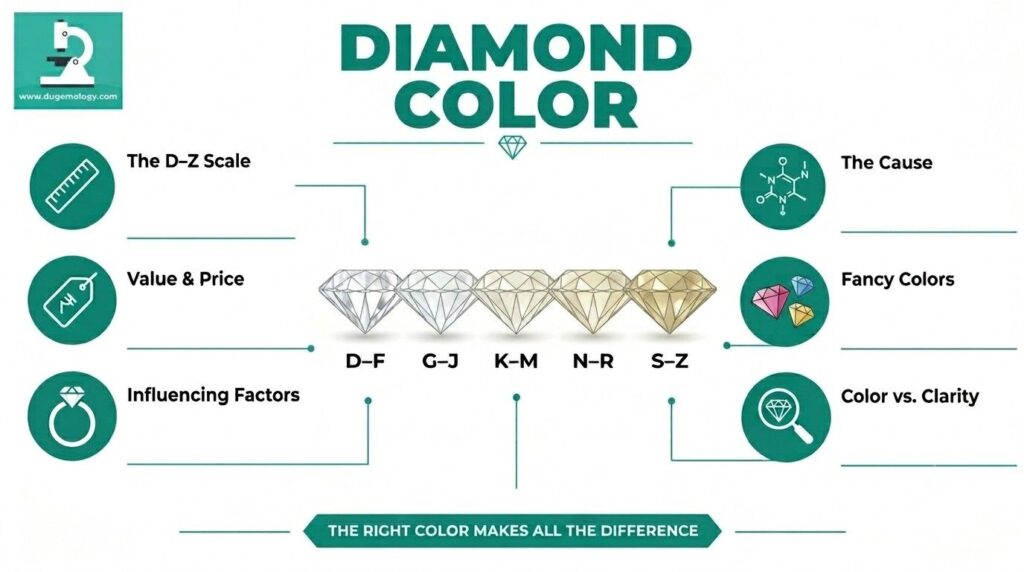
Diamond color tells you which color your diamond belongs to. On the standard D-to-Z color scale, diamonds range from D (colorless) to Z (more noticeable yellow or brown). Color is one of the 4Cs of diamond grading, along with cut, clarity, and carat weight. It can affect how white or colored a diamond looks and can also affect its value.
However, color is not the only thing that matters. Cut, shape, size, lighting, and setting can also change how the diamond’s color looks.
What Is a Diamond Color?
Diamond color means how much body color a diamond shows. In the standard color grading system, a diamond with less visible color gets a higher color grade.
When we say a diamond is colorless, it does not always mean it has absolutely no color. It means that little or no body color is visible under standard grading conditions. The less color a diamond shows, the more colorless it appears.
How Is Diamond Color Graded?
Diamond color is tested by trained professionals under controlled lighting and viewing conditions. The diamond is compared with master stones that have known color grades to determine its color grade.
The difference between two color grades can be very small and difficult to see with the naked eye. That is why professional grading is important.
An independent laboratory report records the diamond’s color grade, making it easier to understand and compare the diamond with others.
The Diamond Color Scale Explained
The standard diamond color scale ranges from D to Z. It shows how much body color a diamond has, with D being the highest color grade and Z showing more noticeable color.
| Color Grade | Category | General Appearance |
|---|---|---|
| D–F | Colorless | Very little to no visible body color |
| G–J | Near Colorless | Slight body color may be present |
| K–M | Faint | A warmer tone may be noticeable |
| N–R | Very Light | More visible body color |
| S–Z | Light | Noticeable yellow or brown color |
As you move from D toward Z, the amount of visible body color generally increases. However, the difference between some grades can be subtle and may be difficult to see without grading.
- D, E and F — Colorless Diamonds
D, E and F are the top grades on the diamond color scale. These diamonds show very little to no noticeable body color and generally look very clear and colorless.
- G, H, I and J — Near Colorless Diamonds
G, H, I and J are called near colorless. They may have a slight amount of body color, but it is often hard to notice when looking at the diamond from the top.
- K, L and M — Faint Color Diamonds
K, L and M have a faint body color. You may notice a warmer or slightly yellowish tone, especially in larger diamonds.
- N to Z — Very Light and Light Color Diamonds
N to Z includes the very light and light color grades. The body color becomes easier to see as the grade moves closer to Z, with yellow or brown tones becoming more noticeable.
Which Diamond Color Is Best?
There is no single best diamond color for everyone. The right color depends on the look you want, your budget, and the diamond you choose.
If you want a very colorless look, D–F grades are a good choice. If you want a balance between appearance and budget, G–J grades may be worth considering. Lower grades can also be a good option if you like a warmer look.
Your diamond shape, setting metal, personal preference, and budget all matter. So, choosing the highest color grade is not always necessary.
Does Diamond Color Affect Price?
Yes, diamond color can affect its price. When other factors are similar, diamonds with higher color grades generally cost more because they have less visible body color. But color is only one of the 4Cs. Cut, clarity, and carat weight also has an important role in a diamond’s price. So, two diamonds with the same carat weight can still have different prices because of their color grade and other characteristics.
How Does Diamond Color Affect Appearance?
Diamond color can affect how a diamond looks, especially when checked under different lighting conditions.
- Face-up appearance: A diamond may look more colorless when viewed from the top, so slight color may not always be easy to notice.
- Warmth or yellow tint: Lower color grades can show a warmer or slightly yellowish tone, which becomes more noticeable as the color grade decreases.
- Brilliance and sparkle: Diamond color does not directly determine how much a diamond sparkles. Cut quality also has a greater effect on brilliance and light return.
- Viewing conditions: Lighting, background, and the way a diamond is viewed can change how its color appears.
- Shape and cut: Some diamond shapes can show body color more easily than others. Cut quality can also influence how the diamond looks.
So, diamond color is only one part of a diamond’s overall appearance. Cut, shape, lighting, and viewing conditions also have an important role.
Does Diamond Shape Affect Color Appearance?
Yes, diamond shape can affect how its color looks. Different shapes reflect light differently, so the same color grade may appear slightly different in different shapes. Shapes like oval, pear, marquise, and radiant can sometimes show body color more clearly, especially near the edges/ends.
However, this does not mean these shapes will always show more color. Cut quality, color grade, size, and lighting can also affect how the color appears.
So, when choosing a diamond, look at the overall appearance instead of focusing only on its shape or color grade.
Does Diamond Size Affect Color Appearance?
Yes, diamond size can affect how its color looks. In a larger diamond, body color can be easier to notice, especially with lower color grades.
This is why carat weight and diamond color should be considered together. For example, a larger diamond with a lower color grade may look warmer than a smaller diamond with a higher color grade.
Still, size is not the only factor. Shape, cut, color grade, and lighting can also change how the color appears.
So, when choosing a diamond, consider its size and color together to find the look you prefer.
Does the Setting Affect Diamond Color?
Yes, the setting can affect how a diamond’s color looks. The metal around the diamond can change the way its color is seen.
- White metals: White gold and platinum can give the diamond a bright, neutral look and may make it appear more colorless.
- Yellow gold: The warm tone of yellow gold can make a diamond look warmer, especially with a lower color grade.
- Rose gold: Rose gold can also add a warm tone to the overall look.
The setting does not change the diamond’s actual color grade. It only affects how the color appears to the eye.
So, when choosing a diamond, consider both the color grade and the setting metal.
What Causes Color in Diamonds?
A diamond can get its color from different things that develop during its formation or from treatments done later.
- Nitrogen: Nitrogen is a common cause of yellow color in diamonds. The amount and arrangement of nitrogen can affect the shade.
- Structural changes: Changes in the diamond’s crystal structure can affect how it reflects light, which can create different colors.
- Other elements: Small amounts of other elements can also affect a diamond’s color.
- Treatments: Some diamonds are treated to change or improve their color. Irradiation is one example of a treatment used for this purpose.
So, the color of a diamond can depend on its composition, crystal structure, and whether it has been treated.
What Are Fancy Color Diamonds?
Fancy color diamonds are diamonds with noticeable colors such as yellow, pink, blue, green, or red. They are not graded on the regular D–Z color scale used for most diamonds. Instead, they are graded using a different system based on their color and intensity.
- Natural Fancy Color Diamonds
Natural fancy color diamonds get their color naturally while forming inside the Earth. Their color can come from certain elements or changes in their crystal structure.
- Treated or Enhanced Color Diamonds
Some diamonds are treated to change or improve their color. Treatments such as irradiation or heating may be used. A laboratory report can help identify whether a color treatment is done or not.
How Are Fancy Color Diamonds Graded?
Fancy color diamonds are mainly evaluated by looking at three important aspects:
- Hue: The basic color of the diamond, such as yellow, pink, or blue.
- Tone: How light or dark the color appears.
- Saturation: How strong or intense the color looks.
Together, these factors help describe and grade the color of a fancy color diamond.
Diamond Color vs Clarity
Diamond color is about the body color you can see in a diamond. Clarity is about the internal and external features, such as inclusions and blemishes. Both color and clarity can affect a diamond’s appearance and value. But one is not always more important than the other.
The right choice depends on the diamond’s overall look, your budget, and what you prefer.
How to Choose the Right Diamond Color
The right diamond color depends on the look you want, your budget, and the setting.
- Want a very colorless look? Choose D–F grades.
- Want a good balance of look and value? G–J grades may be a good option.
- Prefer a warmer look? Lower color grades can work well.
- Using yellow or rose gold? Slightly lower color grades may blend nicely with the warm metal.
There is no single best color grade for everyone. Choose the grade that looks right to you and fits your budget.
Frequently Asked Questions About Diamond Color
Q1. What is the best color grade for a diamond?
Ans:- There is no single best diamond color grade for everyone. D–F offers a very colorless look, while G–J can provide a good balance of appearance and value.
Q2. What does D color mean in a diamond?
Ans:- D color is the highest grade on the standard diamond color scale. It means the diamond has little to no visible body color and appears very colorless.
Q3. Is G color good for a diamond?
Ans:- Yes, G color is a good diamond color grade. It falls in the near-colorless range and can offer a good balance between a colorless appearance and value.
Q4. Is H color good for a diamond?
Ans:- Yes, H color is a good choice for many diamonds. It is in the near-colorless range and can appear very close to colorless, especially when viewed face-up.
Q5. Does diamond color affect price?
Ans:- Yes, diamond color can affect price. When other factors are similar, higher color grades generally cost more because they have less visible body color.
Q6. Can you see diamond color with the naked eye?
Ans:- Yes, sometimes. Lower color grades may show a visible yellow or warm tint, while higher grades usually appear more colorless.
Q7. What causes color in diamonds?
Ans:- Diamond color can be caused by trace elements, crystal structure changes, or treatments. Nitrogen, for example, can cause yellow color in diamonds.
Q8. What is a fancy color diamond?
Ans:- A fancy color diamond is a diamond with a noticeable color such as yellow, pink, blue, green, or red. It is graded differently from diamonds on the regular D–Z color scale.
Q9. Does diamond shape affect color?
Ans:- Yes. Diamond shape can affect how color appears. Shapes like oval, pear, marquise, and radiant may show body color differently depending on their cut and other factors.
Q10. Does the setting affect diamond color?
Ans:- Yes. The setting can influence how a diamond’s color looks. White metals may make it appear more colorless, while yellow or rose gold can give it a warmer appearance.
Conclusion
Diamond color is an important part of the 4Cs, but choosing the highest color grade is not always required. Understanding the color scale, shape, setting, and overall appearance can help you make a better choice. Lastly, choose a diamond that looks good to you, meets your needs, and fits your budget.


