
Diamond clarity is how clean a diamond is from internal and surface characteristics. It is one of the 4Cs of diamond grading, along with Cut, Color, and Carat Weight.
Table of Contents
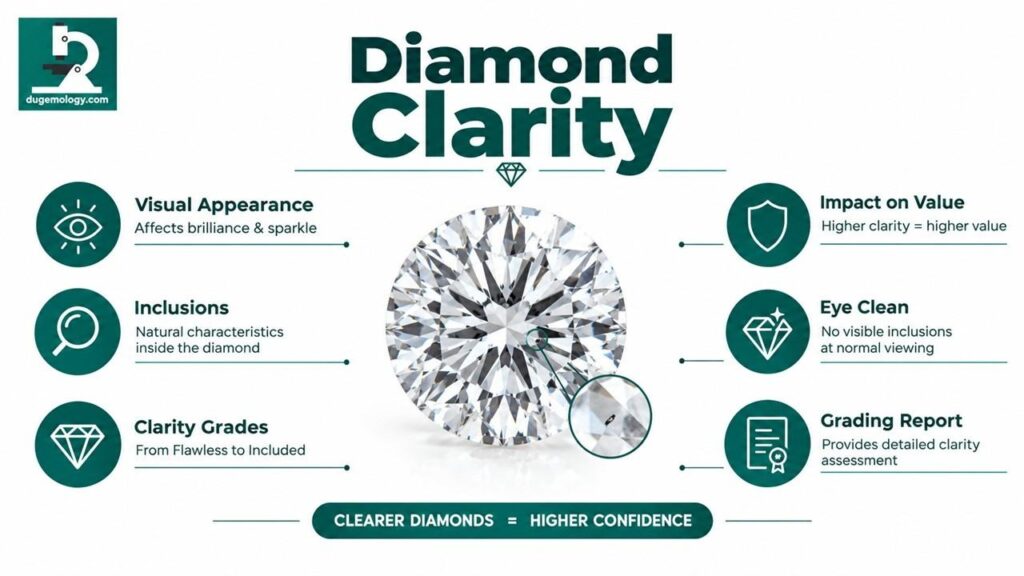
A diamond with fewer and less noticeable inclusions and blemishes generally gets a higher clarity grade. However, a higher clarity grade does not always mean that a diamond will look more beautiful to the naked eye.
Diamond clarity is usually checked under 10× magnification because many inclusions and blemishes are too small to see without magnification. A gemologist examines their size, number, position, and visibility before assigning a clarity grade.
Diamond Clarity Chart
| Clarity Grade | Full Form | General Meaning |
|---|---|---|
| FL | Flawless | No inclusions or blemishes visible under 10× magnification |
| IF | Internally Flawless | No internal inclusions visible under 10× magnification |
| VVS1 | Very, Very Slightly Included 1 | Extremely difficult inclusions to see under 10× magnification |
| VVS2 | Very, Very Slightly Included 2 | Very difficult inclusions to see under 10× magnification |
| VS1 | Very Slightly Included 1 | Minor inclusions that are difficult to see under 10× magnification |
| VS2 | Very Slightly Included 2 | Minor inclusions that are somewhat easier to see under 10× magnification |
| SI1 | Slightly Included 1 | Noticeable inclusions under 10× magnification |
| SI2 | Slightly Included 2 | More noticeable inclusions under 10× magnification |
| I1 | Included 1 | Inclusions may affect appearance and/or durability |
| I2 | Included 2 | More obvious inclusions |
| I3 | Included 3 | Prominent inclusions that can significantly affect appearance and/or durability |
What Are Diamond Inclusions and Blemishes?
When a diamond is checked for clarity, a gemologist looks for small characteristics inside the diamond and on its surface. These are mainly called inclusions and blemishes.
What Are Diamond Inclusions?
Diamond inclusions are characteristics found inside the diamond. Most natural inclusions form when a diamond grows deep inside the Earth. Lab-grown diamonds can also have their own types of internal characteristics.
Some inclusions are so small that they are difficult to see even under magnification. Others may be easier to spot and can affect the diamond’s clarity grade.
What Are Diamond Blemishes?
Diamond blemishes are characteristics found on the surface of the diamond. They can develop during cutting, polishing, and handling.
Common examples include scratches, polish lines, extra facets, and naturals. Their size, number, and visibility can also affect the clarity grade.
Common Types of Diamond Inclusions
Some common inclusions found in diamonds include:
- Crystals: Small mineral crystals trapped inside the diamond.
- Pinpoints: Very tiny dot-like inclusions that can be seen under magnification.
- Clouds: A group of tiny pinpoints close together, which can give an area a hazy appearance.
- Feathers: Internal fractures that may look like a small feather under magnification.
- Needles: Long and thin inclusions that have a needle-like shape.
- Cavities: Small openings or spaces in the diamond that reach the surface.
The effect of an inclusion depends on its type, size, location, and visibility. So, two diamonds with the same clarity grade can still look different.
Common Types of Diamond Blemishes
Some common surface blemishes include:
- Scratches: Fine marks or lines on the diamond’s surface.
- Polish Lines: Fine lines left on the surface during the polishing process.
- Extra Facets: Additional facets that are not part of the diamond’s planned cutting pattern.
- Naturals: Small areas of the original rough diamond surface that remain on the finished diamond.
The easiest way to remember the difference is:
Inclusions are inside the diamond, while blemishes are on the diamond’s surface.
Both are considered when a gemologist determines the diamond’s clarity grade.
How Is Diamond Clarity Graded?
Diamond clarity grading is not simply about counting the number of inclusions. A gemologist looks at the overall effect of the diamond’s internal and surface characteristics before assigning a clarity grade.
Two diamonds can have the same number of inclusions but get different clarity grades because the size, position, type, and visibility of the characteristics may be different.
During clarity grading, a trained gemologist examines the diamond under 10× magnification and considers several important factors.
- Size
The size of an inclusion or blemish can affect its impact on clarity. A larger characteristic is generally easier to see and may have a greater effect on the clarity grade than a very small one.
- Number
The number of inclusions and blemishes is also considered. However, having more inclusions does not automatically mean a lower clarity grade. Their size, position, and visibility also matter.
- Position
Where an inclusion is located inside the diamond can make a big difference. A characteristic close to the center or table area may be easier to notice than one near the edge.
- Nature
Nature refers to the type and characteristics of the inclusion or blemish. For example, a crystal, feather, cloud, or cavity can have a different effect on clarity depending on its individual characteristics.
- Relief
Relief describes how easily an inclusion is found from the surrounding diamond. An inclusion with stronger relief may be easier to see under magnification, while one with low relief may blend more with the diamond.
- Visibility
The final consideration is how easily the characteristic can actually be seen under 10× magnification. A gemologist considers the overall visibility of the inclusions and blemishes rather than looking at each characteristic in isolation.
Why These Factors Matter
These factors are considered together when determining a diamond’s clarity.
For example, two diamonds may have the same number of inclusions but different clarity grades because one diamond may have larger or more visible inclusions, while the other has smaller and less noticeable ones.
In simple terms, diamond clarity grading is an overall assessment of the size, number, position, nature, relief, and visibility of a diamond’s clarity characteristics under 10× magnification.
What Is a Diamond Clarity Plot?
A diamond clarity plot is a diagram on a laboratory report that shows the type and approximate location of inclusions and blemishes in a diamond.
- What Do the Symbols Represent?
Different symbols are used to show characteristics such as crystals, feathers, clouds, needles, and cavities. These symbols are placed on the diagram to show roughly where they are found.
- Why Is It Useful?
A clarity plot gives you a visual idea of the diamond’s clarity characteristics. It can also help match a diamond with its laboratory report.
- Why Read It With the Grading Report?
The plot does not tell you everything about an inclusion, such as its exact size, relief, or visibility. So, it should always be read along with the complete laboratory grading report.
Does Diamond Clarity Affect Appearance?
Higher diamond clarity does not automatically mean a diamond will look more beautiful. What matters is how visible the inclusions are and how they affect the diamond’s overall appearance.
- Eye-clean appearance: Some diamonds with lower clarity grades can look completely clean to the naked eye.
- Visibility of inclusions: Inclusions that are large, dark, or easy to see can have a greater effect on appearance.
- Cut quality: A well-cut diamond can look bright and lively, even if it has a lower clarity grade.
- Inclusion position: An inclusion near the center of the diamond may be easier to notice than one near the edge.
- Diamond size: Inclusions can be easier to see in a larger diamond because there is more surface area to observe.
- Shape: Different diamond shapes can make inclusions more or less noticeable. For example, elongated shapes may show certain inclusions differently than round diamonds.
In simple terms, clarity is important, but the highest clarity grade does not always mean a beautiful diamond. An eye-clean diamond with a good cut can often have a better balance of appearance and value.
How Does Diamond Shape Affect Clarity?
The shape of a diamond can affect how easily its inclusions are seen. Some shapes have more facets and sparkle, which can help hide small inclusions. Others have larger, open facets that can make inclusions easier to notice.
- Round Brilliant: Its sparkle can help hide small inclusions, so finding an eye-clean diamond can be easier.
- Oval: Its brilliant-style facets can also help make small inclusions less noticeable.
- Cushion: The visibility of inclusions depends on its cut style and where the inclusion is located.
- Emerald: Its large, open facets can make inclusions easier to see, so clarity can be more important.
- Asscher: Like the emerald shape, its step-cut facets can make inclusions more noticeable.
- Pear: Its brilliant-style faceting can help hide some small inclusions.
- Marquise: Its faceting can help hide some inclusions, but those near the center may still be noticeable.
In simple terms, the best clarity grade depends partly on the diamond’s shape. A diamond does not always need the highest clarity grade to look clean.
Does Diamond Size Affect Clarity?
Diamond size does not determine its clarity grade. A larger diamond can have the same clarity grade as a smaller diamond. However, inclusions may be easier to notice in a larger diamond because there is more surface area.
For example, a small inclusion that is difficult to notice in a smaller diamond may be easier to spot in a larger stone.
Does Diamond Clarity Affect Price?
Yes, diamond clarity can affect its price, but it is not the only factor.
A diamond with a higher clarity grade usually costs more because it has fewer inclusions and blemishes. High-clarity diamonds are also rarer, which can increase their value.
However, carat weight, cut, color, and shape also affect the price. For example, a well-cut diamond with slightly lower clarity can look brighter and cleaner than a higher-clarity diamond with a poor cut.
Similarly, a larger diamond can cost more even when two diamonds have the same clarity grade. The shape and market demand can also influence the price.
VVS1 vs VVS2 Diamond Clarity
VVS1 and VVS2 are both in the Very, Very Slightly Included (VVS) clarity group. The main difference is how easy the inclusions are to see under 10× magnification.
- VVS1: Inclusions are very difficult to see.
- VVS2: Inclusions are slightly easier to see than in VVS1.
To the naked eye, the difference is usually very hard to notice. Both can look very clean.
The appearance also depends on the size, type, and location of the inclusions and the diamond’s cut. So, it is always better to check the actual diamond rather than looking at the clarity grade alone.
VS1 vs VS2 Diamond Clarity
VS1 and VS2 are both part of the Very Slightly Included (VS) clarity group. The main difference is how easily the inclusions can be seen under 10× magnification.
- VS1: Inclusions are usually harder to see.
- VS2: Inclusions are usually easier to see.
However, the difference may not be obvious to the naked eye. A VS2 diamond can sometimes look just as clean as a VS1 or even a higher-clarity diamond.
The final appearance depends on the size, type, and location of the inclusions, as well as the diamond’s cut. So, it is always better to look at the actual diamond rather than choosing only by the clarity grade.
SI1 vs SI2 Diamond Clarity
SI1 and SI2 are both part of the Slightly Included (SI) clarity category. The main difference is how easily the inclusions can be seen under 10× magnification.
- SI1: Inclusions are generally less noticeable.
- SI2: Inclusions are generally easier to see and may sometimes be visible to the naked eye.
However, the clarity grade alone does not tell the whole story. The size, type, color, and location of an inclusion can make a big difference in how the diamond looks.
A well-chosen SI2 diamond may sometimes look cleaner than an SI1 diamond, depending on the inclusion characteristics. This is why it is important to look at the actual diamond before making a choice.
How to Choose the Right Diamond Clarity
Choosing the right diamond clarity is not just about picking the highest grade. Keep these points in mind:
- Consider Your Budget: Choose a clarity grade that fits your budget without compromising on appearance.
- Consider the Size: Inclusions can be easier to notice in larger diamonds.
- Consider the Shape: Some shapes can hide inclusions better than others.
- Check if It Is Eye-Clean: Make sure inclusions are not easily visible to the naked eye.
- Examine the Inclusions: Look at their size, type, color, and location.
- Check the Laboratory Report: Review the clarity grade and clarity characteristics mentioned in the report.
- Look at All 4Cs: Consider Cut, Color, Clarity, and Carat Weight together before making your decision.
Diamond Clarity and Laboratory Reports
A professional diamond grading report provides important information about a diamond’s quality and characteristics.
It can show:
- Clarity Grade: The diamond’s clarity level, such as VS1, VS2, or SI1.
- Clarity Characteristics: The type of inclusions and blemishes found in the diamond.
- Clarity Plot: A diagram showing the approximate location of clarity characteristics, where applicable.
- 4Cs Information: Details about Cut, Color, Clarity, and Carat Weight.
- Treatments or Disclosures: Any treatments or other important details, where applicable.
Professional diamond grading and identification help confirm what a diamond is and provide you with an understanding of its quality.
Frequently Asked Questions About Diamond Clarity
Q1. What is the best diamond clarity?
Ans:- There is no single best grade. VS or VVS can offer excellent clarity, while some SI diamonds can also be eye-clean.
Q2. Is VS2 a good diamond clarity?
Ans:- Yes. VS2 is a good clarity grade, and many VS2 diamonds can be eye-clean while offering good value.
Q3. Is SI1 diamond clarity good?
Ans:- Yes. SI1 can be a good clarity grade, especially if the diamond is eye-clean and its inclusions are not easily visible.
Q4. Can you see inclusions without magnification?
Ans:- Yes, some inclusions can be visible to the naked eye, especially in lower-clarity diamonds.
Q5. What is the difference between inclusions and blemishes?
Ans:- Inclusions are inside the diamond, while blemishes are found on its surface. Both can affect the diamond’s clarity grade.
Q6. Does higher clarity mean a better diamond?
Ans:- Not always. Higher clarity means fewer inclusions, but a lower-clarity diamond can still look beautiful and eye-clean.
Q7. Which diamond shapes hide inclusions better?
Ans:- Round, Oval, Cushion, Pear, and Marquise shapes can hide small inclusions better because of their faceting and sparkle.
Q8. Do lab-grown diamonds have inclusions?
Ans:- Yes. Lab-grown diamonds can have inclusions and other internal characteristics, just like natural diamonds.
Q9. How does clarity affect diamond price?
Ans:- Higher clarity usually means a higher price because high-clarity diamonds are rarer. However, cut, color, carat weight, and shape also affect the final price.
Q10. What clarity should I choose for an engagement ring?
Ans:- VS clarity is often a practical choice, as many VS diamonds are eye-clean and offer a good balance of appearance and value.
Conclusion
Diamond clarity is important, but the highest clarity grade is not always required. What matters most is how clean the diamond looks to the naked eye and whether its inclusions affect its appearance.
VVS, VS, and SI diamonds can all be good choices. Consider clarity along with cut, color, carat weight, and shape before making a decision.


