
Unlike other metals, diamonds do not have fixed retail prices. The diamond price in India depends on several factors, mainly the 4Cs—carat, cut, colour, and clarity. Other factors such as the diamond’s shape, origin, certification, and current market demand also affect the price.
Table of Contents
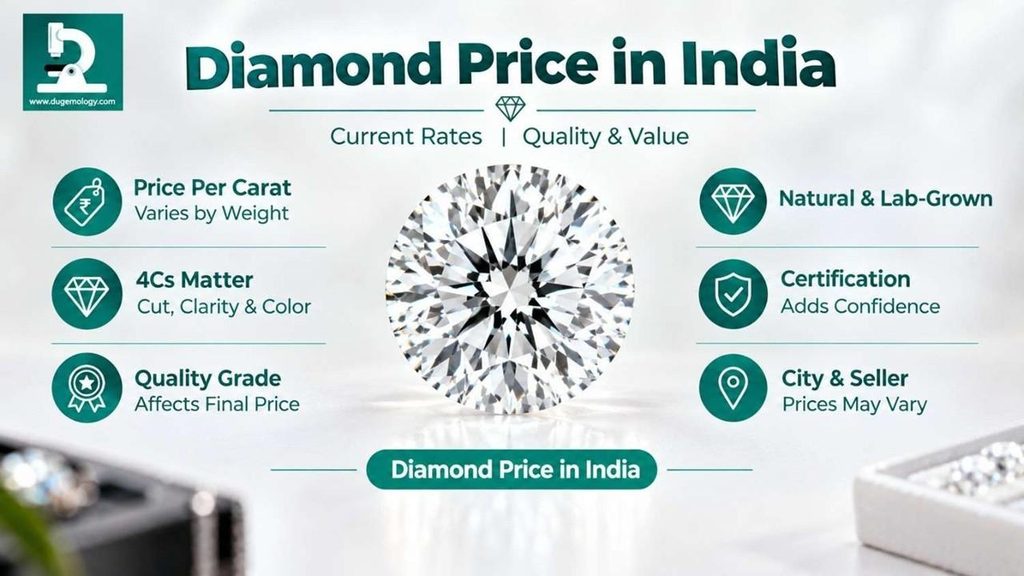
It is also important to understand the difference between diamond price and diamond value. Diamond price is the amount you pay when buying a diamond, including the stone, setting or making charges, and taxes. Diamond value refers to what the diamond is actually worth based on its rarity, quality, appraisal, and how easily it can be sold in the resale market.
Diamond Price in India 2026 at a Glance
Diamond price in India are usually in two ways: price per carat or the total price of the finished diamond jewellery.
The price can vary a lot depending on whether the diamond is natural or lab-grown. Natural diamonds are mined from the earth and are generally more expensive because of their rarity. A standard 1-carat natural diamond may cost around ₹2,00,000 to ₹4,00,000 or more, depending on its quality.
Lab-grown diamonds can look very similar to natural diamonds but are usually much more affordable. They may cost around ₹25,000 to ₹55,000 per carat, depending on their quality and certification.
You may also notice that diamond price charts from different sellers show different rates. This is because the final price depends on several factors, including cut quality, colour, clarity, certification, fluorescence, and the seller’s retail markup.
Diamond Price Per Carat vs Total Diamond Price
For a loose diamond, the basic calculation is:
Total Diamond Price = Carat Weight × Price Per Carat
However, the price per carat is not fixed. Larger diamonds are rarer, so their price per carat usually increases as the size goes up. The same applies when you choose better colour, clarity, or cut grades.
For example, a 2-carat diamond will not necessarily cost just twice as much as a 1-carat diamond of the same quality. Because the per-carat price can increase significantly for larger stones, a 2-carat diamond may cost three or even four times more overall.
What Determines Diamond Price in India?
The price of a diamond in India depends on several factors. The most important ones are the 4Cs—Carat, Cut, Colour, and Clarity. The diamond’s shape, origin, and certification also play an important role.
1. Carat Weight
Carat refers to the weight of a diamond. One carat is equal to 0.2 grams.
Larger diamonds are much rarer than smaller ones, so their price usually increases faster as the carat weight goes up. This means a 2-carat diamond can cost much more than simply twice the price of a 1-carat diamond of similar quality.
2. Cut
Cut describes how well a diamond is cut and how it handles light. A well-cut diamond can look brighter and more sparkly because light is reflected properly through the stone.
The cut is different from the shape. Shape refers to the diamond’s outline, such as round, oval, or pear. Cut looks at factors such as proportions, symmetry, and how effectively the diamond reflects light.
3. Colour
Diamond colour is commonly graded on the GIA D-to-Z scale. It measures how much yellow or brown tint can be seen in a diamond.
- D–F: Colourless
- G–J: Near-colourless
- K–Z: Faint colour
Diamonds with higher colour grades, especially colourless ones, generally cost more. However, the appearance of colour can be less noticeable in smaller diamonds or when the diamond is set in yellow gold.
4. Clarity
Clarity refers to the internal inclusions and surface marks found in a diamond. These are graded from very high clarity to diamonds with more visible inclusions.
The common clarity grades include:
- FL/IF: Very high clarity with no or almost no visible inclusions
- VVS: Very small inclusions that are difficult to see
- VS: Small inclusions, which may still look clean to the eye
- SI: More noticeable inclusions
- I: Inclusions that are generally easier to see
Higher-clarity diamonds usually cost more. However, a diamond does not always need the highest clarity grade to look beautiful. Some eye-clean VS diamonds can offer a good balance between appearance and price.
5. Diamond Shape
The diamond’s shape can also affect its price.
Round Brilliant diamonds are generally more expensive per carat because cutting them requires more of the rough diamond to be removed to achieve the desired shape and proportions.
Other shapes, such as Oval, Princess, Cushion, Emerald, Pear, and Marquise, can often make better use of the rough diamond. As a result, they may cost less per carat than a similar-quality round diamond.
6. Natural or Lab-Grown Diamond
Whether a diamond is natural or lab-grown has a major effect on its price.
Natural diamonds are formed deep inside the Earth over millions or billions of years, making them naturally rare. Lab-grown diamonds are created using advanced technology, mainly CVD or HPHT processes.
Lab-grown diamonds have essentially the same basic chemical and physical properties as natural diamonds, but they are generally much less expensive because they can be produced in controlled environments.
7. Certification
A diamond grading report from a recognized gemological laboratory, such as GIA or IGI, provides important information about the stone.
The report records details such as the diamond’s carat weight, colour, clarity, cut-related characteristics, measurements, and other identifying features. For buyers, certification makes it easier to understand what they are purchasing and compare diamonds from different sellers.
It can also be useful when determining the diamond’s market price and when considering resale.
Diamond Rate: Current Price List by Carat in India
The diamond prices below are approximate market prices for loose diamonds in India. Actual prices can change depending on the diamond’s carat, cut, colour, clarity, shape, certification, fluorescence, brand, and current market conditions.
So, consider these prices as a general guide rather than fixed rates. The final price can be different from one seller to another.
Natural Diamond Price Chart in India 2026
| Carat Weight | Quality / Specification | Approx. Price Range (INR) |
|---|---|---|
| 0.25 ct | G–H / VS–SI | ₹25,000 – ₹40,000 |
| 0.50 ct | F–H / VVS–VS | ₹85,000 – ₹1,20,000 |
| 0.75 ct | F–G / VVS–VS | ₹1,50,000 – ₹2,20,000 |
| 1.00 ct | E–G / VVS–VS | ₹3,00,000 – ₹4,50,000 |
| 1.50 ct | F–G / VVS–VS | ₹7,00,000 – ₹9,50,000 |
| 2.00 ct | E–G / VVS–VS | ₹13,00,000 – ₹17,50,000 |
| 3.00 ct+ | F–G / VVS–VS | ₹32,00,000 – ₹45,00,000+ |
Lab-Grown Diamond Price Chart in India 2026
| Carat Weight | Quality / Specification | Approx. Price Range (INR) |
|---|---|---|
| 0.25 ct | D–F / VVS–VS | ₹5,000 – ₹10,000 |
| 0.50 ct | D–F / VVS–VS | ₹12,000 – ₹22,000 |
| 0.75 ct | D–F / VVS–VS | ₹18,000 – ₹30,000 |
| 1.00 ct | D–F / VVS–VS | ₹25,000 – ₹45,000 |
| 1.50 ct | D–F / VVS–VS | ₹42,000 – ₹70,000 |
| 2.00 ct | D–F / VVS–VS | ₹70,000 – ₹1,20,000 |
| 3.00 ct+ | D–F / VVS–VS | ₹1,75,000 – ₹3,00,000 |
Important: Diamond prices can change frequently. The actual price you pay may be higher or lower than these ranges depending on the exact 4Cs, shape, certification, fluorescence, seller, and market conditions. Always compare the grading report and specifications before buying.
1 Carat Diamond Price in India 2026
A certified 1-carat natural diamond can cost around ₹2,00,000 to ₹6,00,000 or more. A 1-carat lab-grown diamond, on the other hand, is usually much more affordable and may cost around ₹25,000 to ₹45,000.
The main reason for the price difference is the diamond’s quality. Diamonds with D–F colour, VVS clarity, and Excellent cut usually cost more. Diamonds with G–I colour and VS clarity can still look very attractive to the eye while costing less.
The diamond’s shape also affects the price. Round diamonds are generally more expensive than shapes such as oval or emerald. A grading report from a recognized laboratory such as GIA or IGI can also help confirm the diamond’s exact specifications.
Why Two 1-Carat Diamonds Can Have Different Prices
Two diamonds can have exactly the same 1.00-carat weight but still have very different prices. This is because carat weight is only one part of a diamond’s overall quality.
For example:
- Diamond A – Higher Specifications: 1.00 ct, Round, D Colour, VVS1, Triple Excellent — Approx. ₹8,00,000+
- Diamond B – Commercial Specifications: 1.00 ct, Round, H Colour, SI1, Very Good — Approx. ₹2,20,000
So, when comparing 1-carat diamonds, don’t look at carat weight alone. Always check the 4Cs—Carat, Cut, Colour, and Clarity, along with the diamond’s shape and certification.
How Is Diamond Price Calculated in India?
Diamond price is usually calculated as Carat Weight × Price Per Carat. But the price per carat can change depending on the diamond’s 4Cs, size, shape, rarity, certification, origin, and current market demand. Larger diamonds can sometimes cost more per carat because good-quality stones in larger sizes are harder to find. That’s why two diamonds with the same carat weight can still have very different prices.
Certified Diamond Price: Why Certification Matters
A diamond certificate tells you important details about the diamond, such as its carat, cut, colour, and clarity. It helps you compare different diamonds and understand their quality. However, a certificate does not mean every diamond will have the same price—the price still depends on the diamond’s features and market demand. Before buying, always check that the certificate details match the actual diamond.
Loose Diamond Price in India
A loose diamond is a diamond that is sold separately, without being set into jewellery. Its price mainly depends on its carat, cut, colour, clarity, shape, certification, and whether it is natural or lab-grown.
When you buy a loose diamond, you are mainly paying for the diamond itself. This makes it easier to compare different diamonds based on their quality and price.
Natural Diamond vs Lab-Grown Diamond Price in India
Natural and lab-grown diamonds can look very similar, but their prices can be quite different. Natural diamonds are formed inside the Earth over a very long period, so they are generally more expensive because they are naturally rare. Lab-grown diamonds are made in a laboratory using advanced technology and are usually more affordable. The price of both types depends on factors such as carat, cut, colour, clarity, shape, certification, and market demand.
| Factor | Natural Diamond | Lab-Grown Diamond |
|---|---|---|
| Origin | Natural geological formation | Laboratory growth |
| Composition | Carbon | Carbon |
| Physical Diamond Properties | Diamond | Diamond |
| Grading | Graded for characteristics | Graded for characteristics |
| Typical Market Pricing | Generally higher | Generally lower |
| Main Pricing Factors | 4Cs, rarity, market, certification | 4Cs, production, market, certification |
Why Diamond Price Change in India
Diamond price in India can go up or down for many reasons. Global demand, supply, market conditions, currency rates, and the type of diamond all play a role.
Supply and Demand
Diamond prices depend a lot on supply and demand. When more people want diamonds and supply is limited, prices can increase. When supply is higher and demand is lower, prices may fall.
Global Diamond Market Conditions
India is part of the global diamond market, so changes in countries like the US and China can affect prices here. In 2026, the natural diamond market is still facing changes in demand and inventory levels.
Rough and Polished Diamond Market
Rough diamonds are diamonds in their natural, uncut form. They are cut and polished before being used in jewellery.
When the price of rough diamonds changes, it can also affect the price of polished diamonds. In the first half of 2026, rough diamond prices were lower than in the same period of 2025.
Natural Diamond Market
Natural diamond prices have been under pressure due to changing demand, available inventory, and competition from lab-grown diamonds.
However, the price can still vary greatly depending on the diamond’s size, quality, colour, clarity, and other features.
Lab-Grown Diamond Market
Lab-grown diamond prices have generally become lower as production has increased and competition has grown.
This has made lab-grown diamonds more affordable and has also added price pressure to some natural diamond categories.
Currency and Other Market Factors
Currency rates can also affect diamond price in India because diamonds are traded internationally, mainly in US dollars.
Changes in the rupee, gold prices, taxes, import costs, and other expenses can also affect the final price you pay for diamond jewellery.
In simple terms, diamond price in India depend on supply and demand, global market conditions, the type and quality of the diamond, currency rates, and other costs.
Diamond Pricing in Different Indian Cities
Rather than claiming that every city has its own fixed diamond rate, explain why quoted prices can vary between markets and sellers.
Cover examples such as:
- Delhi
- Mumbai
- Surat
- Jaipur
- Kolkata
- Bengaluru
Factors can include:
- Supplier
- Diamond specifications
- Certification
- Retail margins
- Jewellery vs loose diamond
- Business costs
- Market conditions
How to Compare Diamond Prices in India
When comparing diamond prices, make sure you are comparing diamonds with similar quality and features. A cheaper diamond is not always the better option.
Compare Diamonds With Similar Specifications
Look at the carat, shape, 4Cs, polish, symmetry, fluorescence, and certification. Comparing these details will help you understand why two diamonds may have different prices.
Don’t Compare Only Price Per Carat
Price per carat is useful, but it should not be the only thing you check. Two diamonds with the same carat can have different prices because of their cut, clarity, colour, and overall appearance.
Check the Grading Report
Before buying, check the diamond’s grading report. Verify the report number and diamond details on the grading laboratory’s official website and make sure they match the actual diamond.
Frequently Asked Questions About Diamond Price in India
Q1: What is the diamond price in India in 2026?
Ans: Diamond price in India in 2026 vary by the diamond’s 4Cs, carat, shape, certification, and type. A 1-carat natural diamond may cost around ₹2 lakh–₹6 lakh+.
Q2: What is the price of a 1 carat diamond in India?
Ans: A 1-carat diamond in India can cost around ₹2 lakh–₹6 lakh+ for a natural diamond, while a lab-grown diamond is generally much cheaper.
Q3: What is the diamond price per carat in India?
Ans: Diamond prices per carat in India vary by carat, 4Cs, shape, certification, and whether the diamond is natural or lab-grown. Natural diamonds can range from around ₹2 lakh to ₹6 lakh+ per carat.
Q4: Why do diamond prices vary so much?
Ans: Diamond prices vary because of differences in carat, cut, colour, clarity, shape, certification, origin, and market demand.
Q5: How is diamond price calculated?
Ans: Diamond price is generally calculated as Carat Weight × Price Per Carat. The price per carat depends on the diamond’s 4Cs, shape, certification, and market demand.
Q6: Is a certified diamond more expensive?
Ans: Yes, a certified diamond may cost more because the grading report verifies its quality, 4Cs, and authenticity, making it easier to compare and trust.
Q7: Are lab-grown diamonds cheaper than natural diamonds?
Ans: Yes, lab-grown diamonds are generally cheaper than natural diamonds because they can be produced in controlled laboratory environments and are more widely available.
Q8: Does diamond shape affect price?
Ans: Yes, diamond shape affects price. Round diamonds are generally more expensive, while shapes like oval, pear, and emerald can be more affordable.
Q9: Is a loose diamond cheaper than diamond jewellery?
Ans: Usually, yes. A loose diamond costs only for the stone, while diamond jewellery also includes metal, making charges, and taxes.
Q10: Can I determine diamond value from carat weight alone?
Ans: No. Carat weight alone does not determine diamond value; cut, colour, clarity, shape, certification, and market demand also matter.
Conclusion
The diamond price in India depends on more than just carat weight. Factors like the 4Cs, shape, certification, diamond type, market demand, and seller can all affect the price.
Whether you choose a natural or lab-grown diamond, compare diamonds with similar qualities and check the grading report before buying. This will help you understand the price and choose a diamond that fits your budget and needs.


