A diamond necklace is a piece of jewellery with one or more diamonds set in a chain or pendant design, made in yellow gold, white gold, rose gold or platinum. It suits everyday wear, weddings, parties and gifting. The choice depends on four things: the design, the diamond quality, the metal and the price.
Table of Contents
What Is a Diamond Necklace?
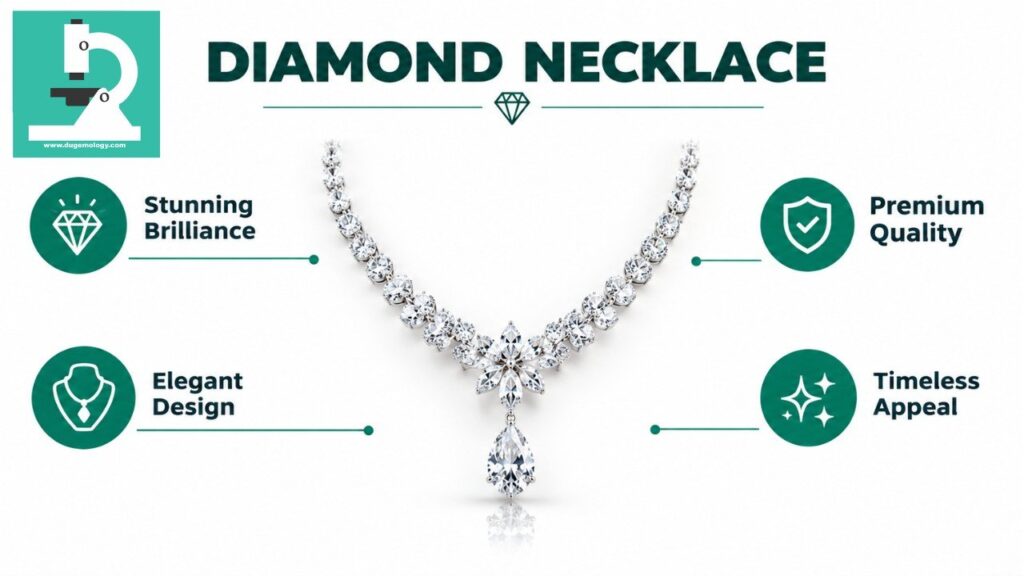
A diamond necklace has one or more diamonds set in a gold or platinum chain or decorative design. Some have a single centre stone. Others have dozens of small diamonds arranged in a row, a cluster or a pattern.
Both natural and lab-grown diamonds are used in necklaces. Both are real diamonds; they differ in origin, and that difference affects price and certification.
Types of Diamond Necklaces
| Type | What It Looks Like | Best For |
|---|---|---|
| Pendant | One diamond or a cluster on a chain. | Daily wear, gifting. |
| Solitaire | One main diamond in a simple setting. | Everyday and formal wear. |
| Tennis | A continuous row of diamonds. | Parties, formal events. |
| Choker | Sits close to the neck. | Weddings, festive wear. |
| Long / Layered | Falls lower, or stacks several chains. | Traditional and western outfits. |
| Bridal | Multiple rows, larger diamonds, detailed patterns. | Weddings. |
| Necklace Set | Necklace with matching earrings. | Weddings, festivals, gifting. |
| Minimalist | Fine chain, small diamonds, geometric shapes. | Lightweight daily wear, layering. |
Diamond Pendant Necklace
A pendant necklace has a diamond or a group of small diamonds hanging from a chain. Solitaire pendants are the most popular version because they work with office wear, casual outfits and formal dress.
Solitaire Diamond Necklace
One main diamond in round, oval, pear, princess or another shape. The look depends on the diamond’s size, cut, setting and metal.
Diamond Tennis Necklace
A row of diamonds set close together for a continuous line of sparkle. Price depends on total diamond weight, the quality of each stone, the metal and the craftsmanship. Because it contains many stones, always ask what the grading report covers.
Diamond Choker Necklace
A choker settled close to the neck, with a row of diamonds or a detailed centre design. It works well with open necklines, sarees, lehengas and gowns.
Long and Layered Diamond Necklace
A long necklace falls lower on the chest; a layered necklace combines two or more chains of different lengths. Both work with traditional and western outfits.
Bridal Diamond Necklace
Bridal necklaces use large diamonds, several rows or detailed patterns. Weight matters here: you may wear it for hours, so check comfort and how securely it sits before you buy.
Diamond Necklace Set
In India, many buyers choose a necklace with matching earrings (and sometimes a ring or bracelet). Sets are common for weddings and gifting. Compare the total diamond weight and metal weight of the whole set, not just the necklace.
Modern and Minimalist Diamond Necklace
Simple chains, small diamonds and geometric designs. They are light, easy to wear daily and easy to layer.
Necklace Length Guide
Length changes how a necklace sits on your neckline and outfit.
| Style | Length (inches) | Length (cm) | Where It Falls | Works With |
|---|---|---|---|---|
| Choker | 14–16 in | 35–40 cm | Close around the neck | Open necklines, sarees, lehengas |
| Princess | 17–19 in | 43–48 cm | Around the collarbone | Most everyday outfits |
| Matinee | 20–24 in | 50–60 cm | Above the bust | Office wear, high necklines |
| Opera | 28–34 in | 70–86 cm | Below the bust | Traditional outfits, layering |
| Rope | 36 in and above | 90 cm and above | Long; can be doubled | Statement and layered looks |
Tip: If you’re unsure, a princess-length (about 18 in) necklace is the most versatile choice. Measure the neck with a soft tape and compare it with the chain length before you buy.
How to Choose the Right Diamond Necklace
1. Match the design to the occasion
A simple pendant suits daily wear. A tennis necklace or choker suits weddings and parties. If you want one necklace for many outfits, pick a design that looks good with both traditional and western clothing.
2. Pick the right metal
Yellow gold looks traditional. White gold and platinum have a lighter colour. Rose gold has a warm pink tone. In India, diamond jewellery is commonly made in 14K and 18K gold.
Check the hallmark. Gold jewellery sold in India carries a BIS hallmark with a 6-character HUID. Look for the purity mark (for example 585 for 14K, 750 for 18K) and ask the jeweller to show the HUID.
3. Consider diamond shape, size and setting
Round, oval, pear, princess and emerald cuts each give a different look. Carat measures weight, not size. Two diamonds of the same carat weight can look different because of their shape and proportions. The setting holds the stone: choose one that looks good and keeps the diamond secure.
4. Check the clasp and chain
A strong clasp and well-made chain matter as much as the diamond. A weak clasp is the most common reason a necklace is lost.
Diamond Quality: The 4Cs in Brief
The 4Cs describe a diamond’s quality:
- Cut: how well the diamond reflects light. It drives brightness and sparkle.
- Color: how much body colour a colourless diamond shows, on the D-to-Z scale. D is the most colourless.
- Clarity: the internal inclusions and external blemishes, graded from Flawless to Included.
- Carat: weight. One carat is 200 milligrams.
No single C decides quality. A bigger diamond is not automatically better, and a high clarity grade does not guarantee the best sparkle.
Diamond Certification: What to Ask Before You Buy
A grading report records a diamond’s carat weight, colour, clarity, measurements and other details.
Important for necklaces: A necklace may contain many small diamonds (called melee). These are usually not individually certified. A report may cover only the centre stone or selected stones, not the whole piece.
Five-step report check
- Check the laboratory that issued the report.
- Verify the report number on the laboratory’s official website.
- Compare the details: carat weight, colour, clarity and measurements against what the jeweller tells you.
- Check the laser inscription, if the report mentions one, under magnification.
- Confirm natural or lab-grown origin on the report.
Also ask which stones the report covers, and get the answer in writing on the invoice.
A grading report describes the diamond. It does not guarantee a resale price.
Natural vs. Lab-Grown Diamond Necklaces
Natural and lab-grown diamonds have essentially the same chemical composition and crystal structure. The difference is how they form. Natural diamonds form deep in the Earth over a very long time. Lab-grown diamonds are created in a laboratory by CVD (Chemical Vapour Deposition) or HPHT (High Pressure High Temperature) methods.
| Feature | Natural | Lab-grown |
|---|---|---|
| Origin | Formed inside the Earth | Created in a laboratory |
| Material | Diamond | Diamond |
| Appearance | Depends on cut and quality | Depends on cut and quality |
| Price | Usually higher | Usually lower for comparable quality |
| Identification | Needs professional testing | Needs professional testing |
Choose by budget and preference, and make sure the invoice and report clearly say which type you are buying. A visual check or a basic diamond tester cannot reliably separate natural from lab-grown, so use a gemological laboratory if you need to confirm origin.
Diamond Necklace Price in India
The price of a diamond necklace depends on the quality and weight of the diamonds, as well as their origin. Lab-grown diamonds usually cost less than similar natural diamonds. The type of metal, such as 14K or 18K gold or platinum, also affects the price. Necklaces with detailed designs or multiple rows of diamonds may have higher making charges. Before buying, check the current metal rate and ask for a clear breakdown of the diamond cost, metal cost, making charges, and applicable taxes on the bill.
Compare like with like
When two necklaces have different prices, compare these five items: diamond origin, diamond quality details, total diamond weight, net metal weight and purity, and making charges.
Prices don’t rise in a fixed line with carat weight. Larger diamonds cost more, especially with good colour, clarity and cut, but the jump between sizes is not uniform.
Is a diamond necklace a good investment?
Treat it mainly as jewellery you will wear, rather than a guaranteed investment. Resale value is generally lower than the purchase price because retail pricing includes making charges and margin. Ask the jeweller about buyback and exchange terms before you buy, and get them in writing. This is general information, not financial advice.
How to Check the Quality of a Diamond Necklace
- Inspect the setting. Look for loose stones, uneven prongs, damaged links or sharp edges. Check the whole necklace, not only the centre stone.
- Test the clasp. It should close firmly and feel secure.
- Read the report and invoice. Match the details to the piece. Confirm which stones the report covers.
- Confirm what the stones are. Cubic zirconia and moissanite are different materials that can look like diamond. If you need to be sure of identity or origin, have the necklace tested.
Get your necklace tested at DU Gemology
Diamond Necklaces for Every Occasion
Everyday wear
Choose a lightweight pendant or simple chain with a secure clasp and a low setting that doesn’t catch on clothes.
Weddings and bridal wear
Chokers, layered necklaces and statement designs are popular. Match the necklace to the neckline, colour and embroidery of your saree or lehenga, and check comfort for long hours.
Parties and special occasions
Tennis necklaces, solitaire pendants and modern designs work well. With a statement necklace, choose simpler earrings to keep the look balanced.
Sarees, lehengas and western dresses
For sarees and lehengas, chokers, layered necklaces and traditional diamond designs suit well. For western dresses, solitaire pendants, tennis necklaces and minimalist designs are popular. Always consider the neckline first.
Gifting
For anniversaries, birthdays and festivals, a solitaire pendant or a lightweight necklace set is a safe choice. Keep the invoice and report, and check the exchange policy.
How to Care for a Diamond Necklace
- Cleaning: Soak in lukewarm water with a few drops of mild dish soap, brush gently with a soft brush, rinse and dry with a soft cloth. Check the maker’s care instructions first, especially if the piece includes other gemstones, pearls or delicate settings. Avoid harsh chemicals, and use an ultrasonic cleaner only if the piece is suitable.
- Storage: Keep it in a soft pouch or separate compartment to avoid scratches and tangles.
Regular checks: Inspect the clasp, links and settings regularly, especially if you wear it daily. If a stone feels loose or the clasp is damaged, stop wearing the necklace until a jeweller checks it.
Frequently Asked Questions
Q1. Which diamond necklace is best for everyday wear?
Ans:- A lightweight solitaire pendant or a simple chain with a secure setting. Choose a princess-length chain (about 17–19 inches) and a reliable clasp.
Q2. What is the difference between a diamond pendant and a diamond necklace?
Ans:- A pendant is the decorative piece hanging from a chain. A necklace is the whole piece, which may include a pendant or have diamonds set along the chain itself.
Q3. Are lab-grown diamond necklaces real diamonds?
Ans:- Yes. They have essentially the same chemical composition and crystal structure as natural diamonds. They are created in a laboratory, not mined.
Q4. How can I check whether a diamond necklace is genuine?
Ans:- Check the grading report, hallmark and invoice. Verify the report number on the issuing lab’s website. For identity or origin, get it tested at a gemological laboratory.
Q5. Does one grading report cover the whole necklace?
Ans:- Not always. Reports often cover the centre stone or selected stones only. Small stones in a necklace are usually not individually certified. Ask in writing which stones are covered.
Q6. Which diamond necklace is best for bridal wear?
Ans:- Chokers, layered necklaces and statement designs are popular. Choose one that matches your outfit, feels comfortable for long hours and fits your budget.
Q7. What is the best necklace length for everyday use?
Ans:- Princess length (17–19 inches), which sits near the collarbone, is the most versatile for many people.
Q8. How can I verify a diamond grading report?
Ans:- Use the issuing lab’s official online verification, compare the report number and details with the piece, and confirm which stones it covers.
Q9. What is a diamond necklace set?
Ans:- A necklace sold with matching earrings, and sometimes a ring or bracelet. Compare total diamond weight and metal weight for the whole set.
Q10. Is a diamond necklace a good investment?
Ans:- It is best bought as jewellery to wear. Resale value is generally below the purchase price, so check buyback and exchange terms before you buy.
Conclusion
Choosing a diamond necklace is easier when you separate the decisions: design and length first, then metal and hallmark, then diamond quality and the grading report, then price. Compare necklaces like for like, get the details in writing, and check which stones a report covers.
If you’re unsure whether the stones in a necklace are natural, lab-grown or simulated, have them tested by a qualified gemological laboratory.