
An HPHT diamond is a diamond developed within High Pressure High Temperature (HPHT) technology. HPHT is used to grow lab grown diamonds and can also be used to treat certain diamonds to change their appearance. In this guide, we’ll explain what an HPHT diamond is, how it is made, how it differs from natural and CVD diamonds, and how it is graded and identified.
Table of Contents
What Is an HPHT Diamond
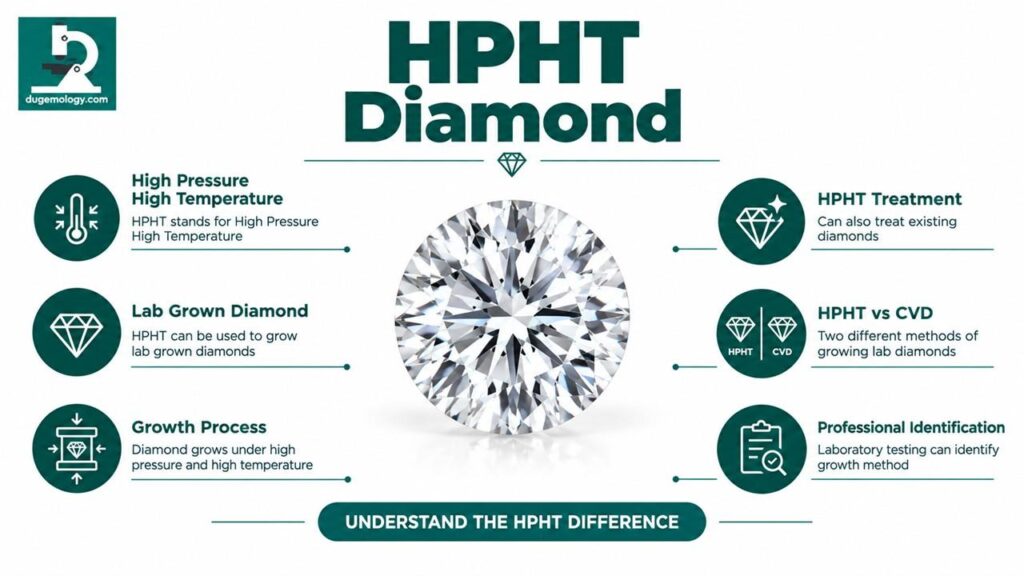
HPHT stands for High Pressure High Temperature. The term HPHT diamond can mean two different things. It can refer to a lab grown diamond made using the HPHT method or a diamond that has been treated using high pressure and high temperature.
An HPHT lab grown diamond is grown in a laboratory from a small diamond seed. An HPHT-treated diamond, on the other hand, is an existing diamond that is treated to change or improve its color.
So, when you hear “HPHT diamond,” it is important to know whether the diamond is HPHT grown or HPHT treated.
What Is the Main Difference?
The main difference is how HPHT is used:
- HPHT diamond: HPHT is used to grow the diamond.
- HPHT-treated diamond: HPHT is used to treat an existing diamond.
So, an HPHT-grown diamond and an HPHT-treated diamond are two different things. A proper laboratory report can help identify the diamond.
Are HPHT Diamonds Real Diamonds?
Yes, HPHT lab grown diamonds are real diamonds. They have the same basic carbon structure as natural diamonds and share many of the same properties.
Lab grown does not mean fake or imitation. The main difference is how they are formed—HPHT diamonds are grown in a laboratory, while natural diamonds form deep inside the Earth.
What Is the HPHT Diamond Process?
The HPHT process is a method used to grow lab grown diamonds. It uses very high pressure and high temperature to create conditions similar to those in which natural diamonds form.
How Are HPHT Diamonds Grown?
The process is simple:
- Diamond seed: A small diamond seed is placed in a special chamber.
- Carbon source: A carbon material is added around the seed.
- High pressure: Very high pressure is applied.
- High temperature: The temperature is increased to help the diamond grow.
- Crystal growth: Carbon gradually forms around the seed and creates a rough diamond.
- Cutting and polishing: The rough diamond is cut and polished to give it its final shape and appearance.
| HPHT Lab Grown Diamond | HPHT-Treated Diamond |
|---|---|
| Grown in a laboratory | Existing diamond is treated |
| HPHT is the growth method | HPHT is the treatment process |
| Not formed naturally | Can be a natural diamond |
| Created from a diamond seed | Starts with an existing diamond |
HPHT Diamond vs Natural Diamond
| Feature | HPHT Lab Grown Diamond | Natural Diamond |
|---|---|---|
| Origin | Laboratory | Natural geological formation |
| Main Composition | Carbon | Carbon |
| Crystal Structure | Diamond | Diamond |
| Formation | HPHT technology | Natural geological processes |
| Identification | Professional testing | Professional testing |
How Is HPHT Treatment Used on Diamonds?
HPHT treatment is used on some existing diamonds to change their color. The diamond is treated with high pressure and high temperature, which can change its color and appearance.
What Is HPHT Color Treatment?
HPHT color treatment is a process used to change the color of a diamond. The result can vary depending on the diamond and its original characteristics.
It is important to remember that HPHT treatment is different from HPHT diamond growth. In HPHT treatment, the diamond already exists before the treatment.
HPHT Diamond vs CVD Diamond
HPHT and CVD are two different ways of growing lab grown diamonds. Both methods produce real diamonds, but the growing process is different.
HPHT vs CVD Diamond Growth Process
HPHT is used for High Pressure High Temperature. In this method, a diamond seed and carbon source are placed under high pressure and high temperature.
CVD stands for Chemical Vapor Deposition. In this method, a diamond seed is placed inside a chamber with carbon-containing gases. The gases are activated, and carbon slowly builds up on the seed to form a diamond.
HPHT vs CVD Diamond Appearance
Both HPHT and CVD diamonds can look very similar. Both can have different shapes, colors, clarities and carat weights. The appearance of a diamond depends mainly on its cut, color, clarity and carat weight, not simply on whether it was grown using HPHT or CVD.
How Are HPHT and CVD Diamonds Identified?
You generally cannot tell whether a diamond is HPHT or CVD just by looking at it. Special laboratory testing is needed for reliable identification.
Laboratories examine features such as growth patterns and internal characteristics to determine whether the diamond was grown using HPHT or CVD.
What Are the Properties of HPHT Diamonds?
An HPHT lab grown diamond is made of carbon, just like a natural diamond. It has the same basic diamond structure and many of the same physical properties. The main difference is how it is formed.
- Chemical Composition
Diamond is mainly made of carbon. HPHT lab grown diamonds are also made mainly of carbon. Small amounts of other elements may be present and can affect the diamond’s color and other characteristics.
- Crystal Structure
In a diamond, carbon atoms are arranged in a stable crystal structure. This structure is responsible for many of the properties that make diamonds unique.
- Hardness
Diamond is one of the hardest natural materials. HPHT lab grown diamonds also have the diamond crystal structure, so they are also very hard and can be used in jewellery.
- Optical Properties
HPHT diamonds can show the brightness, fire and sparkle we normally associate with diamonds. Their appearance depends on factors such as cut, color and clarity.
- Thermal Properties
Diamond is also an excellent conductor of heat. HPHT lab grown diamonds have this property as well, which is useful when identifying diamond materials.
Overall, HPHT lab grown diamonds have many of the same properties as natural diamonds. The main difference is their origin: HPHT diamonds are grown in a laboratory, while natural diamonds form naturally inside the Earth.
HPHT Diamonds and the 4Cs
The 4Cs—Color, Clarity, Cut and Carat Weight—describe the quality of a diamond. HPHT is different. It tells us how a lab grown diamond was made or, in some cases, whether an existing diamond has been treated using HPHT.
- HPHT Diamond Color
Color describes how much color a diamond shows. HPHT lab grown diamonds can have different color grades.
The color can affect the diamond’s appearance and may also affect its value.
- HPHT Diamond Clarity
Clarity refers to the small internal or surface features found in a diamond.
HPHT lab grown diamonds can have different clarity grades depending on the features formed during the growth process.
- HPHT Diamond Cut
Cut describes how well a diamond has been cut and polished. A good cut helps the diamond reflect light and show more brightness, fire and sparkle. An HPHT diamond can have different cuts and shapes.
- HPHT Diamond Carat Weight
Carat weight tells us how much a diamond weighs. It does not directly tell us how large the diamond looks.
HPHT diamonds can be grown in different carat weights, and their carat weight is considered along with the other 4Cs.
HPHT and the 4Cs Are Different
The main thing to remember is that the 4Cs describe diamond quality, while HPHT describes the diamond’s origin or treatment.
So, an HPHT diamond can have its own Color, Clarity, Cut and Carat Weight grades.
How to Identify an HPHT Diamond
It is not always easy to tell whether a diamond is HPHT grown just by looking at it. HPHT, CVD and natural diamonds can look very similar to the naked eye.
To identify the growth method with confidence, professional laboratory testing is usually required.
How Laboratories Identify HPHT Diamonds
Gemological laboratories use different tests and instruments to identify HPHT diamonds. These may include:
- Microscopic examination: Experts look for specific internal features.
- Growth characteristics: Certain features can help show how the diamond was grown.
- Spectroscopic testing: This helps examine the diamond’s internal characteristics and composition.
- Specialized instruments: Advanced gemological equipment is used for more detailed testing.
If you need to know whether a diamond is HPHT, CVD or natural, professional laboratory testing is the most reliable option.
Does an HPHT Diamond Have a Certificate?
An HPHT diamond can have a laboratory report that gives important details about the diamond. The report helps you understand its quality and, where applicable, whether it is lab grown or has been treated.
A laboratory report is not the same as a price or valuation certificate. It mainly provides information about the diamond based on professional testing.
What Information Does an HPHT Diamond Report Include?
The details can vary between laboratories, but a report may include:
- Carat weight: How much the diamond weighs.
- Color: The diamond’s color grade.
- Clarity: The clarity grade based on its internal and surface features.
- Cut: Information about the cut grade, where applicable.
- Measurements: The diamond’s length, width and depth.
- Laboratory-grown disclosure: The report may state that the diamond is lab grown and may mention its growth method.
- Treatment information: If the diamond has been treated, this may also be mentioned in the report.
A laboratory report helps provide a clearer picture of the diamond’s characteristics and origin before buying or selling it.
HPHT Diamond Price: What Affects the Cost?
The price of an HPHT diamond depends from one diamond to another. There is no single fixed price because many factors affect the cost.
The 4Cs, diamond shape, grading report, market conditions and seller can all has an important role in the final price.
Does an HPHT Diamond Cost Less Than a Natural Diamond?
An HPHT lab grown diamond can cost less than a similar natural diamond. However, the price difference is not always the same.
It can depend on the diamond’s carat weight, color, clarity, cut, grading report and current market conditions.
What Factors Affect HPHT Diamond Price?
Some of the main factors are:
- Carat weight: The weight of the diamond can affect its price.
- Color: Different color grades can have different prices.
- Clarity: Clarity grade can also affect the cost.
- Cut: A well-cut diamond may be priced differently based on its cut quality.
- Shape: Different shapes can have different prices.
- Grading report: A laboratory report provides important details about the diamond and its characteristics.
- Market conditions: HPHT diamond prices can change as the lab grown diamond market changes.
- Retailer or source: Different sellers may have different prices based on their sourcing and pricing.
So, when comparing HPHT diamond prices, it is better to compare diamonds with similar 4Cs and other characteristics rather than looking only at carat weight.
What Are the Advantages of HPHT Diamonds?
- Laboratory-Controlled Production
HPHT diamonds are grown in a controlled laboratory. High pressure and high temperature are used to create conditions that help a diamond grow.
The growth process can be monitored and controlled during production.
- Different Size and Quality Options
HPHT diamonds are available in different sizes and quality levels. You can find diamonds with different carat weights, colors, clarity grades, shapes and cuts.
This gives buyers more choices based on their preferences and budget.
- Availability of Different Colors
HPHT diamonds can be available in different colors depending on how they are grown and their characteristics.
Color can affect both the appearance and value of a diamond.
- Can Be Professionally Graded and Identified
HPHT diamonds can be tested and graded by gemological laboratories. A laboratory report can provide details such as carat weight, color, clarity and cut.
Specialized laboratory testing can also help determine whether a diamond is HPHT grown, CVD grown or natural.
Overall, HPHT diamonds offer controlled production, different choices in size and quality, and professional grading and identification.
Are HPHT Diamonds a Good Choice?
Whether an HPHT diamond is a good choice depends on what you are looking for in a diamond. There is no single answer that fits for everyone.
Before buying, consider the following factors:
- Budget
If you are comparing a lab grown diamond with a natural diamond, price can be an important factor. An HPHT lab grown diamond may provide you a different price point than a similar natural diamond.
- Preference for Natural or Lab Grown
Some buyers prefer natural diamonds because of their geological origin, while others prefer lab grown diamonds because they are made in a controlled laboratory process with affordable prices.
- Desired Size
If size is important to you, compare diamonds based on carat weight, measurements and overall appearance rather than carat weight alone.
- 4Cs
Always consider the Color, Clarity, Cut and Carat Weight. These factors have a major impact on a diamond’s appearance and value.
- Certification
A laboratory report can provide important information about the diamond’s characteristics and origin. It can also help confirm whether the diamond is lab grown and, where applicable, whether it was grown using the HPHT method.
Frequently Asked Questions About HPHT Diamonds
Q1. What does HPHT stand for in diamonds?
Ans:- HPHT stands for High Pressure High Temperature. In the diamond industry, HPHT can refer to a method used to grow lab grown diamonds or a treatment used to change the color of an existing diamond.
Q2. Are HPHT diamonds real?
Ans:- Yes, HPHT lab grown diamonds are real diamonds with the same basic crystal structure as natural diamonds. The main difference is that they are grown in a laboratory.
Q3. Are HPHT diamonds natural?
Ans:- No, HPHT lab grown diamonds are not natural diamonds. They are grown in a laboratory using the High Pressure High Temperature method.
Q4. What is the difference between HPHT and CVD diamonds?
Ans:- HPHT and CVD are two different methods used to grow lab grown diamonds. HPHT uses high pressure and high temperature, while CVD grows diamonds layer by layer using carbon-containing gases.
Q5. Can HPHT diamonds be identified?
Ans:- Yes, HPHT diamonds can be identified through professional laboratory testing. Specialized equipment can help determine whether a diamond is HPHT grown, CVD grown or natural.
Q6. Are HPHT diamonds cheaper than natural diamonds?
Ans:- Yes, HPHT diamonds can be identified through professional laboratory testing. Specialized equipment can help determine whether a diamond is HPHT grown, CVD grown or natural.
Q7. Can natural diamonds be HPHT treated?
Ans:- Yes, some natural diamonds can be HPHT treated to change or improve their color. This is different from using HPHT to grow a lab grown diamond.
Q8. Does an HPHT diamond need a laboratory report?
Ans:- A laboratory report is recommended because it provides important information about the diamond’s quality, origin and growth method.
Q9. How Long Does It Take to Grow an HPHT Diamond?
Ans:- The time can vary depending on the diamond’s size, equipment, and growing conditions. Larger diamonds usually take longer to grow.
Q10. Can You Identify an HPHT Diamond by Looking at It?
Ans:- In most cases, you cannot reliably identify an HPHT diamond by looking at it. Its appearance can be very similar to other diamonds.
Conclusion
HPHT diamond can mean two different things in the diamond industry. It can be used to grow a lab grown diamond or to treat an existing diamond (HPHT-treated diamond). Knowing the difference, along with checking the 4Cs and laboratory report, can help you understand the diamond better and make a more informed choice.


