
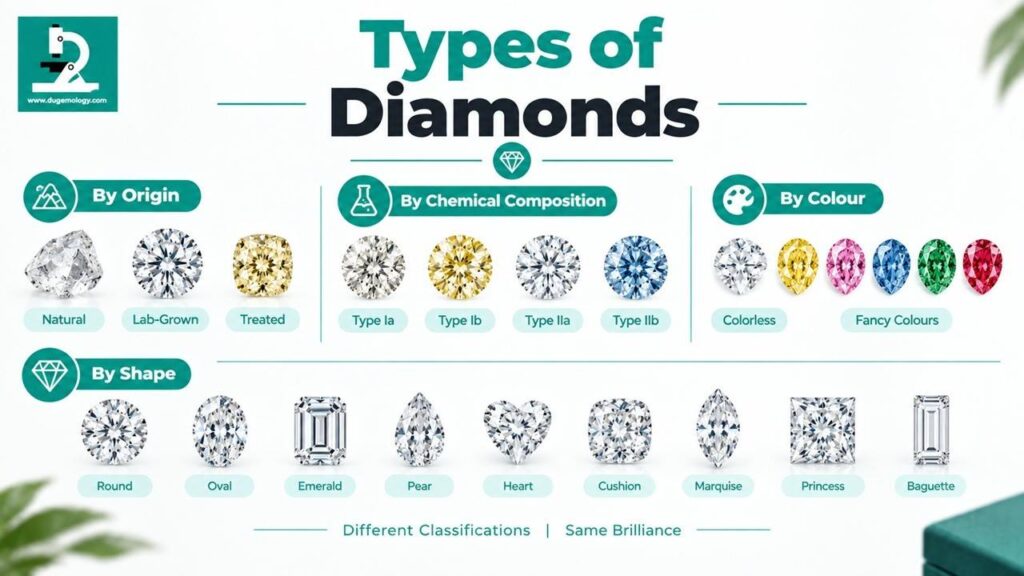
Diamonds can be classified in several ways based on their characteristics. The types of diamonds can be grouped by their origin, chemical composition, color, shape, cut, clarity, and treatment. Understanding these classifications makes it easier to see how different diamonds vary in their appearance, properties, and other important features.
Table of Contents
Types of Diamonds Based on Origin
Natural Diamonds
Natural diamonds are formed deep in the Earth under very high pressure and temperature. This process takes millions or even billions of years. Natural diamonds are made of carbon and can have different colors, clarity levels, inclusions, and other features.
Lab-Grown Diamonds
Lab-grown diamonds are real diamonds made in a laboratory using advanced technology. They have the same basic chemical and physical properties as natural diamonds, but they are created in a controlled environment instead of forming naturally inside the Earth.
The two main methods used to make lab-grown diamonds are CVD (Chemical Vapor Deposition) and HPHT (High Pressure High Temperature). CVD diamonds are grown using carbon-rich gases, while HPHT diamonds are made using high pressure and high temperature.
Treated Diamonds
Treated diamonds are diamonds that have been processed to change or improve certain features, such as their color or clarity. Different treatments can change how a diamond looks and may affect its value and other characteristics.
This is why treatment should be clearly disclosed when a diamond is sold. A reliable diamond report can help you understand whether a diamond has been treated.
Diamond vs Lab-Grown Diamond vs Simulant
| Feature | Natural Diamond | Lab-Grown Diamond | Diamond Simulant |
|---|---|---|---|
| Origin | Natural | Laboratory | Different material |
| Is it diamond? | Yes | Yes | No |
| Chemical Composition | Carbon | Carbon | Depends on material |
| Common Examples | Natural diamond | CVD, HPHT | Moissanite, CZ |
| Identification | Laboratory methods may be needed | Laboratory methods may be needed | Usually distinguishable through testing |
Types of Diamonds Based on Chemical Composition
Diamonds can also be classified based on their chemical composition. One important factor in this classification is the presence of nitrogen and boron inside the diamond’s crystal structure. These elements can affect a diamond’s color and other properties.
Based on this composition, diamonds are mainly divided into four types: Type Ia, Type Ib, Type IIa, and Type IIb.
Type Ia Diamonds
Type Ia diamonds are the most common type of natural diamond. They contain nitrogen atoms that are grouped together in the crystal structure. This nitrogen can give the diamond a slight yellow or brownish color.
Type Ib Diamonds
Type Ib diamonds contain nitrogen atoms that are more spread out in the crystal structure. This can give the diamond a stronger yellow, orange, or brown color. Type Ib diamonds are less common in natural diamonds but can also occur in some lab-grown diamonds.
Type IIa Diamonds
Type IIa diamonds contain very little or almost no measurable nitrogen or boron. They are known for their high level of chemical purity and can appear very clear and colorless. Both natural and lab-grown diamonds can be Type IIa.
Type IIb Diamonds
Type IIb diamonds contain boron in their crystal structure. Boron can give these diamonds a blue or grayish-blue color and can also make them electrically conductive. Natural Type IIb diamonds are rare.
In simple terms, nitrogen plays an important role in distinguishing Type I diamonds, while Type II diamonds have little or no measurable nitrogen. Boron is a key feature of Type IIb diamonds.
Types of Diamonds Based on Colour
Diamonds can also be classified by their color. Most diamonds used in jewelry are valued for having little or no visible color. However, some diamonds naturally occur in beautiful colors such as yellow, pink, blue, green, and red. These are called fancy color diamonds and can be very rare.
Colorless Diamonds
Colorless diamonds have little or no noticeable body color and usually look clear or white. They are commonly graded on the D to Z color scale. D is the highest grade on this scale, while lower grades show a more noticeable yellow or brown tint.
Fancy Color Diamonds
Fancy color diamonds have a noticeable color that falls outside the usual D-to-Z range. They can occur in different colors, and their appearance depends on the strength and intensity of the color.
Their value can also be influenced by factors such as color, intensity, size, clarity, and rarity.
Common Fancy Color Diamonds
- Yellow Diamonds: Their yellow color is often related to nitrogen in the diamond.
- Pink Diamonds: Natural pink diamonds are rare, and their color is mainly related to changes in the crystal structure.
- Blue Diamonds: Their blue color is commonly associated with boron in the diamond.
- Green Diamonds: Their green color can develop due to natural radiation.
- Brown Diamonds: Brown diamonds are relatively common, and their color is generally linked to changes in the crystal structure.
- Red Diamonds: Natural red diamonds are extremely rare, and their color is mainly related to changes in the crystal structure.
Types of Diamonds Based on Shape
When discussing different types of diamonds, people often refer to the shape of the stone. Technically, shape and type are not the same thing. Diamond shape means the outline of the stone when viewed from the top.
However, shape is one of the easiest ways for buyers to compare different diamonds.
Round Diamond
A round diamond has a classic circular shape and is one of the most popular diamond shapes. Its balanced and symmetrical design can give the diamond a lot of sparkle when it is well cut.
Princess-Cut Diamond
A princess-cut diamond usually has a square shape with sharp corners. Its faceting gives it good sparkle and makes it a popular choice for modern jewelry.
Cushion-Cut Diamond
A cushion-cut diamond has a square or rectangular shape with rounded corners. It has a classic look and can have larger facets that give the stone a distinctive appearance.
Oval Diamond
An oval diamond has a long, rounded shape. Its elongated outline can make the diamond look larger and gives jewelry a simple and elegant look.
Emerald-Cut Diamond
An emerald-cut diamond usually has a rectangular shape with cut corners. Its long, step-like facets give it a clean appearance rather than the intense sparkle of a brilliant-style diamond.
Pear-Shaped Diamond
A pear-shaped diamond has a rounded end and a pointed tip, giving it a teardrop-like shape. Its unique outline makes it a popular choice for jewelry designs.
Marquise Diamond
A marquise diamond has a long, narrow shape with pointed ends. Its elongated shape can make the diamond appear larger and gives rings a graceful look.
Radiant-Cut Diamond
A radiant-cut diamond usually has a square or rectangular shape with cut corners. It has brilliant-style facets that can give the diamond plenty of sparkle.
Asscher-Cut Diamond
An Asscher-cut diamond has a square shape with cut corners and step-like facets. Its geometric design gives it a clean and distinctive look.
Heart-Shaped Diamond
A heart-shaped diamond has a heart outline with a pointed bottom. Because of its unique shape, it is often used in jewelry with a romantic design.
Types of Diamonds Based on Cut
Shape and cut are not the same thing. Shape means the outline of a diamond when viewed from the top, while cut refers to how the diamond is proportioned, faceted, and polished.
The cut affects how the diamond reflects light and how much sparkle it shows.
Brilliant Cut
A brilliant cut has many facets arranged to reflect light and create good sparkle. The round brilliant cut is the best-known example. Brilliant-style faceting is also used in other diamond shapes.
Step Cut
A step cut has long, straight facets arranged like a set of steps. Emerald-cut and Asscher-cut diamonds are common examples.
They usually have a clean, open look with bright flashes of light rather than the strong sparkle of a brilliant cut.
Mixed Cut
A mixed cut combines features of brilliant and step cuts. It is designed to give the diamond both good sparkle and a distinctive appearance. The radiant cut is a common example of a mixed-cut diamond.
Types of Diamonds Based on Clarity
Diamond clarity tells us how many inclusions and blemishes a diamond has and how easy they are to see. These grades are not different types of diamonds; they are clarity classifications used to describe the diamond.
The clarity scale ranges from FL (Flawless) to I3, with fewer and less visible inclusions toward the top of the scale.
- FL (Flawless): No inclusions or blemishes are visible under 10× magnification.
- IF (Internally Flawless): No inclusions are visible under 10× magnification, though small surface marks may be present.
- VVS1: Inclusions are extremely difficult to see under 10× magnification.
- VVS2: Inclusions are very difficult to see under 10× magnification.
- VS1: Inclusions are difficult to see under 10× magnification.
- VS2: Inclusions are slightly easier to see under 10× magnification.
- SI1: Inclusions are noticeable under 10× magnification and may sometimes be visible to the naked eye.
- SI2: Inclusions are easier to see and may be visible without magnification.
- I1: Inclusions are obvious and may affect the diamond’s appearance.
- I2: Inclusions are more noticeable and can have a greater effect on appearance and durability.
- I3: Inclusions are very obvious and can significantly affect appearance and durability.
In simple terms, FL and IF represent the highest clarity levels, while I1, I2, and I3 have more visible inclusions. Clarity is one of the important factors used to describe a diamond, along with cut, color, and carat weight.
How Are Different Types of Diamonds Identified?
Different types of diamonds can be identified using visual examination, a loupe, a microscope, and diamond testing instruments. Gemologists may also use spectroscopy, fluorescence, and phosphorescence to learn more about a diamond.
For a more detailed check, advanced laboratory testing may be needed to find out whether a diamond is natural, lab-grown, or treated. A grading or identification report can record these findings.
Since different diamonds can look very similar, simply looking at a diamond is not always enough to confirm its origin or treatment.
How to Choose the Right Type of Diamond?
Choosing the right diamond depends on what you like, how you plan to use it, and your budget. First, decide whether you want a natural or lab-grown diamond. Then look at its shape, cut, color, clarity, and carat weight.
It is also important to check if the diamond has been treated and whether it comes with a reliable grading or identification report. Considering all these factors can help you find a diamond that suits your needs and budget.
Frequently Asked Questions About Types of Diamonds
Q1. What are the main types of diamonds?
Ans:- The main types of diamonds can be classified by origin, chemical composition, color, shape, cut, and clarity. Common categories include natural, lab-grown, treated, colorless, and fancy color diamonds.
Q2. What is the difference between natural and lab-grown diamonds?
Ans:- Natural diamonds form inside the Earth, while lab-grown diamonds are created in laboratories. Both are real diamonds with the same basic chemical composition.
Q3. What are Type I and Type II diamonds?
Ans:- Type I diamonds contain measurable nitrogen, while Type II diamonds have little or no measurable nitrogen. Type I includes Ia and Ib, while Type II includes IIa and IIb.
Q4. How many diamond shapes are there?
Ans:- There is no fixed number of diamond shapes, but common ones include round, princess, cushion, oval, emerald, pear, marquise, radiant, Asscher, and heart.
Q5. What is a fancy color diamond?
Ans:- A fancy color diamond is a diamond with a noticeable color outside the normal D–Z color range, such as yellow, pink, blue, green, or red.
Q6. Are treated diamonds real diamonds?
Ans:- Yes, treated diamonds are real diamonds that have been altered to improve their color or clarity.
Q7. Are diamond simulants the same as diamonds?
Ans:- No, diamond simulants are not diamonds. They are different materials, such as moissanite or cubic zirconia, that resemble diamonds.
Q8. Can you identify a diamond type by looking at it?
Ans:- Not always. Some diamond types can look similar, so professional testing may be needed to confirm their origin, treatment, or composition.
Conclusion
Understanding the types of diamonds makes it easier to compare diamonds based on their origin, composition, color, shape, cut, clarity, and treatment. Whether you choose a natural, lab-grown, or treated diamond, knowing these differences can help you make a more informed choice.


