
Diamond rings are rings set with one or more diamonds in gold, platinum, or with other metal. People choose them for engagements, weddings, anniversaries, gifts, office and everyday wear.
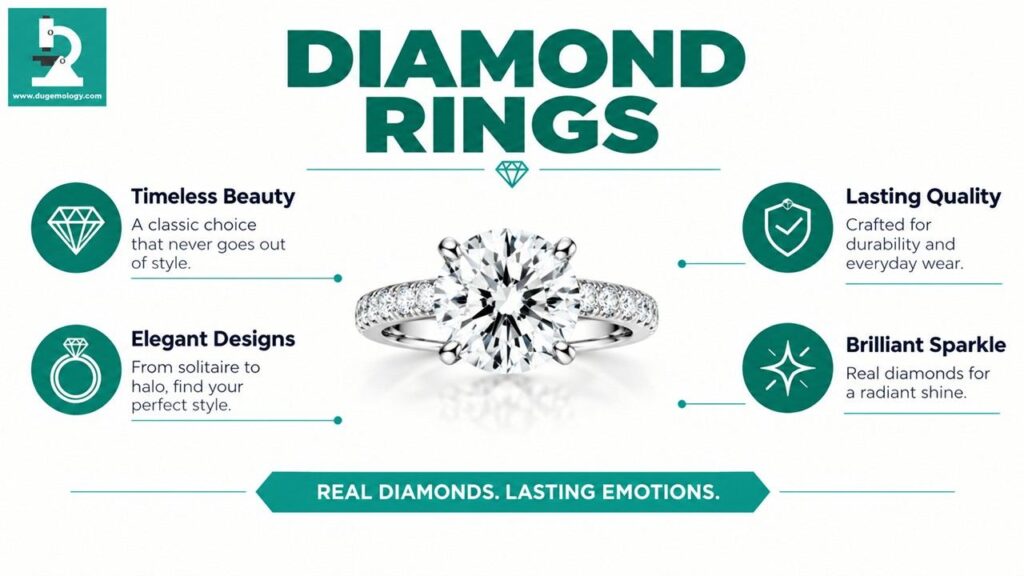
A diamond ring has three dimensions in one: the diamond (type, shape, and quality), the setting (the design that holds the stone), and the metal (gold or platinum). Each one determines how the ring looks and what it costs.
Types of Diamond Rings
Each style has a different look, so pick the one that matches your budget, interest and occasion.
Solitaire Diamond Rings
A solitaire ring has a single diamond in the centre and nothing else competing around it. The simple design pulls all the attention on the stone, which is why it is the classic first for engagements and everyday wear. Because there are no side stones, the quality of the one diamond matters more than in any other.
Halo Diamond Rings
A halo ring surrounds the centre diamond with rings of smaller diamonds. This adds shine and can make the centre stone look larger, so it is a good way to get more visual impact from a smaller carat weight.
Three-Stone Diamond Rings
Three-stone rings have a centre diamond with a smaller diamond on each side. The balanced look suits engagements, anniversaries, and milestone gifts.
Pavé Diamond Rings
Pavé rings have small diamonds set closely along the band, so the metal almost disappears under a surface of sparkle.
Cluster Diamond Rings
Cluster rings have several small diamonds into one design, generally flower or a geometric pattern. They give a larger, showier look at a lower price than a single large diamond.
Vintage-Style Diamond Rings
Vintage-style rings use detailed designs, engraved bands, and edges. They are a good choice if you prefer a classic look with traditional charm.
Men’s Diamond Rings
Men’s diamond rings are generally heavier, with the diamond set into the band or in a bold bezel or signet style. Flush and bezel settings protect the stone, which makes it fit for daily wear.
Natural, Lab-Grown, Treated and Simulant: Know What You Are Buying
This is the most important difference in the diamond ring market, and the one buyers most often get confused.
Natural Diamond Rings
Natural diamonds formed deep inside the Earth over millions or even billions of years. They come in a range of shapes, sizes, and quality grades, and they carry the highest prices because of their rarity and origin.
Lab-Grown Diamond Rings
Lab-grown diamonds are created in a laboratory using methods such as HPHT or CVD. They are real diamonds with the same physical, chemical, and optical properties as natural diamonds. The difference is origin, and for this reason they generally cost much less than natural diamonds of similar size and quality.
Treated Diamond Rings
Treated diamonds are natural or lab-grown stones that have been processed to improve their colour or clarity. Treatments such as HPHT colour enhancement, laser drilling, or fracture filling should always be disclosed on the grading report.
Diamond Simulants
Simulants such as cubic zirconia and moissanite look like diamonds but are different materials. They are not diamonds, and they cost a small fraction of the price. Natural and lab-grown stones are both real diamonds; simulants are not.
Can you tell them apart by eye?
No. You cannot confirm a diamond’s origin or treatment just by looking at it, and even a loupe is not enough. Identifying a stone needs gemological instruments, which is what a professional laboratory like DU Gemology uses.
Diamond Ring Prices in India
The price of a diamond ring depends on the diamond’s weight, 4Cs quality, whether it is natural or lab-grown, the design, and the metal.
Indicative Price Ranges
The table below gives rough ranges for a solitaire ring in 18K gold. Actual prices vary by seller, quality, and market rates.
| Centre Diamond | Natural Diamond Ring | Lab-Grown Diamond Ring |
|---|---|---|
| 0.30 ct | ₹50,000 – ₹1,50,000 | ₹20,000 – ₹50,000 |
| 0.50 ct | ₹1,20,000 – ₹3,50,000 | ₹30,000 – ₹80,000 |
| 1.00 ct | ₹4,00,000 – ₹10,00,000+ | ₹60,000 – ₹1,50,000 |
The table below gives rough ranges for a solitaire ring in 18K gold. Actual prices vary by seller, quality, and market rates. These are indicative figures for comparison, not quotes. Diamond and gold prices change, so always ask for a written, itemised price.
How Carat Weight Affects Price
Carat is a measure of weight, not size. Price rises faster than weight, because large diamonds are rarer. A 1-carat diamond usually costs far more than two 0.50-carat diamonds of the same quality.
Natural vs Lab-Grown Prices
Lab-grown diamond rings generally cost a fraction of natural diamond rings of the same size and quality. Both are real diamonds, but they have different origins and different market values.
Gold vs Platinum Settings
The metal changes the price, too. Gold cost depends on purity, weight, and the day’s gold rate. Platinum settings generally cost more than comparable gold settings, because platinum is denser, so more metal goes into the ring, and it is rarer.
| Metal | Purity | Notes |
|---|---|---|
| 18K Gold | 75% gold | A popular choice for diamond rings in India |
| 14K Gold | 58.3% gold | Harder and more affordable, with a lighter gold colour |
| Platinum | Usually 95% (Pt950) | Dense, naturally white, generally hypoallergenic, and usually more expensive |
Gold comes in white, yellow, and rose colours. White gold is usually rhodium-plated, so it needs re-plating from time to time.
Other Costs to Consider
- Making charges: the cost of crafting the setting, charged per gram or as a percentage.
- GST: currently 3% on diamond and gold jewellery. Confirm the current rate with your seller.
- Certification fee: sometimes included, sometimes charged separately.
The 4Cs of Diamond Quality
Every diamond is graded on four factors. Knowing them lets you compare any two rings fairly.
- Cut: how well the diamond is proportioned and polished. Cut controls sparkle more than any other factor.
- Colour: graded from D (colourless) to Z (light yellow or brown). D to F is colourless, G to J is near-colourless and provides the best value, and once a diamond is set, G to H looks white to most eyes.
- Clarity: how free the stone is from internal marks (inclusions) and surface marks (blemishes). Grades are from Flawless to Included. VS1 to SI1 stones generally look clean to the naked eye and cost far less than Flawless stones.
- Carat: the weight of the diamond. One carat equals 0.2 grams.
Gemologist tip: a well-cut G-colour, VS2 diamond usually looks as good to the eye as a more expensive D-colour, IF stone. Spend on cutting first, then size, then colour and clarity.
Popular Diamond Shapes for Rings
Shape is about style, but it also affects how big a diamond looks.
- Round
The classic circular shape, cut to give the most sparkle of any shape. It is the most popular choice for engagement rings and everyday wear.
- Oval
An elongated shape with an elegant look that can make fingers appear longer. Ovals have a larger surface area than rounds of the same weight, so they look bigger for the same carat.
- Princess Cut
A square shape with pointed corners. The corners are the most unprotected part, so choose a setting with prongs that protect them.
- Emerald Cut
A rectangular shape with long, step-like facets. It gives broad flashes of light rather than sparkle, and it shows inclusions more easily, so choose a higher clarity grade.
- Pear
A teardrop shape with one rounded end and one point. Like the oval, it looks larger than a round diamond of the same carat weight because of its larger surface area.
- Cushion
A square or rectangular shape with rounded corners. It combines a soft, classic look with strong sparkle.
Oval, pear, and marquise shapes usually look largest for their weight, because they spread more of the diamond’s weight across the top surface.
How to Choose the Right Diamond Ring
Follow these steps in order. They keep you safe from overspending on the wrong things.
- Set your budget first. Decide the total, including the setting, GST, and any certification.
- Decide natural or lab-grown. This one choice changes your budget more than any other.
- Choose the shape. Pick the shape you like, then check how it looks on your hand.
- Prioritise cut, then carat. Excellent or Very Good cut gives the sparkle. Then choose the carat weight according to your budget, and compromise on colour and clarity (G to H, VS2 to SI1) before you compromise on cut.
- Pick the metal and setting. Choose gold or platinum to suit your style and budget. Make sure the setting holds the stone safely. For active hands, a lower setting with protective prongs or a bezel is safer.
- Ask for the grading report. Never buy a stone above roughly 0.30 ct without one.
- Think about your lifestyle. Choose a ring that is comfortable and practical for the way you live. Make sure of the ring size before you order, because resizing is not always possible with some designs.
How to Check the Quality of a Diamond Ring Before You Buy
- Check the diamond: look at the cut, colour, clarity, and carat weight on the report, and compare them with what you are shown.
- Check the report: make sure the report details match the stone, and verify the report number online.
- Ask about treatments: confirm whether the diamond is natural, lab-grown, or treated.
- Inspect the ring: make sure the diamond is secure, the prongs are even, and the finish is clean.
- Check the metal: look for the BIS hallmark on gold, and the purity mark on platinum.
- Get an independent opinion: you cannot confirm a diamond’s origin by looking. A qualified gemologist or laboratory can identify and grade the stone for you.
Want to be sure about your ring? DU Gemology is a gemology and diamond testing lab. Bring your diamond ring in for testing and verification before you buy, or to check a stone you already own.
Where to Buy Diamond Rings in India
You can buy from jewellery stores, direct sellers, or online websites. Before you buy, check these points:
- Product details: the diamond type, carat weight, quality grades, and design.
- Certification: look for a grading report from a trusted laboratory.
- Metal purity: check the BIS hallmark on gold, and the purity of platinum.
- Return and exchange policy: read the rules, and ask about buy-back terms also.
. - After-sales service: ask about resizing, repairs, polishing, and cleaning.
Compare at least two or three sellers on the same stone specification before you decide.
How to Care for Your Diamond Ring
- Clean it every few weeks with warm water and a soft brush.
- Remove it before heavy work, gym sessions, swimming, and using chemicals.
- Store it separately, since diamonds can scratch other jewellery.
- Have the prongs checked once a year to make sure the stone is secure.
Frequently Asked Questions About Diamond Rings
Q1. How much does a diamond ring cost in India?
Ans:- Prices start at a few thousand rupees for small lab-grown stones and go up to many lakhs for large natural diamonds. The price depends on carat weight, quality, whether the stone is natural or lab-grown, the design, and the metal. See the price table above for indicative ranges.
Q2. Which diamond ring is best for an engagement?
Ans:- Solitaire and halo rings are the most popular choices. The best ring is one that suits the wearer’s style and daily life, and fits your budget.
Q3. Are lab-grown diamond rings real diamonds?
Ans:- Yes. Lab-grown diamonds are real diamonds with the same physical, chemical, and optical properties as natural diamonds. They are made in a laboratory instead of being formed on Earth, and they usually cost less.
Q4. Is a certified diamond ring better?
Ans:- A grading report from a reputable lab gives you an independent record of the diamond’s quality, so you can compare stones and check what you are paying for. It does not make a diamond better, but it makes the purchase more transparent.
Q5. Which diamond shape looks the biggest?
Ans:- Oval and pear shapes look larger than a round diamond of the same carat weight, because their elongated shape spreads the weight across a larger surface area.
Q6. Do diamond rings have resale value?
Ans:- Yes, but expect to get back much less than you paid. Resale prices depend on the diamond’s quality, certification, and market demand, and retailer margins, making charges, and GST are usually not recovered. Natural diamonds hold value better than lab-grown ones, and lab-grown rings typically resell for very little. Buy a ring because you love it, not as an investment.
Q7. What is the difference between a diamond ring and a solitaire ring?
Ans:- A solitaire is one type of diamond ring, with a single centre diamond and no side stones. Halo, three-stone, pavé, and cluster rings are other types.
Q8. How can I check if my diamond ring is real?
Ans:- Home tests such as the fog test are not reliable. The only dependable way is to have it tested by a gemologist or laboratory using proper instruments.
Conclusion
Choosing diamond rings is easier once you know the three decisions behind it: the diamond, the setting, and the metal. Decide natural or lab-grown first, put your money into cut before size, check grading reports, and verify the stone independently if you are unsure. Whether you choose natural or lab-grown, take the time to check every detail before you buy, so you end up with a ring you will love for years.
If you want an expert to confirm what you are buying, DU Gemology can test and verify your diamond ring.


