
The diamond shape you choose changes how a stone looks, how it appears and how much it costs. A round diamond looks classic and an oval looks elegant. Two diamonds with the same carat weight can look very different on the hand.
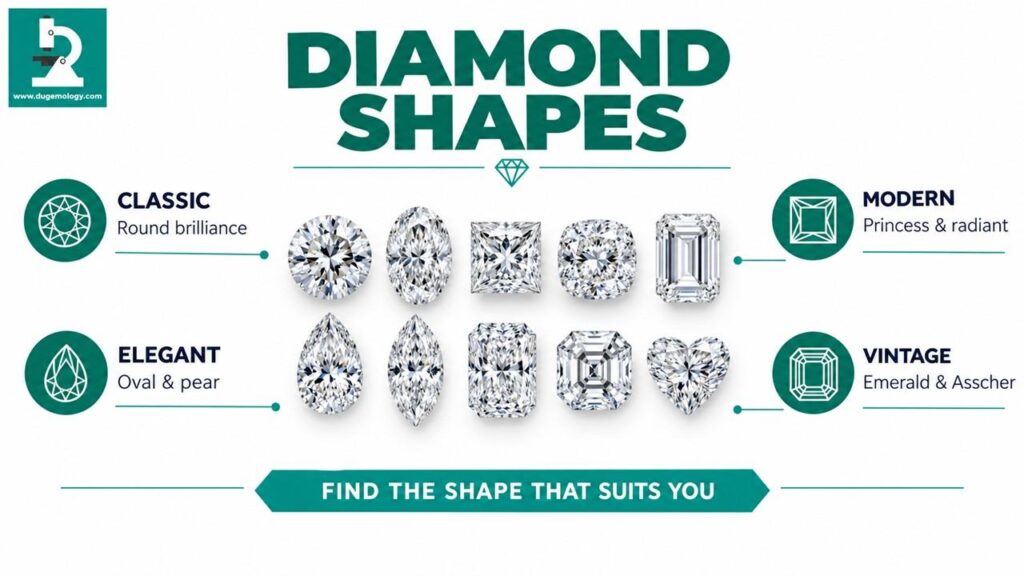
In this guide, we discussed every popular diamond shape, and showed you how to choose the right one for your style, budget and ring setting.
What Is a Diamond Shape?
A diamond shape is the outline of a diamond seen from above, such as round, oval, square, rectangular, pear or heart. The most popular diamond shapes are round, oval, princess, cushion, emerald, pear, marquise, radiant, Asscher and heart.
Shapes divided into two groups:
- Round brilliant: the classic circular shape, which makes up most diamonds sold.
- Fancy shapes: every other shape, including oval, princess, pear and emerald.
Shape is not the same as diamond cut. Shape describes the outline, while cut describes the proportions, facets and finish that decide how well the diamond handles light.
Diamond Shape vs. Diamond Cut: What Is the Difference?
People often use the two terms interchangeably, but they mean different things.
| Feature | Diamond Shape | Diamond Cut |
|---|---|---|
| Meaning | The outline of the diamond | The proportions, symmetry, polish, and facet arrangement |
| Examples | Round, oval, pear, princess | Brilliant cut, step cut, mixed cut; grades from Excellent to Poor |
| Purpose | Defines the look and style | Influences sparkle and light performance |
| Effect on Sparkle | Influences the type of sparkle | Strongly influences how much sparkle you see |
A beautiful shape with a poor cut can look dull. That is why you should evaluate both, along with the other Cs.
Diamond Shapes Chart: Compare All Popular Shapes
Use this chart for a quick comparison. Sizes are approximate face-up measurements for a 1 carat stone and will vary with proportions.
Ratios and sizes are commonly cited guideline figures. Always check the measurements on the grading report of the actual stone.
| Shape | Outline | Facet Style | Typical Length-to-Width Ratio | Approx. Size at 1 ct | Price vs. Round | Best For |
|---|---|---|---|---|---|---|
| Round Brilliant | Circular | Brilliant | 1.00 | ~6.5 mm | Highest per carat | Maximum sparkle, classic look |
| Oval | Elongated, rounded | Brilliant | 1.30–1.50 | ~7.7 × 5.7 mm | Usually lower | Longer-looking fingers, larger appearance |
| Princess | Square | Brilliant-style | 1.00–1.05 | ~5.5 mm | Usually lower | Modern, geometric style |
| Cushion | Square or rectangular, rounded corners | Brilliant or mixed | 1.00–1.20 | ~5.5–6 mm | Usually lower | Soft, romantic or vintage look |
| Emerald | Rectangular, cut corners | Step cut | 1.30–1.50 | ~7 × 5 mm | Usually lower | Clean, elegant lines |
| Pear | Teardrop | Brilliant | 1.50–1.75 | ~8.5 × 5.5 mm | Usually lower | Statement rings, longer look |
| Marquise | Long, two pointed ends | Brilliant | 1.75–2.25 | ~10 × 5 mm | Usually lower | Large appearance for the carat weight |
| Radiant | Rectangular or square, cut corners | Brilliant-style | 1.20–1.50 | ~6.5 × 5 mm | Usually lower | Sparkle with a geometric outline |
| Asscher | Square, cut corners | Step cut | 1.00–1.10 | ~5.5–6 mm | Usually lower | Vintage, Art Deco style |
| Heart | Heart | Brilliant | 0.90–1.10 | ~6.2 mm | Usually lower | Romantic pendants and rings |
Popular Diamond Shapes Explained
Round Diamond Shape
The round brilliant is the most popular diamond shape. Its circular outline and 57 or 58 facets are designed to return as much light as possible.
Pros: classic and timeless, excellent sparkle, easy to resell, suits every setting.
Cons: the highest price per carat, because more rough diamond is lost in cutting and demand is highest.
Best settings: solitaire, halo, pavé and three-stone. A solitaire keeps all attention on the stone.
Oval Diamond Shape
An oval diamond is a round diamond stretched into an elongated outline. It has similar brilliance to a round stone, and its length can make fingers look longer and the stone look larger than a round of the same weight.
Pros: large face-up appearance, flattering on the hand, often better value than round.
Cons: some ovals show a bow-tie effect, a darker area across the centre. Check the stone in person or in video before buying.
Best settings: solitaire, halo, hidden halo and three-stone, usually set lengthwise along the finger.
Princess Cut Diamond
The princess cut is a square diamond with sharp corners and brilliant-style facets. It looks modern and clean, and it is one of the most popular shapes for engagement rings after round and oval.
Pros: strong sparkle, contemporary look, usually less expensive than a round of similar quality.
Cons: the corners can chip under a hard knock. Choose a setting with protective corner prongs.
Best settings: solitaire, channel, halo and three-stone.
Cushion Cut Diamond
A cushion cut has a square or rectangular outline with softly rounded corners. Some cushions show a crushed-ice sparkle with many small flashes, while others show larger, bolder flashes. This is why two cushions of the same carat weight can look quite different.
Pros: romantic, vintage-inspired look and durable rounded corners.
Cons: appearance varies a lot, so compare the actual stones, not just the grade.
Best settings: halo, solitaire, three-stone and vintage-style designs.
Emerald Cut Diamond
An emerald cut is a rectangular diamond with cut corners and long, straight step facets. Instead of many small flashes, it shows broad flashes of light, often called a hall-of-mirrors effect.
Pros: sophisticated look, usually good value, and a large-looking surface.
Cons: the open facets make inclusions and colour easier to see, so choose a higher clarity and colour grade than you might for a brilliant cut.
Best settings: solitaire, three-stone and baguette-accent designs.
Pear Diamond Shape
A pear-shaped diamond combines a round end with a pointed tip, forming a teardrop. It can make the finger look longer and works well as a statement ring or pendant.
Pros: distinctive look, good face-up size, flattering on the hand.
Cons: can show a bow-tie effect, and the tip is vulnerable. Look for even curves, a well-defined point and a V-shaped prong to protect the tip.
Best settings: solitaire, halo and bezel.
Marquise Diamond Shape
A marquise is long and narrow with pointed ends, often compared to a boat or an eye. It has one of the largest face-up appearances for its carat weight.
Pros: maximum finger coverage and a bold, vintage-inspired look.
Cons: it can show a bow-tie effect, and both pointed ends need protection.
Best settings: solitaire, halo, three-stone and east-west.
Radiant Cut Diamond
The radiant cut mixes an emerald-style rectangular outline with brilliant-style facets, so it offers lively sparkle in a geometric shape. It suits people who like the look of an emerald cut but want more fire.
Pros: high sparkle, durable cut corners, good value.
Cons: facet patterns vary, so compare the actual stone.
Best settings: solitaire, halo, pavé and three-stone.
Asscher Cut Diamond
The Asscher cut is a square step cut with cut corners. It looks like a squarer emerald cut, with a layered, art deco character.
Pros: distinctive vintage style and a symmetrical, balanced look.
Cons: inclusions are easier to see through the open facets, so choose clarity and colour carefully.
Best settings: solitaire, halo, bezel and vintage-inspired designs.
Heart-Shaped Diamond
A heart-shaped diamond has two rounded lobes and a pointed bottom. It is a popular choice for romantic gifts, pendants and statement rings.
Pros: unmistakable symbolism and a unique look.
Cons: symmetry matters a lot, and small hearts may not show their outline clearly. Protect the point with a suitable setting.
Best settings: solitaire, halo and bezel.
Uncommon and Fancy Diamond Shapes
Other than the ten popular shapes, you will come across a few less common ones.
- Baguette: a narrow rectangular step cut, most often used as side stones or in art deco designs.
- Trillion: a triangular shape, used as a centre stone or as accents beside a larger diamond.
- Shield and kite: angular, geometric shapes for a bold, modern look.
- Briolette: a teardrop with facets all over, typically used in earrings and pendants.
Vintage and Antique Diamond Cuts
Older cuts have broader facets and a softer pattern of light than modern diamonds.
- Rose cut: a flat bottom with a domed, triangle-faceted top that gives a soft glow rather than strong sparkle.
- Old European cut: a round antique cut with a small table, high crown and large culet.
- Old mine cut: a cushion-like antique cut with a high crown, small table and visible culet.
Antique stones are individual, so check their condition, proportions and any grading report before buying.
How to Choose the Best Diamond Shape
There is no single best shape. Use these five questions to choose your own.
- What is your style? Choose round for classic, oval or pear for elongated and elegant, princess or radiant for modern, emerald or Asscher for clean lines, and cushion for romantic.
- What suits your hand? Oval, pear and marquise lengthen the finger, while round and cushion look compact. Try on a few shapes rather than following strict rules.
- What is your budget? Fancy shapes are often cheaper than round at the same carat weight and quality, so you can go larger or higher in quality for the same spend.
- How much sparkle do you want? Brilliant shapes give lively sparkle, while step cuts give broad, mirror-like flashes.
- What setting do you like? Pointed or cornered shapes such as pear, marquise, heart and princess need protective prongs.
Which Diamond Shape Looks the Biggest?
Marquise, oval and pear diamonds look biggest for their carat weight because their length spreads the weight across larger visible areas. Always compare the millimetre measurements on the report, not only the carat weight.
Which Diamond Shape Sparkles the Most?
The round brilliant sparkles the most when well cut. Oval, pear, princess, cushion and radiant diamonds also sparkle strongly. Emerald and Asscher cuts show broader flashes instead of many small ones. Cut quality matters more than shape, so look for a certificate showing a strong cut grade.
How Does Diamond Shape Affect Price?
Round brilliants usually cost the most per carat, because more rough is lost in cutting and demand is highest. Emerald, Asscher, cushion, pear and oval diamonds are often more affordable at similar quality. Price also depends on:
- Carat weight: larger stones cost disproportionately more.
- Colour: how much body colour is visible.
- Clarity: the inclusions and blemishes present.
- Cut quality: proportions, symmetry and polish.
- Origin: natural or lab-grown
- Market demand: popularity of the shape at the time.
What Is the Bow-Tie Effect in Diamonds?
The bow-tie effect is a dark, bow-shaped area across the centre of some elongated diamonds, most commonly oval, pear and marquise. It appears when parts of the stone do not return light well to the eye. A faint bow-tie is normal and may be barely visible, while a strong one can make the diamond look dull. View elongated stones from several angles and in different lighting.
Why a Diamond Certificate Matters, Especially for Fancy Shapes
Fancy shapes vary more from stone to stone than round diamonds do, so the grading report matters. A report from a reputed lab such as IGI or GIA records the shape, measurements, length-to-width ratio and the clarity and colour grades, so you can compare stones objectively.
At DU Gemology, our gemologists test and verify diamonds, and can help you check shape, proportions and whether a stone is natural or lab-grown before you buy.
Frequently Asked Questions About Diamond Shape
Q1. What are the different diamond shapes?
Ans:- The popular diamond shapes are round, oval, princess, cushion, emerald, pear, marquise, radiant, Asscher and heart. Less common shapes include baguette, trillion, shield and briolette, and vintage options include rose, old European and old mine cuts.
Q2. What is the most popular diamond shape?
Ans:- The round brilliant is the most popular diamond shape, followed by oval, which has grown quickly in engagement rings.
Q3. Which diamond shape is the most expensive?
Ans:- The round brilliant is usually the most expensive per carat, because of rough loss during cutting and high demand.
Q4. Which diamond shape is the least expensive?
Ans:- Emerald, Asscher, cushion and pear shapes are often the most affordable at similar quality and carat weight. Exact prices depend on the individual stone.
Q5. Which diamond shape looks the biggest?
Ans:- Marquise, oval and pear diamonds look biggest for their weight, thanks to their elongated outlines.
Conclusion
The best diamond shape is the one that matches your style, budget and setting. Round diamonds give classic sparkle, oval, pear and marquise stones look larger and lengthen the finger, princess and radiant stones feel modern, and emerald and Asscher cuts provide clean, vintage-inspired lines.
Whatever shape you choose, check the cut quality, measurements, colour, clarity and certificate, and view the actual stone if you can.


