
Buying a diamond can be confusing. Some stones look brighter, some look whiter, and some have marks inside them. So how do you compare their quality? That is what the 4 Cs of diamond are for. They are Cut, Colour, Clarity and Carat weight, the standard way to describe a diamond and compare one stone with another.
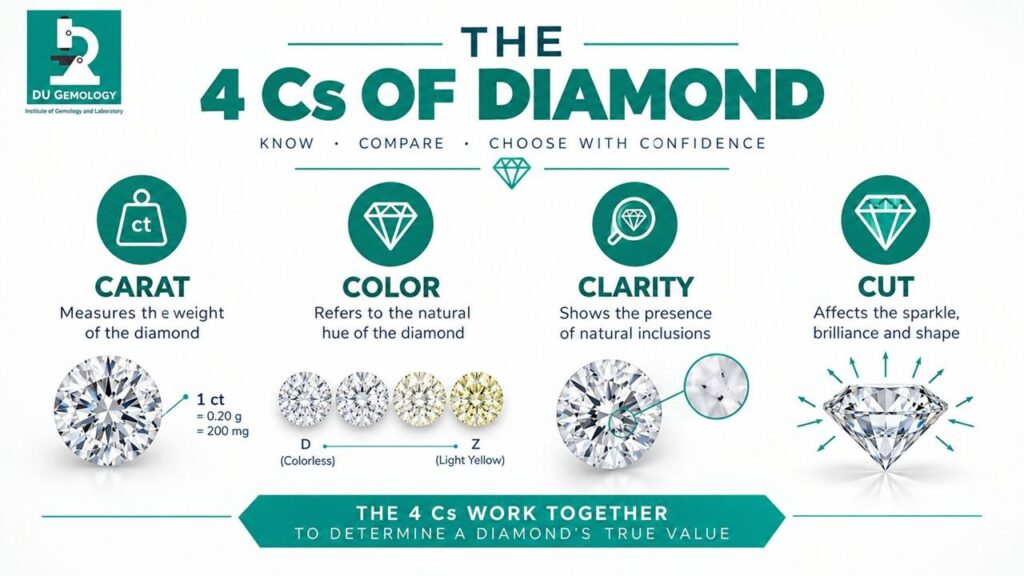
This guide explains each Cs, shows how the four work together, and gives indicative prices in India and the checks a gemologist would make before you buy.
What Are the 4 Cs of Diamond?
The 4 Cs are the four main characteristics used to describe and compare diamonds. They were introduced by GIA (the Gemological Institute of America) and are now used by laboratories around the world. Each C tells you something different about the stone.
| The C | What It Means |
|---|---|
| Cut | How well the diamond is proportioned and polished, and how it reflects light. |
| Colour | How much body colour is visible in the diamond. |
| Clarity | The internal marks (inclusions) and surface marks (blemishes). |
| Carat | How much the diamond weighs. |
ll four matter, but how much each one matters depends on what you want. If sparkle is your priority, cut deserves the most attention. If you want a bigger-looking stone, focus on carat weight, shape and measurements. Other factors such as shape, treatments and origin (natural or lab-grown) also change how a diamond looks and what it costs.
4 Cs of Diamond Chart (Quick Reference)
This 4 Cs of diamond chart puts all four scales in one place. Use it for a quick comparison, then read the sections below for the detail on each C.
| The C | What It Measures | Scale | Top Grade | Often Good Value | Mainly Affects |
|---|---|---|---|---|---|
| Cut | Proportions, polish and symmetry | Excellent to Poor (round brilliant) | Excellent | Excellent to Very Good | Sparkle |
| Colour | Body colour in the stone | D to Z | D | G to H | How white the stone looks |
| Clarity | Inclusions and blemishes | FL to I3 | FL | VS2 to SI1, if eye-clean | Visible marks and price |
| Carat | Weight (1 ct = 200 mg) | Measured, not graded | Not applicable | Just below a round size, such as 0.90 ct | Size and price |
Carat is the only C that is measured rather than graded. Compare it with the millimetre measurements on the report, because two stones of the same weight can look different in size.
1. Diamond Cut
What Is Diamond Cut?
Cut is how well a diamond has been shaped, proportioned and polished. It decides how the stone handles light. A well-cut diamond reflects light back to your eye and looks bright and lively. A poorly cut one lets light escape through the sides or bottom and can look dull, even if its colour and clarity are excellent.
Diamond Cut Grades
Round brilliant diamonds are graded on this scale by GIA and some other labs.
| Cut Grade | Meaning |
|---|---|
| Excellent | Very strong cut quality and light performance. |
| Very Good | High cut quality with good light performance. |
| Good | Good overall cut quality. |
| Fair | Noticeable limitations in cut quality. |
| Poor | Significant limitations in cut or light performance. |
Not every lab uses the same system. GIA gives a cut grade only for round brilliant diamonds, while some other labs also grade fancy shapes such as oval and pear.
How Cut Affects Sparkle
A well-cut diamond shows three effects:
- Brightness: the white light reflected back to your eye.
- Fire: the rainbow-coloured flashes as light passes through the stone.
- Scintillation: the flashes of light and dark that appear when the diamond or the viewer moves.
For round diamonds, the overall cut grade also reflects polish and symmetry, so look for strong grades in all three.
The cut is not the same as diamond shape. Round, oval, pear and princess are shapes. Cut quality describes how well the proportions, facets and finish work with light. Two round diamonds can have very different cut grades.
2. Diamond Colour
What Is Diamond Colour?
Diamond colour describes how much body colour you can see in a stone. On the standard D to Z scale, diamonds run from colourless to increasingly noticeable yellow or brown. The less colour, the higher the grade. Fancy-coloured diamonds, such as pink, blue and yellow, are graded by a different method.
Diamond Colour Scale
| Colour Grade | Category | Description |
|---|---|---|
| D to F | Colourless | Little or no noticeable colour. |
| G to J | Near-colourless | Slight colour that is hard to notice. |
| K to M | Faint | A more noticeable warm tint. |
| N to R | Very light | More visible yellow or brown. |
| S to Z | Light | Clearly visible yellow or brown. |
These grades are given under controlled lighting. Comparing two diamonds side by side makes small differences easier to see.
How Colour Affects Appearance and Price
When other qualities are similar, a higher colour grade usually costs more. The setting also matters. White gold and platinum can make a warmer tint easier to notice, while yellow or rose gold suits warmer tones well. You do not need the top grade. G to H diamonds look white to most people once set in a ring, and they cost less than D to F.
3. Diamond Clarity
What Is Diamond Clarity?
Clarity is how free a diamond is from small marks. Marks inside the stone are called inclusions, such as tiny crystals, feathers, clouds and pinpoints. Marks on the surface are called blemishes, such as scratches and polish marks. Some form naturally as the diamond grows, and others can appear during cutting or handling.
The size, position, number and type of marks decide the clarity grade.
Diamond Clarity Chart
The GIA clarity scale has 11 grades.
| Clarity Grade | Meaning |
|---|---|
| FL (Flawless) | No inclusions or blemishes visible under 10x magnification. |
| IF (Internally Flawless) | No inclusions visible under 10x; minor blemishes may be present. |
| VVS1 to VVS2 | Very, very small inclusions, difficult to see under 10x. |
| VS1 to VS2 | Very small inclusions, usually minor under 10x. |
| SI1 to SI2 | Inclusions that are more noticeable under 10x magnification. |
| I1 to I3 | Inclusions that may be obvious and can affect appearance or durability. |
Can a Lower-Clarity Diamond Look Eye-Clean?
Yes. An eye-clean diamond has no inclusions you can see without magnification. Many VS stones and some SI1 stones are eye-clean, depending on the size, position and type of the inclusions. SI stones vary a lot, so view the actual diamond, or a high-quality video and the report, before you buy.
4. Diamond Carat Weight
What Is Carat?
Carat is the unit of weight for diamonds. One carat equals 200 milligrams, or 0.2 grams. A 2-carat diamond weighs 400 milligrams.
Carat is weight, not size. Two diamonds of the same weight can look different in size because of their shape and proportions. A diamond cut too deep carries extra weight below the surface and can look smaller from the top. Oval and marquise shapes usually look larger face-up than round diamonds of the same weight.
Diamond Carat Weight Chart
Approximate diameters for round brilliant diamonds. Actual measurements vary with the cut.
| Carat Weight | Approximate Diameter |
|---|---|
| 0.25 ct | 4.0 to 4.2 mm |
| 0.50 ct | 5.0 to 5.2 mm |
| 0.75 ct | 5.7 to 5.9 mm |
| 1.00 ct | 6.3 to 6.5 mm |
| 1.50 ct | 7.3 to 7.5 mm |
| 2.00 ct | 8.0 to 8.2 mm |
How Carat Affects Price
Larger diamonds are rarer, so price per carat rises as size goes up. Prices also jump at round numbers such as 0.50, 1.00 and 2.00 carats. A 0.90 ct diamond can cost noticeably less than a 1.00 ct stone that looks almost identical.
How Do the 4 Cs of Diamond Work Together?
Looking at one C alone does not give the full picture. Two 1-carat diamonds can look and cost very differently if one has a better cut, less colour or fewer visible inclusions.
Gemologist tip: a well-cut G-colour, VS2 diamond usually looks as good to the eye as a far more expensive D-colour, IF stone. Spend on cut first, then size, then colour and clarity.
Which of the 4 Cs Is Most Important?
There is no single answer, but for most buyers cut comes first because it controls sparkle. A well-cut diamond with a slightly lower colour or clarity grade often looks better than a poorly cut stone with top grades.
- Want more sparkle: focus on cut, polish and symmetry.
- Want a bigger look: compare carat weight, shape and face-up measurements.
- Want a whiter look: compare colour grades and see the stone in its setting.
- Want fewer visible marks: check clarity and whether any marks can be seen without magnification.
What Is the Best Combination of the 4 Cs?
Many buyers get the best balance of beauty and budget with the starting point below. Adjust it to your own priorities.
For a larger stone or a white metal setting, you may prefer a higher colour grade. For a collector’s piece, you may choose VVS or higher.
How to Read the 4 Cs on a Diamond Certificate
A grading report shows the 4 Cs as a short list of lines. The example below is illustrative, not a real report, and it shows what each line tells you.
Check that every line matches what the seller told you, and verify the report number on the issuing lab’s website. A report applies only to the stone it was issued for, so confirm that the diamond in your hand is that stone.
Not sure your diamond matches its certificate? DU Gemology is a gemology and diamond testing lab. Our gemologists verify the 4 Cs, origin and treatments, so you can buy or sell with confidence.
How to Choose the Right Diamond Using the 4 Cs
Follow these steps in order. They keep you from overspending on the wrong things.
- Set your budget first. Decide the total, including the setting, GST and certification, then work backwards.
- Decide natural or lab-grown. This one choice changes your budget more than any other.
- Check the cut. Choose Excellent or Very Good, and look at how the stone handles light.
- Compare colour by appearance. A small colour difference may not be visible to you, so judge the stone in its setting.
- Examine the clarity. Check whether any marks are visible without magnification and whether they affect durability.
- Look at the actual size. Compare measurements, not just carat weight.
- Ask for the grading report. Review the details and confirm the origin before you pay.
- Compare like with like. Compare prices only between stones with similar 4 Cs, origin and certificates.
The best diamond is not the one with the highest grade in every category. It is the one that matches your taste, budget and expectations.
Need help choosing between two diamonds? Bring both reports to DU Gemology and compare them with our gemologists. We will explain what each grade means for sparkle, colour and price.
Common Mistakes When Using the 4 Cs
- Choosing by carat alone. Weight does not show size or quality.
- Ignoring cuts. A poorly cut diamond looks dull, whatever its colour and clarity.
- Paying for perfection you cannot see. FL, IF and D colour cost far more and rarely look different to the eye.
- Comparing prices without comparing specs. Match cut, colour, clarity, carat, origin and certificate first.
- Buying without a grading report. Never buy a stone above roughly 0.30 ct without one.
- Treating a report as a price guarantee. A report describes the stone; it does not set its value.
Frequently Asked Questions About the 4 Cs of Diamond
Q1. What are the 4 Cs of diamond?
Ans:- The 4 Cs are Cut, Colour, Clarity and Carat weight. They describe and compare a diamond’s quality and characteristics.
Q2. Which of the 4 Cs is most important?
Ans:- For most buyers, cut, because it controls sparkle. The right answer still depends on your budget, preferences and the stone you choose.
Q3. What is the best combination of the 4 Cs?
Ans:- A balanced choice is an Excellent or Very Good cut, G to H colour, VS2 to SI1 clarity that looks eye-clean, and the carat weight your budget allows.
Q4. Which diamond clarity grade is best?
Ans:- Flawless (FL) is the highest grade on the GIA scale. Diamonds with lower grades can still look beautiful and clean to the eye, and they cost far less.
Q5. Does a higher carat diamond mean better quality?
Ans:- No. Carat measures weight, not quality. Cut, colour and clarity matter as well.
Q6. Can two diamonds with the same carat weight have different prices?
Ans:- Yes. Their cut, colour, clarity, shape, origin, treatments and certificates can all change the price.
Q7. Can a lower-clarity diamond still look eye-clean?
Ans:- Yes. Some diamonds with lower grades have inclusions that cannot be seen without magnification. It depends on their size, position and type.
Q8. Can lab-grown diamonds be graded using the 4 Cs?
Ans:- Yes. Lab-grown diamonds are graded on the same 4 Cs as natural ones. The report states the origin separately.
Conclusion
The 4 Cs of diamond make it far easier to compare stones and choose one that suits you. Cut affects sparkle, colour describes the body colour, clarity covers inclusions and blemishes, and carat tells you the weight. Put your money into cut first, check the actual measurements, insist on a grading report, and verify the stone independently if you are unsure.
Buying, selling or insuring a diamond? DU Gemology provides diamond testing and grading service.


