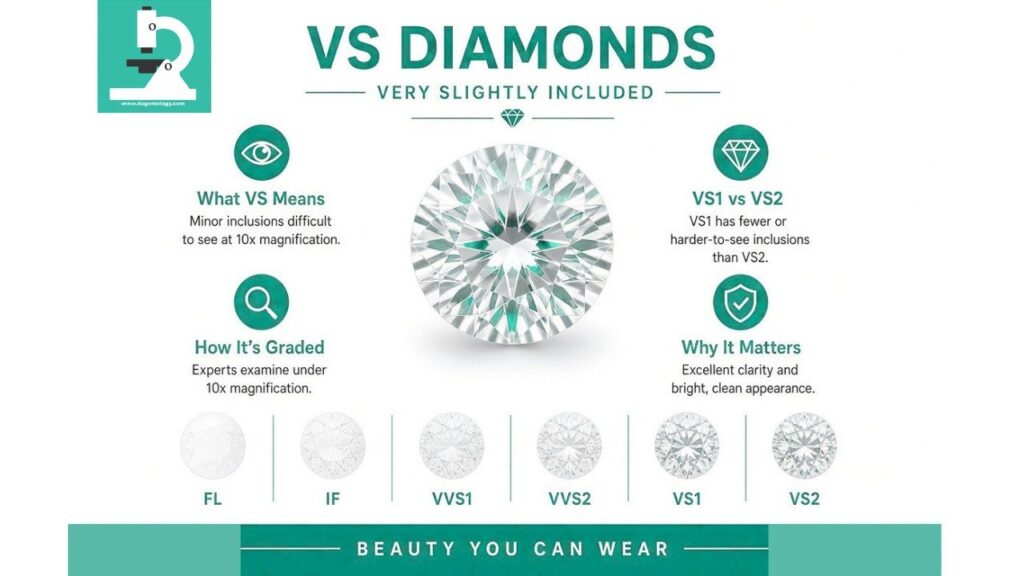
A VS diamond is a diamond graded Very Slightly Included (VS), which means it has tiny inclusions that range from difficult to somewhat easy to see under 10× magnification.
Table of Contents
In most VS diamonds these marks cannot be seen without magnification, so the stone looks clean to the naked eye while costing less than a VVS or flawless diamond. This guide explains what VS clarity means, how VS1 and VS2 differ, what a VS diamond costs, and how to choose a good one.
Key Takeaways
- VS stands for Very Slightly Included. There are two grades: VS1 and VS2.
- VS1 inclusions are difficult to see under 10× magnification. VS2 inclusions are somewhat easy to see under 10×.
- Most VS diamonds are eye-clean, but this depends on the size, type and position of the inclusions.
- Cut affects sparkle far more than clarity does.
- VS2 is often the best value. VS1 is worth paying for mainly in larger stones or step cuts.
- Always buy a VS diamond with a grading report from a recognised lab such as GIA, IGI or SGL.
What Does VS Mean in Diamond Clarity?
VS means Very Slightly Included. It describes small natural features inside a diamond (inclusions) or on its surface (blemishes) that are minor and hard to find even for a trained grader using a 10× loupe.
The VS category is split into two grades:
- VS1: inclusions are difficult to see under 10× magnification.
- VS2: inclusions are somewhat easy to see under 10× magnification.
Both grades sit in the middle of the clarity scale, which is why they are popular. You get a clean-looking diamond without paying the premium for VVS or flawless clarity.
Where Does VS Clarity Rank on the Diamond Clarity Scale?
The clarity scale has 11 grades, from Flawless to Included. VS sits below VVS and above SI.
| Grade | Full Name | What It Means Under 10× |
|---|---|---|
| FL | Flawless | No inclusions and no blemishes |
| IF | Internally Flawless | No inclusions, only minor blemishes |
| VVS1, VVS2 | Very, Very Slightly Included | Inclusions are very difficult (VVS1) to difficult (VVS2) to see |
| VS1, VS2 | Very Slightly Included | Inclusions are difficult (VS1) to somewhat easy (VS2) to see |
| SI1, SI2 | Slightly Included | Inclusions are easy to see |
| I1, I2, I3 | Included | Inclusions are obvious and may affect durability or brilliance |
How Do Gemologists Grade VS Diamonds?
A gemologist examines the diamond under 10× magnification and assesses five things:
- Size: how large the inclusions are.
- Number: how many there are.
- Position: where they sit (centre of the table, near the edge, under the crown).
- Nature: the type of inclusion, such as a crystal, feather or cloud.
- Relief: how much the inclusion stands out against the surrounding diamond.
The grader weighs all five to decide between VS1 and VS2. This is why two VS2 diamonds can look different from each other.
Types of Inclusions Found in VS Diamonds
Knowing what the marks are helps you judge whether a particular stone is a good buy.
- Crystals: small mineral grains trapped inside. They are often the most visible type because they can look white or dark.
- Pinpoints: tiny dots, often in groups. Hard to see individually.
- Clouds: groups of pinpoints that can create a hazy patch. A large cloud under the table can reduce transparency.
- Feathers: small internal cracks that look like a feather or a white line. Their visibility depends on the viewing angle.
- Needles: thin, rod-like crystals.
- Twinning wisps: lines or patterns caused by crystal growth irregularities.
Why Position Matters More Than You Think
An inclusion in the centre of the table is much easier to notice than the same inclusion near the girdle (the edge), where it can be hidden by a prong or the setting. This is why a VS2 with a well-placed inclusion can look cleaner than a VS1 with a central one.
The grading report includes a clarity plot, a diagram that shows the type and position of the main inclusions. Always check it before buying.
VS1 vs VS2 Diamond: What Is the Difference?
The main difference is how easily a trained grader can see the inclusions under 10× magnification.
| Feature | VS1 Diamond | VS2 Diamond |
|---|---|---|
| GIA Description | Inclusions difficult to see under 10× | Inclusions somewhat easy to see under 10× |
| Typical Look to the Naked Eye | Almost always eye-clean | Usually eye-clean; depends on position |
| Inclusions Are Often | Smaller, fewer or better placed | Slightly larger or more noticeable |
| Price (Same Size, Cut and Colour) | Higher | Lower |
| Best For | Larger stones, step cuts and buyers who want maximum clarity | Value-focused buyers, brilliant cuts and most engagement rings |
Which Is Better: VS1 or VS2?
VS1 has the higher clarity grade, but better does not always mean better value. If a VS2 diamond is eye-clean and has no inclusions in the centre of the table, you are paying less for the same visual result. Choose VS1 if you want extra assurance, plan to wear a large stone, or are buying a step cut such as an emerald or asscher.
Are VS Diamonds Eye-Clean?
Most VS diamonds are eye-clean, which means you cannot see inclusions with the naked eye at normal viewing distance. This is not guaranteed, because a VS2 with a dark crystal in the centre of the table may be visible.
Which Diamond Shapes Hide VS Inclusions Best?
- Round brilliant, princess, cushion, oval: their many facets break up light and hide inclusions well. VS2 is usually enough.
- Emerald and asscher (step cuts): their large, open facets act like a window, so inclusions show more. VS1 is safer, especially above 1 carat.
Does VS Clarity Affect a Diamond’s Sparkle?
Not directly. The cut grade decides how well a diamond returns light. A well-cut VS2 will sparkle more than a poorly cut VS1. Clarity affects sparkle only when a large inclusion, such as a heavy cloud, blocks the light path. Prioritise cut first, then clarity.
VS Diamond Price: How Much Does a VS Diamond Cost?
The price of a VS diamond depends on carat weight, cut, colour, origin (natural or lab-grown) and certification. Prices change with the market, so treat figures as guides and request a current quote.
What Factors Affect VS Diamond Prices?
- Carat weight: price rises faster than weight, with jumps at 0.50, 1.00 and 2.00 ct.
- Cut: an Excellent cut costs more but gives better sparkle.
- Colour: colourless grades (D–F) cost more than near-colourless (G–J).
- Clarity: VS1 usually costs more than VS2.
- Origin: natural diamonds cost more than lab-grown diamonds of the same grade.
- Certification: a report from GIA, IGI or SGL supports the grade and the price.
VS Diamonds vs Other Clarity Grades
VS vs VVS Diamonds
VVS diamonds have smaller inclusions that are very difficult to see even under 10×. To the naked eye, a VS and a VVS diamond usually look the same, but VVS costs noticeably more. For most buyers VS is the better value.
VS vs SI1 and SI2 Diamonds
SI inclusions are easy to see under 10×, and in some SI2 stones they can be visible to the naked eye. A carefully chosen eye-clean SI1 can save money, but you need to inspect it closely.
VS vs Flawless Diamonds
Flawless diamonds have no inclusions or blemishes under 10×. They are rare and carry a large premium that you cannot see with the naked eye. VS gives the same visual result for far less.
VS1 vs VS2 for Engagement Rings: Which Should You Choose?
- Under 0.50 ct: VS2 is plenty. Even SI1 can be eye-clean at this size.
- 0.50 to 1.00 ct: VS2 in a brilliant cut provide the best balance. Choose VS1 for a step cut.
- 1.00 to 2.00 ct: both work. Check the clarity plot of a VS2 for central inclusions.
- Above 2.00 ct: VS1 is the safer choice, because inclusions are magnified by the larger table.
Natural vs Lab-Grown VS Diamonds
Lab-grown diamonds are real diamonds with the same chemical and physical properties as natural ones. Both can be graded VS1 or VS2 on the same scale. The difference is origin: natural diamonds form in the Earth over billions of years, and lab-grown diamonds are created in a lab in weeks.
A lab-grown VS diamond usually costs much less than a natural one of the same size and grade, so you can often choose a larger stone for the same budget. Natural diamonds are generally valued for rarity. Make sure any lab-grown diamond is clearly identified on its report. DU Gemology can test a stone to confirm whether it is natural or lab-grown.
How to Read a VS Diamond Grading Report
A grading report from a recognised laboratory such as GIA, IGI or SGL gives an independent assessment of the diamond. When checking a VS diamond, look at:
- Clarity grade: confirm that it says VS1 or VS2.
- Clarity plot: see where the inclusions are and what type they are.
- Cut grade: for round brilliants, look for Excellent or Very Good.
- Colour and carat weight: make sure they match the price you are paying.
- Report number: verify it on the lab’s website and check that it matches any inscription on the stone.
Two diamonds with the same clarity grade can still look different, so use the report together with your own inspection.
Buying Tips for a VS Diamond
- Insist on a lab report from a recognised lab.
- Inspect the stone with a loupe and with your eyes, face-up, at normal distance.
- Ask for magnified photos or videos of the inclusions.
- Look at the clarity plot to avoid central inclusions.
- Spend more on cuts before spending more on clarity.
- Compare VS1 and VS2 stones side by side. If you cannot see the difference, take the cheaper one.
Is a VS Diamond Worth Buying?
Yes, for most buyers. A VS diamond gives you a clean appearance at a more reasonable price than VVS or flawless stones. Choose VS1 for larger stones or step cuts, VS2 for the best balance of price and appearance, and SI1 only if you are willing to inspect the stone carefully.
Get Your Diamond Checked at DU Gemology
Unsure whether the diamond you are buying is really VS clarity, or whether it is natural or lab-grown? DU Gemology provides diamond testing and certification support.
Frequently Asked Questions About VS Diamonds
Q1. Is VS2 clarity good?
Ans:- Yes. VS2 is a good clarity grade. Its inclusions are minor, and many VS2 diamonds look clean to the naked eye.
Q2. Is VS1 better than VS2?
Ans:- VS1 has the higher clarity grade, with inclusions that are harder to see under magnification. For most diamonds, though, both look the same to the naked eye, so VS2 is often the better value.
Q3. Are VS diamonds expensive?
Ans:- They cost more than SI diamonds and less than VVS or flawless diamonds. The final price depends on carat weight, cut, colour and whether the diamond is natural or lab-grown.
Q4. Can you see inclusions in a VS diamond without magnification?
Ans:- Usually not. In some stones, especially a VS2 with a large inclusion in the centre of the table, they may be visible.
Q5. Are VS diamonds good for engagement rings?
Ans:- Yes. VS diamonds are among the most popular choices for engagement rings because they combine eye-clean appearance with sensible pricing.
Q6. Is VS2 worth it over SI1?
Ans:- If your budget allows, VS2 is a safer choice because its inclusions are less likely to be visible. A well-chosen eye-clean SI1 can save money, but you must inspect it carefully.
Q7. Is VS clarity good for a lab-grown diamond?
Ans:- Yes. Lab-grown VS diamonds look the same as natural VS diamonds and cost less, so they can be a good way to get a larger or better-quality stone.
Q8. What is the best clarity for a diamond?
Ans:- The best value for most buyers is VS2 or VS1. Higher grades cost more without a visible improvement, and lower grades increase the risk of visible inclusions.
Conclusion
A VS diamond has a clean appearance at a sensible price. VS1 has inclusions that are harder to see and suits larger stones and step cuts. VS2 delivers the same look in most diamonds for less. Whichever you choose, check the grading report, read the clarity plot, prioritise cut and inspect the actual stone before you buy.